LUNEX International University of Health, Exercise and Sports, Differdange, Luxembourg.
Department of Physiotherapy, The University of Melbourne, Victoria, Australia.
Neural Plast. 2019 Dec 27;2019:3480512. doi: 10.1155/2019/3480512. eCollection 2019.
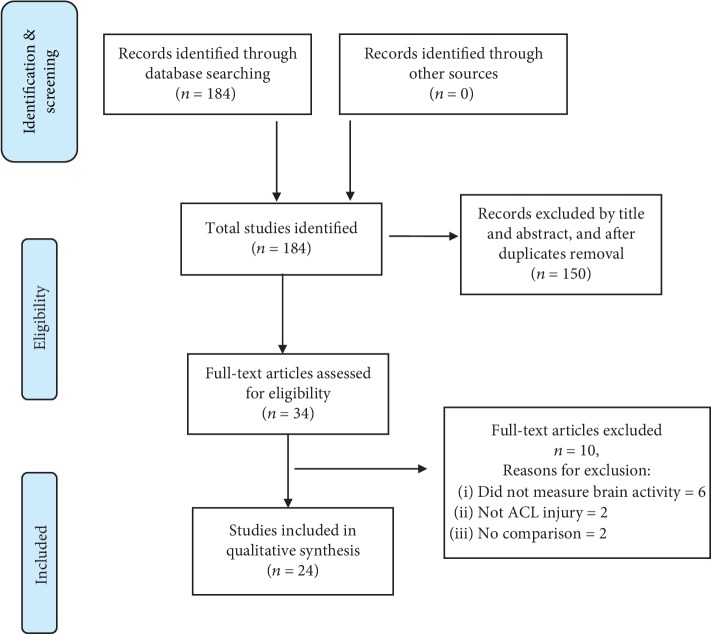
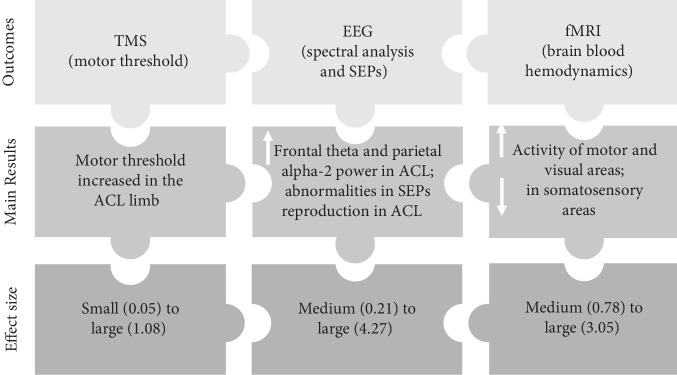
Anterior cruciate ligament (ACL) injury is a common problem with consequences ranging from chronic joint instability to early development of osteoarthritis. Recent studies suggest that changes in brain activity (i.e., functional neuroplasticity) may be related to ACL injury. The purpose of this article is to summarize the available evidence of functional brain plasticity after an ACL injury. A scoping review was conducted following the guidelines of the Joanna Briggs Institute and the Preferred Reporting Items for Systematic Reviews and Meta-Analyses. The terms "brain," "activity," "neuroplasticity," "ACL," "injury," and "reconstruction" were used in an electronic search of articles in PubMed, PEDro, CINAHL, and SPORTDiscus databases. Eligible studies included the following criteria: (a) population with ACL injury, (b) a measure of brain activity, and (c) a comparison to the ACL-injured limb (contralateral leg or healthy controls). The search yielded 184 articles from which 24 were included in this review. The effect size of differences in brain activity ranged from small (0.05, ACL-injured noninjured limbs) to large (4.07, ACL-injured healthy control). Moreover, heterogeneity was observed in the methods used to measure brain activity and in the characteristics of the participants included. In conclusion, the evidence summarized in this scoping review supports the notion of functional neuroplastic changes in people with ACL injury. The techniques used to measure brain activity and the presence of possible confounders, as identified and reported in this review, should be considered in future research to increase the level of evidence for functional neuroplasticity following ACL injury.
前交叉韧带(ACL)损伤是一种常见的问题,其后果从慢性关节不稳定到早期骨关节炎的发展不等。最近的研究表明,大脑活动的变化(即功能神经可塑性)可能与 ACL 损伤有关。本文的目的是总结 ACL 损伤后功能脑可塑性的现有证据。根据 Joanna Briggs 研究所和系统评价和荟萃分析的首选报告项目的指南,进行了范围综述。在 PubMed、PEDro、CINAHL 和 SPORTDiscus 数据库中,使用了“大脑”、“活动”、“神经可塑性”、“ACL”、“损伤”和“重建”等术语进行电子搜索文章。符合条件的研究包括以下标准:(a)ACL 损伤人群,(b)大脑活动测量,(c)与 ACL 损伤肢体(对侧肢体或健康对照)比较。搜索产生了 184 篇文章,其中 24 篇被纳入本综述。大脑活动差异的效应大小从小(0.05,ACL 损伤非损伤肢体)到较大(4.07,ACL 损伤健康对照组)。此外,用于测量大脑活动的方法和纳入的参与者特征存在异质性。总之,本综述中总结的证据支持 ACL 损伤患者存在功能神经可塑性变化的观点。在未来的研究中,应考虑用于测量大脑活动的技术以及本综述中确定和报告的可能混杂因素,以提高 ACL 损伤后功能神经可塑性的证据水平。