Department for Environmental Science, Policy and Management, University of California, Berkeley, United States of America.
Grupo de Ecología Cuantitativa, INIBIOMA (UnComa-CONICET), Bariloche, Río Negro, Argentina.
Sci Rep. 2020 Jan 17;10(1):588. doi: 10.1038/s41598-019-57198-w.
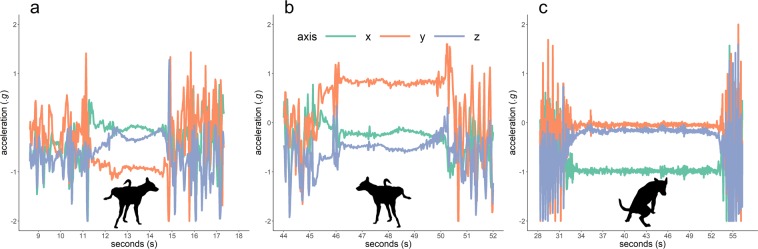
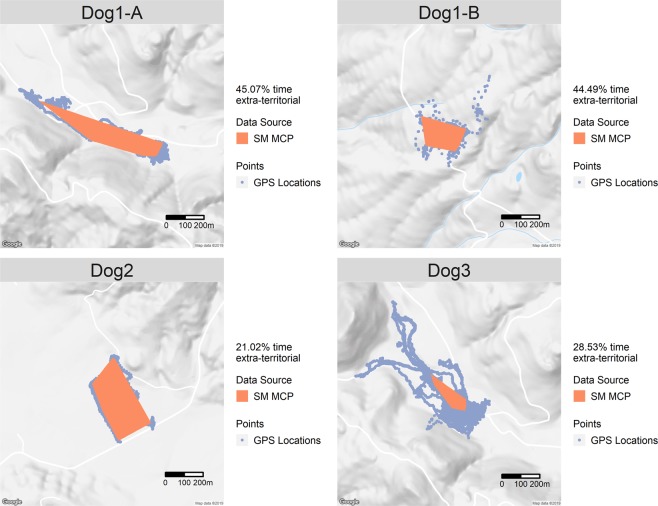
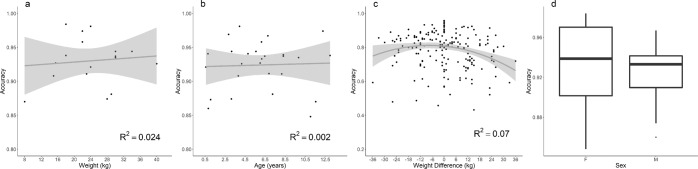
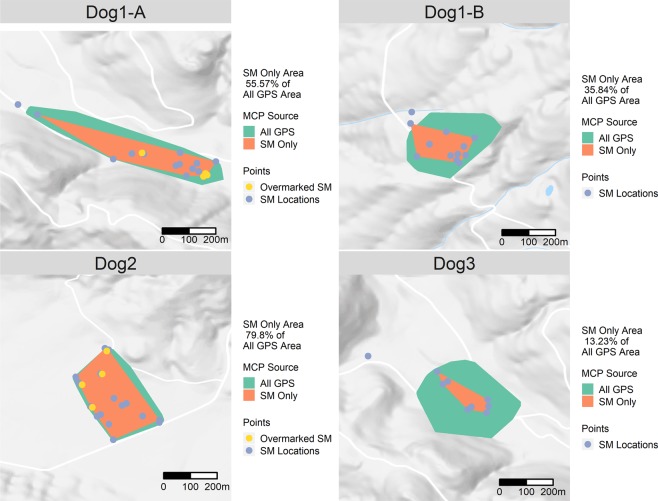
For canid species, scent marking plays a critical role in territoriality, social dynamics, and reproduction. However, due in part to human dependence on vision as our primary sensory modality, research on olfactory communication is hampered by a lack of tractable methods. In this study, we leverage a powerful biologging approach, using accelerometers in concert with GPS loggers to monitor and describe scent-marking events in time and space. We performed a validation experiment with domestic dogs, monitoring them by video concurrently with the novel biologging approach. We attached an accelerometer to the pelvis of 31 dogs (19 males and 12 females), detecting raised-leg and squat posture urinations by monitoring the change in device orientation. We then deployed this technique to describe the scent marking activity of 3 guardian dogs as they defend livestock from coyote depredation in California, providing an example use-case for the technique. During validation, the algorithm correctly classified 92% of accelerometer readings. High performance was partly due to the conspicuous signatures of archetypal raised-leg postures in the accelerometer data. Accuracy did not vary with the weight, age, and sex of the dogs, resulting in a method that is broadly applicable across canid species' morphologies. We also used models trained on each individual to detect scent marking of others to emulate the use of captive surrogates for model training. We observed no relationship between the similarity in body weight between the dog pairs and the overall accuracy of predictions, although models performed best when trained and tested on the same individual. We discuss how existing methods in the field of movement ecology can be extended to use this exciting new data type. This paper represents an important first step in opening new avenues of research by leveraging the power of modern-technologies and machine-learning to this field.
对于犬科动物来说,气味标记在领地性、社交动态和繁殖中起着至关重要的作用。然而,由于人类在很大程度上依赖视觉作为主要感觉模态,因此嗅觉交流的研究受到缺乏可行方法的限制。在这项研究中,我们利用一种强大的生物记录方法,使用加速度计与 GPS 记录仪结合,以监测和描述时间和空间中的气味标记事件。我们使用家养犬进行了验证实验,同时使用视频监测和新的生物记录方法。我们将加速度计附着在 31 只狗(19 只雄性和 12 只雌性)的骨盆上,通过监测设备方向的变化来检测抬腿和蹲姿排尿。然后,我们将该技术应用于描述 3 只护卫犬在加利福尼亚保护牲畜免受郊狼侵害时的气味标记活动,为该技术提供了一个示例应用案例。在验证过程中,算法正确分类了 92%的加速度计读数。高性能部分归因于加速度计数据中典型抬腿姿势的明显特征。准确性不受狗的体重、年龄和性别的影响,因此该方法在犬科动物形态学上具有广泛的适用性。我们还使用每个个体的训练模型来检测其他犬只的气味标记,以模拟使用圈养替代物进行模型训练。我们没有观察到狗对之间体重相似性与预测总体准确性之间的关系,尽管当在相同个体上进行训练和测试时,模型的性能最佳。我们讨论了如何将运动生态学领域的现有方法扩展到使用这种令人兴奋的新数据类型。本文代表了通过利用现代技术和机器学习的力量为该领域开辟新研究途径的重要第一步。