Department of Orthopaedics, Beijing Jishuitan Hospital, Fourth Clinical College of Peking University, Beijing, China.
Clinical Epidemiology Research Center, Beijing Jishuitan Hospital, Fourth Clinical College of Peking University, Beijing, China.
Orthop Surg. 2020 Feb;12(1):210-217. doi: 10.1111/os.12610. Epub 2020 Jan 20.
To investigate the outcomes of total knee arthroplasty (TKA) in patients with a prior femoral or tibial fracture, and identify the risk factors for surgical site complications and reoperations.
Seventy-one TKAs performed in 71 patients with a prior tibial or femoral fracture between January 2005 and December 2016 were reviewed retrospectively. Forty males (40 knees) and 31 females (31 knees) were included. The mean age at the time of TKA was 59.2 (range, 29-83) years. Outcomes were assessed using the Knee Society score before surgery and at the final follow-up visit. The patients' satisfaction rates were evaluated. Complications and reoperations were recorded by clinical and radiographic assessment. Logistic regression analysis was used to identify the risk factors for surgical site complications and reoperations.
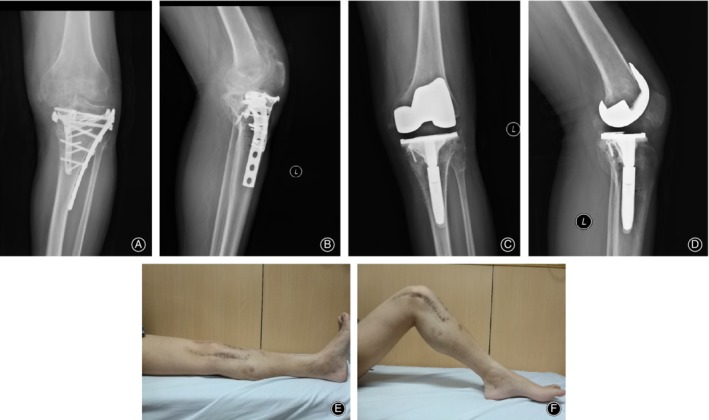
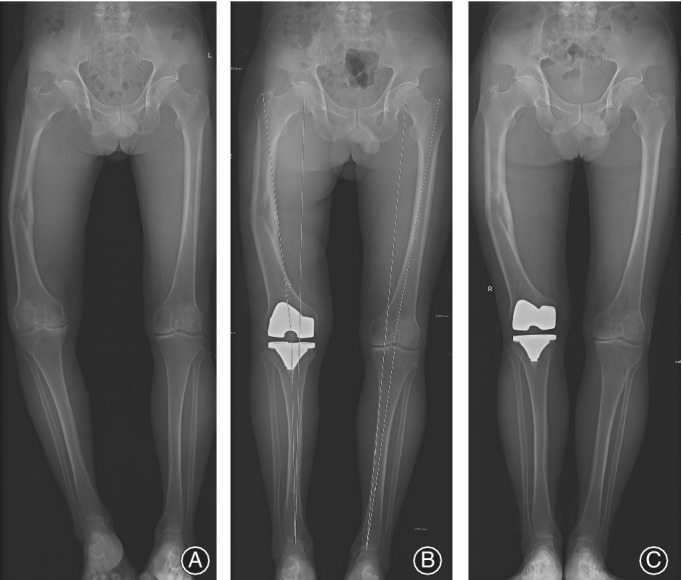
The median follow-up period was 4.7 (range, 3.2-7.1) years. The median knee range of motion increased from 90° preoperatively to 110° at the latest follow-up. The Knee Society knee score and function score improved from 35 (30, 40) and 40 (30, 50) to 90 (82, 93) and 90 (65, 100), respectively. The degree of overall satisfaction after TKA surgery was very satisfied in 41 patients, satisfied in 20 patients, neutral in four patients, dissatisfied in four patients, and very dissatisfied in two patients. The overall satisfaction (very satisfied and satisfied) rate was 85.9% (61 knees). Twelve knees (16.9%) had 19 surgical site complications. Six knees (8.3%) underwent reoperations, including one revision due to periprosthetic joint infection, one debridement and implant retention for superficial infection, two debridements for delayed wound healing, one open reduction and internal fixation for supracondylar fracture, and one re-fixation and bone grafting for hardware failure after a combined femoral shaft osteotomy and TKA. Preoperative patella baja was diagnosed in 12 knees, and was identified as a risk factor for surgical site complications and reoperations.
TKA for post-fracture osteoarthritis significantly relieved pain and improved function, but the incidence of surgical site complications and reoperations was high. Preoperative patella baja was a risk factor for surgical site complications and reoperations.
探讨既往股骨或胫骨骨折患者行全膝关节置换术(TKA)的疗效,并确定手术部位并发症和翻修的危险因素。
回顾性分析 2005 年 1 月至 2016 年 12 月期间收治的 71 例既往有胫骨或股骨骨折的患者(71 膝)接受 TKA 的临床资料。40 例(40 膝)为男性,31 例(31 膝)为女性;患者年龄 29~83 岁,平均 59.2 岁。术前及末次随访时采用膝关节协会评分(KSS)评估膝关节功能。评估患者的满意度,通过临床和影像学评估记录并发症和翻修情况。采用 logistic 回归分析确定手术部位并发症和翻修的危险因素。
中位随访时间为 4.7(3.2~7.1)年。膝关节活动度从术前的 90°增加至末次随访时的 110°。KSS 膝关节评分和功能评分分别从术前的 35(30,40)和 40(30,50)改善至末次随访时的 90(82,93)和 90(65,100)。TKA 术后非常满意 41 例,满意 20 例,一般 4 例,不满意 4 例,非常不满意 2 例,总体满意度(非常满意和满意)为 85.9%(61 膝)。12 膝(16.9%)发生 19 处手术部位并发症,6 膝(8.3%)行翻修术,其中 1 膝因假体周围关节感染行翻修,1 膝行清创术和单纯假体保留治疗浅表感染,2 膝行清创术治疗延迟愈合,1 膝行切开复位内固定治疗髁上骨折,1 膝因股骨干切开联合 TKA 后内固定失败行再次固定和植骨术。术前诊断 12 膝(16.9%)髌骨低位,为手术部位并发症和翻修的危险因素。
TKA 治疗骨折后骨关节炎可显著缓解疼痛、改善膝关节功能,但手术部位并发症和翻修的发生率较高。术前髌骨低位是手术部位并发症和翻修的危险因素。