Simons Nynke, Bijnen Mitchell, Wouters Kristiaan A M, Rensen Sander S, Beulens Joline W J, van Greevenbroek Marleen M J, 't Hart Leen M, Greve Jan Willem M, van der Kallen Carla J H, Schaper Nicolaas C, Schalkwijk Casper G, Stehouwer Coen D A, Brouwers Martijn C G J
Department of Internal Medicine, Division of Endocrinology and Metabolic Diseases, Maastricht University Medical Center, Maastricht, The Netherlands.
Department of Internal Medicine, Division of General Internal Medicine, Laboratory for Metabolism and Vascular Medicine, Maastricht University Medical Center, Maastricht, The Netherlands.
Liver Int. 2020 May;40(5):1079-1088. doi: 10.1111/liv.14384. Epub 2020 Jan 29.
BACKGROUND & AIMS: Plasma soluble E-selectin (sE-selectin) is a frequently used biomarker of systemic endothelial dysfunction. The present study explored the relationship between nonalcoholic fatty liver disease (NAFLD) and plasma sE-selectin levels.
Expression of E-selectin in liver, visceral adipose tissue (VAT) and muscle was studied in relation to plasma sE-selectin in severely obese individuals (n = 74). The course of hepatic E-selectin expression in relation to hepatic steatosis and inflammation was examined in C57BL/6J LDLR mice on a Western-type diet. The relationship between biomarkers of NAFLD, that is, plasma aminotransferase (ALT) and NAFLD susceptibility genes (rs738409 [PNPLA3] and rs1260326 [GCKR]), and plasma sE-selectin was studied in the combined CODAM (n = 571) and Hoorn (n = 694) studies.
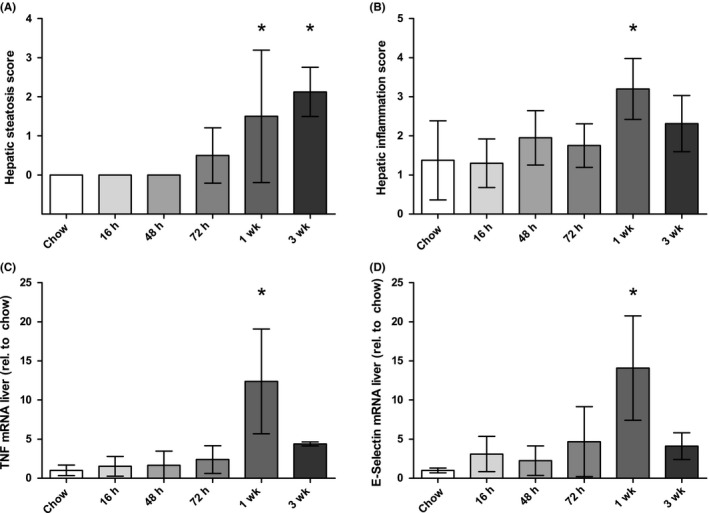
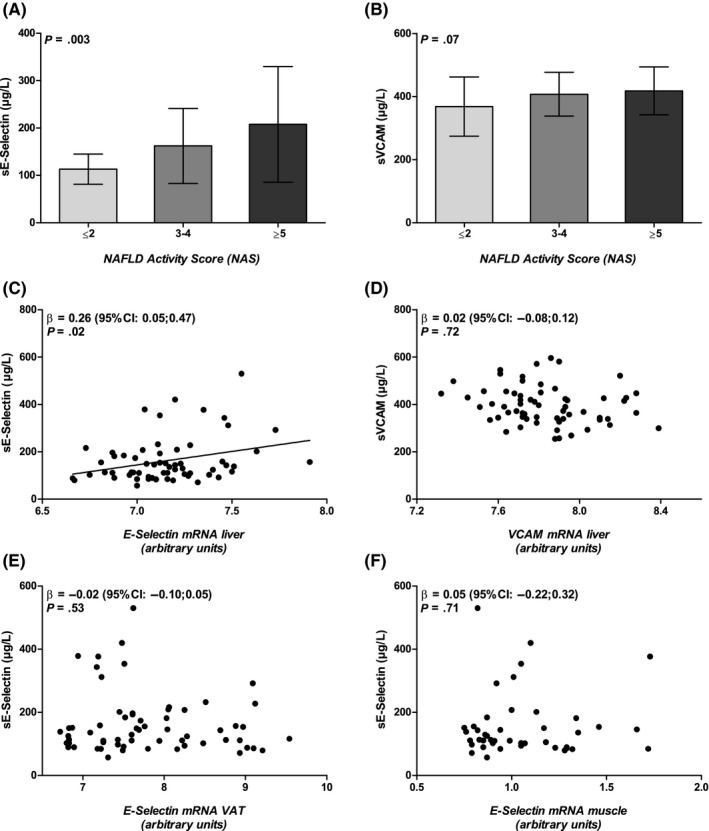
E-selectin expression in liver, not VAT or muscle, was associated with plasma sE-selectin in severely obese individuals (β = 0.26; 95% CI: 0.05-0.47). NAFLD severity was associated with hepatic E-selectin expression (P = .02) and plasma sE-selectin (P = .003). LDLR mice on a Western-type diet displayed increased hepatic E-selectin expression that followed the same course as hepatic inflammation, but not steatosis. In the CODAM study, plasma ALT was associated with plasma sE-selectin, independent of potential confounders (β = 0.25; 95% CI: 0.16-0.34). Both rs738409 and rs1260326 were associated with higher plasma sE-selectin in the combined CODAM and Hoorn studies (P = .01 and P = .004 respectively).
NAFLD and related markers are associated with higher expression of hepatic E-selectin and higher levels of plasma sE-selectin. Further studies are required to investigate the role of E-selectin in the pathogenesis of NAFLD and the applicability of sE-selectin as a plasma biomarker of NAFLD/NASH.
血浆可溶性E选择素(sE选择素)是全身内皮功能障碍常用的生物标志物。本研究探讨了非酒精性脂肪性肝病(NAFLD)与血浆sE选择素水平之间的关系。
研究了严重肥胖个体(n = 74)肝脏、内脏脂肪组织(VAT)和肌肉中E选择素的表达与血浆sE选择素的关系。在接受西式饮食的C57BL/6J LDLR小鼠中,研究了肝脏E选择素表达与肝脂肪变性和炎症的病程关系。在CODAM(n = 571)和Hoorn(n = 694)联合研究中,研究了NAFLD生物标志物(即血浆转氨酶(ALT))和NAFLD易感基因(rs738409 [PNPLA3]和rs1260326 [GCKR])与血浆sE选择素之间的关系。
在严重肥胖个体中,肝脏而非VAT或肌肉中的E选择素表达与血浆sE选择素相关(β = 0.26;95%CI:0.05 - 0.47)。NAFLD严重程度与肝脏E选择素表达(P = 0.02)和血浆sE选择素(P = 0.003)相关。接受西式饮食的LDLR小鼠肝脏E选择素表达增加,其变化过程与肝脏炎症一致,但与脂肪变性无关。在CODAM研究中,血浆ALT与血浆sE选择素相关,不受潜在混杂因素影响(β = 0.25;95%CI:0.16 - 0.34)。在CODAM和Hoorn联合研究中,rs738409和rs1260326均与较高的血浆sE选择素相关(分别为P = 0.01和P = 0.004)。
NAFLD及相关标志物与肝脏E选择素表达增加和血浆sE选择素水平升高有关。需要进一步研究来探讨E选择素在NAFLD发病机制中的作用以及sE选择素作为NAFLD/NASH血浆生物标志物的适用性。