Department of Maternal and Child Health, Xiangya School of Public Health, Central South University, Changsha, Hunan Province, China.
Institute of Child and Adolescent Health, Peking University School of Public Health, National Health Commission Key Laboratory of Reproductive Health, Beijing, China.
PLoS One. 2020 Jan 21;15(1):e0227954. doi: 10.1371/journal.pone.0227954. eCollection 2020.
This study aimed to assess the accuracy of body mass index (BMI) percentile, waist circumference (WC) percentile, waist-height ratio, and waist-hip ratio for identifying cardiometabolic risk factors in Chinese children and adolescents stratified by sex and BMI categories.
We measured anthropometric indices, fasting plasma glucose, lipid profile and blood pressure for 15698 participants aged 6-17 in a national survey between September and December 2013. The predictive accuracy of anthropometric indices for cardiometabolic risk factors was examined using receiver operating characteristic (ROC) analyses. The DeLong test and Z test were used for the comparisons of areas under ROC curves (AUCs).
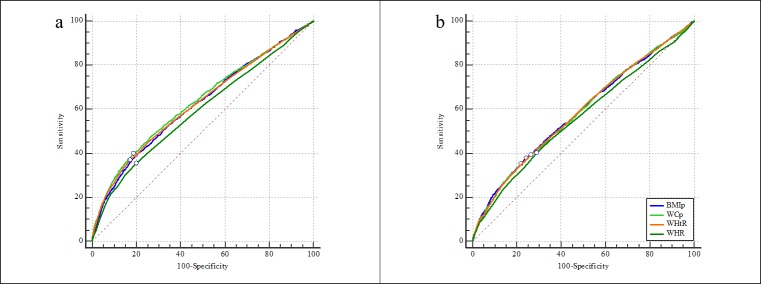
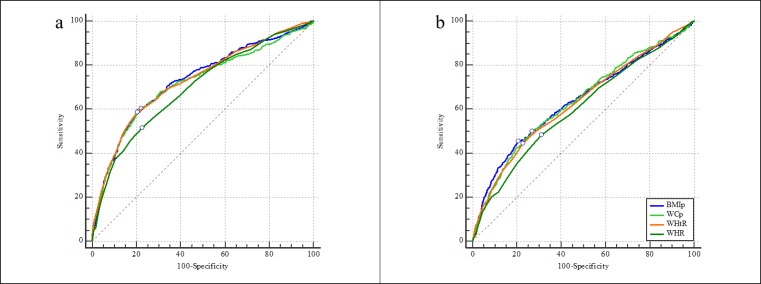
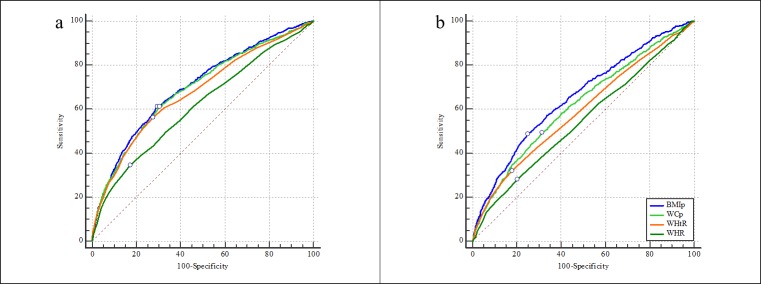
The prevalence of impaired fasting glucose, dyslipidemia, hypertension and cluster of risk factors were 2.9%, 27.3%, 10.5% and 5.7% respectively. The four anthropometric indices showed poor to fair discriminatory ability for cardiometabolic risk factors with the AUCs ranging from 0.53-0.72. Each index performed significantly better AUCs for dyslipidemia (0.59-0.63 vs. 0.56-0.59), hypertension (0.62-0.70 vs. 0.55-0.65) and clustered risk factors (0.70-0.73 vs. 0.60-0.64) in boys than that in girls. BMI percentile performed the best accuracy for hypertension in both sexes; WC percentile had the highest AUC for dyslipidemia and BMI percentile and waist-height ratio performed similarly the best AUCs for clustered risk factors in boys while BMI percentile, WC percentile and waist-height ratio performed similar and better AUCs for dyslipidemia and clustered risk factors in girls; whereas waist-hip ratio was consistently the poorest predictor for them regardless of sex. Though the anthropometric indices were more predictive of dyslipidemia, hypertension and clustered risk factors in overweight/obese group compared to their normal BMI peers, the AUCs in overweight/obese group remained in the poor range below 0.70.
Anthropometric indices are not effective screening tools for pediatric cardiometabolic risk factors, even in overweight/obese children.
本研究旨在评估体质指数(BMI)百分位、腰围(WC)百分位、腰高比和腰臀比在按性别和 BMI 类别分层的中国儿童和青少年中识别心血管代谢危险因素的准确性。
我们在 2013 年 9 月至 12 月期间进行的一项全国性调查中测量了 15698 名 6-17 岁参与者的人体测量指标、空腹血糖、血脂谱和血压。使用接收者操作特征(ROC)分析检查人体测量指标对心血管代谢危险因素的预测准确性。使用 DeLong 检验和 Z 检验比较 ROC 曲线下面积(AUC)。
空腹血糖受损、血脂异常、高血压和危险因素聚集的患病率分别为 2.9%、27.3%、10.5%和 5.7%。四项人体测量指标对心血管代谢危险因素的区分能力较差至中等,AUC 范围为 0.53-0.72。每个指标在男孩中对血脂异常(0.59-0.63 与 0.56-0.59)、高血压(0.62-0.70 与 0.55-0.65)和危险因素聚集(0.70-0.73 与 0.60-0.64)的 AUC 均显著高于女孩。在男孩和女孩中,BMI 百分位对高血压的准确性最好;WC 百分位对血脂异常的 AUC 最高;而 BMI 百分位和腰高比在男孩中对危险因素聚集的 AUC 最佳;而 BMI 百分位、WC 百分位和腰高比在女孩中对血脂异常和危险因素聚集的 AUC 相似且更好;而腰臀比无论性别如何,始终是预测能力最差的指标。尽管与正常 BMI 同龄人相比,超重/肥胖组的人体测量指标对血脂异常、高血压和危险因素聚集的预测更为准确,但超重/肥胖组的 AUC 仍处于较差的 0.70 以下范围。
即使在超重/肥胖儿童中,人体测量指标也不是评估儿童心血管代谢危险因素的有效筛查工具。