Sekgala Machoene Derrick, Opperman Maretha, Mpahleni Buhle, Mchiza Zandile June-Rose
School of Public Health, University of the Western Cape, Bellville, South Africa.
Human and Social Capabilities, Human Sciences Research Council, Cape Town, South Africa.
Front Nutr. 2022 Aug 11;9:974749. doi: 10.3389/fnut.2022.974749. eCollection 2022.
Detecting the early onset of metabolic syndrome (MetS) allows for quick intervention which may slow progression to a variety of health consequences, hence, determining the best measurement to detect MetS is essential.
This research aimed at examining the MetS predictive power of anthropometric indices, such as body mass index (BMI), waist circumference (WC), waist-to-height ratio (WHtR), body shape index (ABSI), body roundness index (BRI), percentage body fat (%BF), conicity index (CI), and Clínica Universidad de Navarra-body adiposity estimator (CUN-BAE) to determine the cut-off points to identify male South African taxi drivers with MetS.
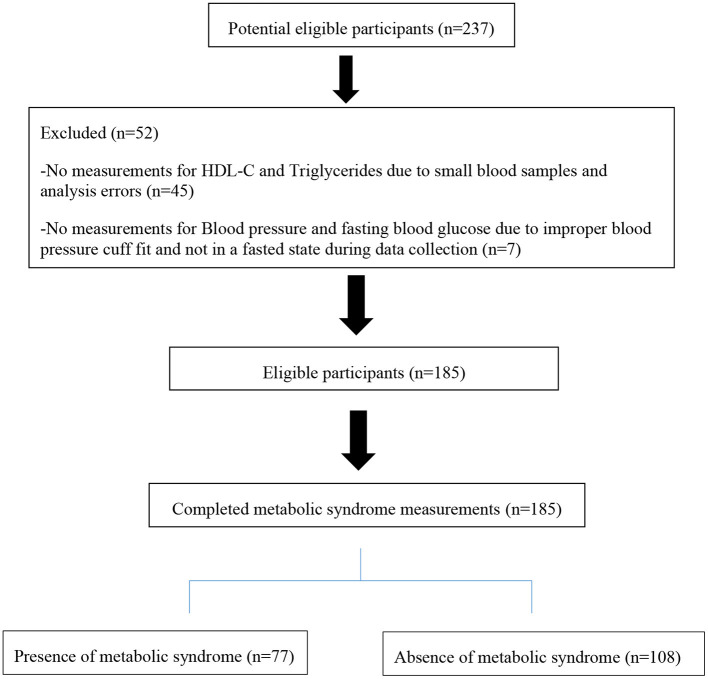
A cross-sectional study was conducted among 185 male taxi drivers. Their weight, height, WC, blood lipid profile were measured. International Diabetes Federation (IDF) definition was used to define MetS. Receiver Operating Characteristic (ROC) curves were used to compare the predictive ability of Anthropometric indices to detect MetS.
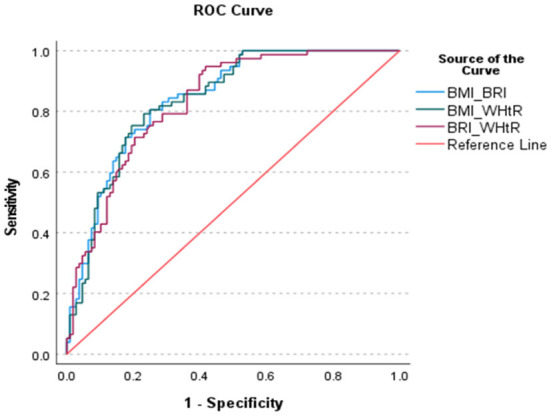
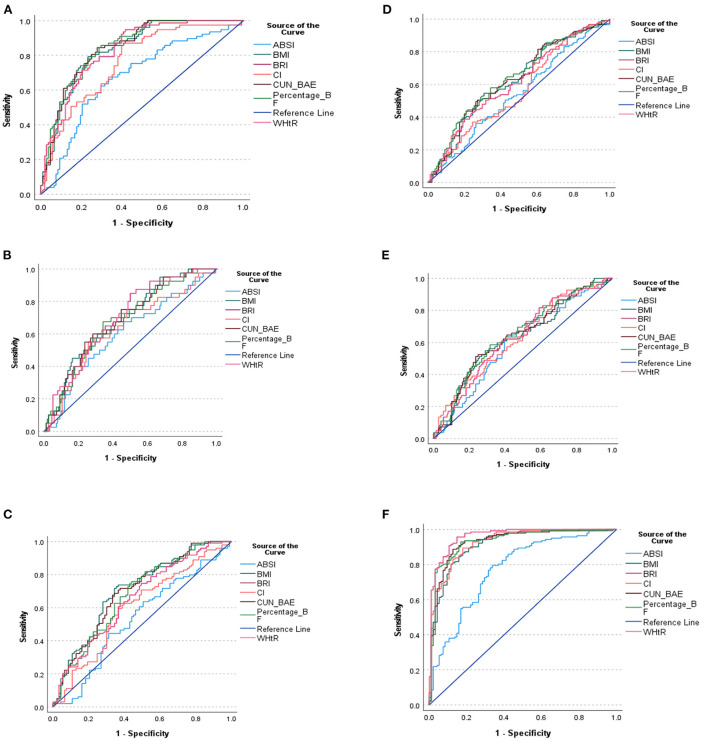
The mean age of the participants was 39.84 years. Overall, 41.6% (N = 77) of the participants presented with MetS. The mean values for BMI, WC, WHtR, %BF, BRI, CUN-BAE, ABSI and CI were 28.60 ± 6.20 kg/m, 99.13 ± 17.59 cm, 0.58 ± 0.10, 27.28 ± 8.28%, 5.09 ± 2.33, 27.78 ± 8.34, 0.08 ± 0.01 and 1.70 ± 0.19, respectively. The mean values for these indices were significantly ( < 0.001) higher in participants with MetS. The highest area under the curve (AUC) outcomes for screening MetS were for the %BF and CUN-BAE, followed by the BMI and WHtR, and lastly the BRI. All these anthropometric indices had outstanding discriminatory powers for predicting MetS with AUCs and sensitivity values above 80%. The BMI, WHtR, %BF, BRI, and CUN-BAE, had cut-off points for detection of metS in South African men at 28.25 kg/m, 0.55, 25.29%, 4.55, and 27.10, respectively. Based on the logistic regression models abnormal BMI, WHtR, %BF, BRI, CUN-BAE, TG, FBG, systolic BP, diastolic BP and WC showed increased risk of MetS.
While the %BF, CUN-BAE, BMI, WC, WHtR, BRI, CI and CUN-BAE could predict MetS among South African male taxi drivers, these indices were less effective in predicting the individual MetS risk factors such as TG, BP, and FBG.
检测代谢综合征(MetS)的早期发病情况有助于进行快速干预,这可能减缓其向各种健康问题的发展进程,因此,确定检测MetS的最佳指标至关重要。
本研究旨在检验人体测量指标,如体重指数(BMI)、腰围(WC)、腰高比(WHtR)、体型指数(ABSI)、身体圆度指数(BRI)、体脂百分比(%BF)、锥度指数(CI)以及纳瓦拉大学临床体脂估计值(CUN - BAE)对MetS的预测能力,以确定识别患有MetS的南非男性出租车司机的临界点。
对185名男性出租车司机进行了一项横断面研究。测量了他们的体重、身高、腰围和血脂谱。采用国际糖尿病联盟(IDF)的定义来界定MetS。受试者工作特征(ROC)曲线用于比较人体测量指标检测MetS的预测能力。
参与者的平均年龄为39.84岁。总体而言,41.6%(N = 77)的参与者患有MetS。BMI、WC、WHtR、%BF、BRI、CUN - BAE、ABSI和CI的平均值分别为28.60±6.20kg/m、99.13±17.59cm、0.58±0.10、27.28±8.28%、5.09±2.33、27.78±8.34、0.08±0.01和1.70±0.19。这些指标在患有MetS的参与者中的平均值显著更高(<0.001)。筛查MetS时曲线下面积(AUC)最高的结果是%BF和CUN - BAE,其次是BMI和WHtR,最后是BRI。所有这些人体测量指标对预测MetS都具有出色的辨别能力,AUC和敏感度值均高于80%。BMI、WHtR、%BF、BRI和CUN - BAE在南非男性中检测MetS的临界点分别为28.25kg/m、0.55、25.29%、4.55和27.10。基于逻辑回归模型,异常的BMI、WHtR、%BF、BRI、CUN - BAE、甘油三酯(TG)、空腹血糖(FBG)、收缩压、舒张压和WC显示出患MetS的风险增加。
虽然%BF、CUN - BAE、BMI、WC、WHtR、BRI、CI和CUN - BAE可以预测南非男性出租车司机中的MetS,但这些指标在预测个体MetS风险因素,如TG、血压和FBG方面效果较差。