Athingo Rauna, Tenzin Tenzin, Shilongo Albertina, Hikufe Emmanuel, Shoombe Kenneth K, Khaiseb Siegfried, van der Westhuizen Jolandie, Letshwenyo Moetapele, Torres Gregorio, Mettenleiter Thomas C, Freuling Conrad M, Müller Thomas
Animal Disease Control, Subdivision-North West, Directorate of Veterinary Services (DVS), Ministry of Agriculture Water and Forestry, Ongwediva 15006, Namibia.
World Organisation for Animal Health (OIE), Sub-Regional Representation for Southern Africa, Gaborone 25662, Botswana.
Trop Med Infect Dis. 2020 Jan 17;5(1):12. doi: 10.3390/tropicalmed5010012.
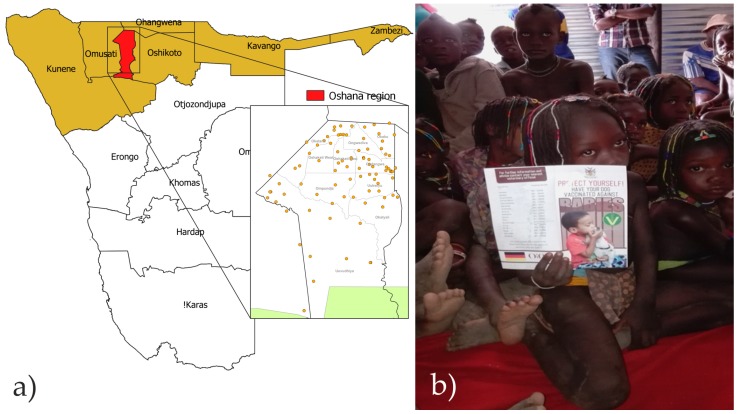
The major part of the global burden of dog-mediated rabies falls on Africa and Asia, where still an estimated 60,000 people die of the disease annually. Like in many African countries, dog-mediated rabies is a major public health concern in Namibia, costing the country an estimated 242 human deaths during the past two decades, in particular in the Northern Communal Areas (NCAs). Consequently, under the "One Health" concept, the Namibian government adopted a National Rabies Control Strategy in 2015, which strives to contribute to the global goal of ending dog-mediated human rabies deaths by 2030. A key component of this strategy was the implementation a dog rabies elimination program in the NCAs in 2016, being designed as a stepwise regional rollout strategy by building on experience gained in a pilot project area. The area of implementation covers approximately 263,376 km and 64 constituencies, with around 1.2 million inhabitants and estimated 93,000 dogs.
犬媒狂犬病造成的全球负担主要集中在非洲和亚洲,据估计,这两个地区每年仍有6万人死于该病。与许多非洲国家一样,犬媒狂犬病也是纳米比亚的一个主要公共卫生问题,在过去二十年中,该国估计有242人死于该病,特别是在北部社区地区。因此,在“同一健康”概念下,纳米比亚政府于2015年通过了一项国家狂犬病控制战略,力求为到2030年消除犬媒狂犬病导致的人类死亡这一全球目标做出贡献。该战略的一个关键组成部分是2016年在北部社区地区实施犬狂犬病消除计划,该计划基于在一个试点项目地区获得的经验,设计为逐步的区域推广战略。实施区域面积约263,376平方公里,涵盖64个选区,约有120万居民和估计93,000只狗。