García-Gutiérrez Lucía, McKenna Stephanie, Kolch Walter, Matallanas David
Systems Biology Ireland, University College Dublin, Belfield, Dublin 4, Ireland.
School of Medicine, University College Dublin, Belfield, Dublin 4, Ireland.
Cancers (Basel). 2020 Jan 17;12(1):229. doi: 10.3390/cancers12010229.
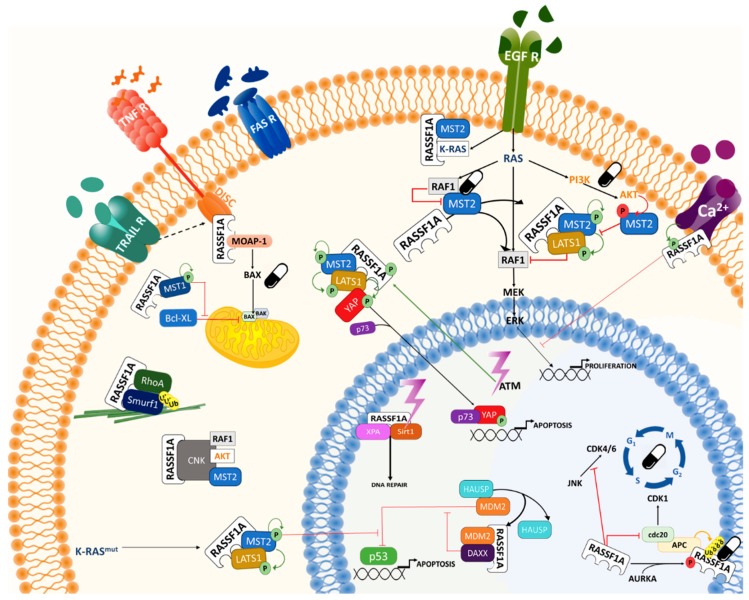
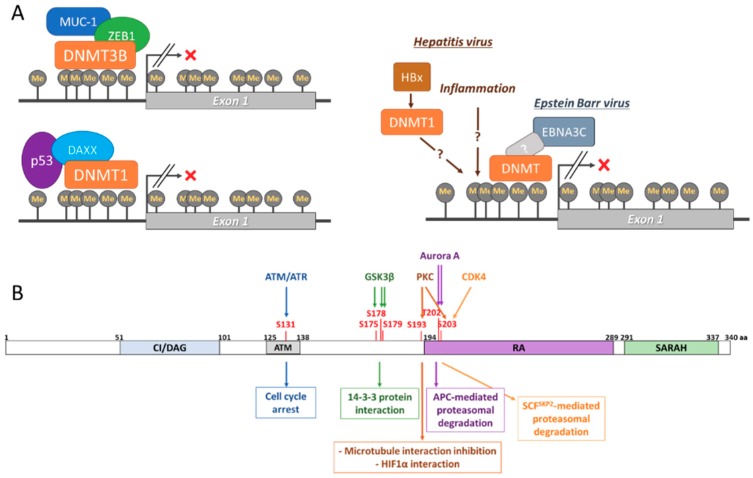
The RASSF1A tumour suppressor is a scaffold protein that is involved in cell signalling. Increasing evidence shows that this protein sits at the crossroad of a complex signalling network, which includes key regulators of cellular homeostasis, such as Ras, MST2/Hippo, p53, and death receptor pathways. The loss of expression of RASSF1A is one of the most common events in solid tumours and is usually caused by gene silencing through DNA methylation. Thus, re-expression of RASSF1A or therapeutic targeting of effector modules of its complex signalling network, is a promising avenue for treating several tumour types. Here, we review the main modules of the RASSF1A signalling network and the evidence for the effects of network deregulation in different cancer types. In particular, we summarise the epigenetic mechanism that mediates RASSF1A promoter methylation and the Hippo and RAF1 signalling modules. Finally, we discuss different strategies that are described for re-establishing RASSF1A function and how a multitargeting pathway approach selecting druggable nodes in this network could lead to new cancer treatments.
RASSF1A肿瘤抑制因子是一种参与细胞信号传导的支架蛋白。越来越多的证据表明,该蛋白处于一个复杂信号网络的交叉点,这个网络包括细胞稳态的关键调节因子,如Ras、MST2/ Hippo、p53和死亡受体通路。RASSF1A表达缺失是实体瘤中最常见的事件之一,通常是由DNA甲基化导致的基因沉默引起的。因此,重新表达RASSF1A或对其复杂信号网络的效应模块进行治疗性靶向,是治疗多种肿瘤类型的一个有前景的途径。在这里,我们综述了RASSF1A信号网络的主要模块以及网络失调在不同癌症类型中的影响的证据。特别是,我们总结了介导RASSF1A启动子甲基化的表观遗传机制以及Hippo和RAF1信号模块。最后,我们讨论了为重新建立RASSF1A功能而描述的不同策略,以及在这个网络中选择可药物作用节点的多靶点途径方法如何能带来新的癌症治疗方法。