Department of Human Genetics, Leiden University Medical Center, Leiden, The Netherlands.
Department of Clinical Genetics, Erasmus Medical Center, Rotterdam, The Netherlands.
Genet Med. 2020 May;22(5):847-856. doi: 10.1038/s41436-019-0736-2. Epub 2020 Jan 22.
Variants in the DNA mismatch repair (MMR) gene MSH6, identified in individuals suspected of Lynch syndrome, are difficult to classify owing to the low cancer penetrance of defects in that gene. This not only obfuscates personalized health care but also the development of a rapid and reliable classification procedure that does not require clinical data.
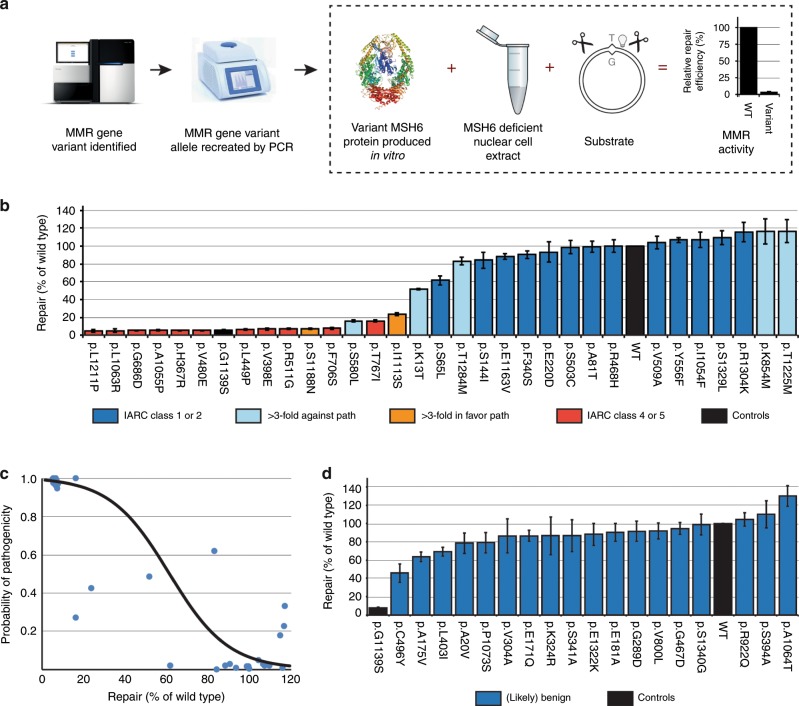
The complete in vitro MMR activity (CIMRA) assay was calibrated against clinically classified MSH6 variants and, employing Bayes' rule, integrated with computational predictions of pathogenicity. To enable the validation of this two-component classification procedure we have employed a genetic screen to generate a large set of inactivating Msh6 variants, as proxies for pathogenic variants.
The genetic screen-derived variants established that the two-component classification procedure displays high sensitivities and specificities. Moreover, these inactivating variants enabled the direct reclassification of human variants of uncertain significance (VUS) as (likely) pathogenic.
The two-component classification procedure and the genetic screens provide complementary approaches to rapidly and cost-effectively classify the large majority of human MSH6 variants. The approach followed here provides a template for the classification of variants in other disease-predisposing genes, facilitating the translation of personalized genomics into personalized health care.
在疑似林奇综合征患者中发现的 DNA 错配修复(MMR)基因 MSH6 的变异,由于该基因缺陷的癌症外显率低,难以分类。这不仅使个性化医疗变得复杂,也阻碍了快速、可靠的分类程序的开发,而该分类程序并不需要临床数据。
采用贝叶斯规则,对体外完全 MMR 活性(CIMRA)测定法进行校准,使其与临床上分类的 MSH6 变体相结合,并整合了对致病性的计算预测。为了验证这种双组分分类程序,我们利用遗传筛选产生了一大组失活的 Msh6 变体,作为致病性变体的替代物。
遗传筛选产生的变体证实,双组分分类程序具有较高的灵敏度和特异性。此外,这些失活变体可直接将意义不明的人类变异(VUS)重新分类为(可能)致病性。
双组分分类程序和遗传筛选为快速、经济有效地分类大多数人类 MSH6 变体提供了互补的方法。此处采用的方法为其他易患疾病基因的变体分类提供了模板,有助于将个性化基因组学转化为个性化医疗。