Ernetti Julia R, Gazolla Camilla B, Recco-Pimentel Shirlei M, Luca Elaine M, Bruschi Daniel P
Programa de Pós-graduação em Ciências Ambientais, Área de Ciências Exatas e Ambientais, Universidade Comunitária da Região de Chapecó, Chapecó, SC, Brazil.
Programa de Pós-graduação em Genética, Departamento de Genética, Universidade Federal do Paraná, Curitiba, PR, Brazil.
Genet Mol Biol. 2020 Jan 13;42(4):e20190151. doi: 10.1590/1678-4685-GMB-2019-0151. eCollection 2020.
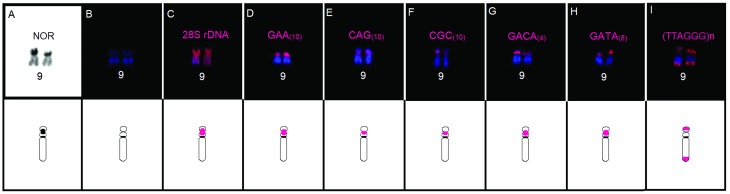
The monkey frog, Pithecopus rusticus (Anura, Phyllomedusidae) is endemic to the grasslands of the Araucarias Plateau, southern Brazil. This species is known only from a small population found at the type locality. Here, we analyzed for the first time the chromosomal organization of the repetitive sequences, including seven microsatellite repeats and telomeric sequences (TTAGGG)n in the karyotype of the species by Fluorescence in situ Hybridization. The dinucleotide motifs had a pattern of distribution clearly distinct from those of the tri- and tetranucleotides. The dinucleotide motifs are abundant and widely distributed in the chromosomes, located primarily in the subterminal regions. The tri- and tetranucleotides, by contrast, tend to be clustered, with signals being observed together in the secondary constriction of the homologs of pair 9, which are associated with the nucleolus organizer region. As expected, the (TTAGGG)n probe was hybridized in all the telomeres, with hybridization signals being detected in the interstitial regions of some chromosome pairs. We demonstrated the variation in the abundance and distribution of the different microsatellite motifs and revealed their non-random distribution in the karyotype of P. rusticus. These data contribute to understand the role of repetitive sequences in the karyotype diversification and evolution of this taxon.
猴蛙(Pithecopus rusticus,无尾目,叶泡蛙科)是巴西南部南洋杉高原草原的特有物种。该物种仅在模式产地发现的一个小种群中被知晓。在此,我们首次通过荧光原位杂交分析了该物种核型中重复序列的染色体组织,包括七个微卫星重复序列和端粒序列(TTAGGG)n。二核苷酸基序的分布模式与三核苷酸和四核苷酸的明显不同。二核苷酸基序丰富且广泛分布于染色体中,主要位于亚末端区域。相比之下,三核苷酸和四核苷酸倾向于聚集,在第9对同源染色体的次缢痕处共同观察到信号,该次缢痕与核仁组织区相关。正如预期的那样,(TTAGGG)n探针在所有端粒中杂交,在一些染色体对的间质区域检测到杂交信号。我们展示了不同微卫星基序丰度和分布的变化,并揭示了它们在猴蛙核型中的非随机分布。这些数据有助于理解重复序列在该分类单元核型多样化和进化中的作用。