Kaur Rashmeet, Dahuja Anshul, Garg Simmi, Bansal Kapil, Garg Radhe S, Singh Paramdeep
Guru Gobind Singh Medical College and Hospital, Faridkot, Punjab, India.
Pol J Radiol. 2019 Nov 14;84:e459-e463. doi: 10.5114/pjr.2019.90277. eCollection 2019.
There have been many studies that have attempted to correlate radiographic acromial characteristics with rotator cuff tears, but the results have not been conclusive. Rotator cuff tears (RCT) are the common aetiology of shoulder pain. We assessed the association of rotator cuff tears with commonly used radiographic parameters of acromial morphology and their different radiographic characteristics.
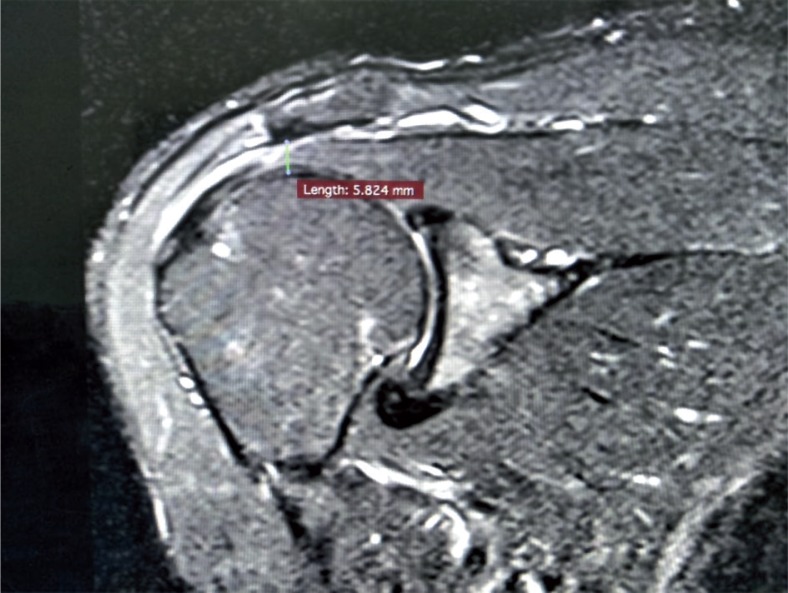
From a retrospective study of 98 patients, we characterised acromial type and measured acromial thickness (AT), critical shoulder angle (CSA), lateral acromial angle (LAA), acromiohumeral distance (AHD), and acromion index (AI) on a 1.5T MRI, from 68 patients with partial or full-thickness supraspinatus tendon tears and 30 controls without tears.
Out the 68 patients with rotator cuff tear, supraspinatus was the most commonly affected tendon, with 86% (59) cases showing abnormalities. The average age of the patients was 45.11 ± 21.45 years with male dominance (80%). Partial tears of rotator cuff were more common than complete tears. Forty-eight cases showed partial tears in supraspinatus as compared to 11 cases of complete tears. The acromial type did not show any correlation with any particular cuff lesion. The AT and AI of controls were significantly smaller than cuff-tear patients. The LAA of cuff-tear patients was significantly different from that of control patients. The impingement patients demonstrated a significantly greater acromial thickness, larger CSA, decreased AHD, and decreased LAA than their control counterparts.
A higher prevalence of rotator cuff tears and impingement associated with low lateral acromial angle, larger CSA and decreased AHD was observed. AT and AI have a direct correlation with rotator cuff tear.
有许多研究试图将影像学上的肩峰特征与肩袖撕裂相关联,但结果尚无定论。肩袖撕裂(RCT)是肩部疼痛的常见病因。我们评估了肩袖撕裂与常用的肩峰形态影像学参数及其不同影像学特征之间的关联。
通过对98例患者的回顾性研究,我们在1.5T MRI上对68例部分或全层冈上肌腱撕裂患者和30例无撕裂的对照患者的肩峰类型进行了特征描述,并测量了肩峰厚度(AT)、临界肩角(CSA)、肩峰外侧角(LAA)、肩峰肱骨头距离(AHD)和肩峰指数(AI)。
在68例肩袖撕裂患者中,冈上肌是最常受累的肌腱,86%(59例)显示异常。患者的平均年龄为45.11±21.45岁男性占主导(80%)。肩袖部分撕裂比完全撕裂更常见。48例显示冈上肌部分撕裂,而完全撕裂为11例。肩峰类型与任何特定的肩袖病变均无相关性。对照组的AT和AI显著小于肩袖撕裂患者。肩袖撕裂患者的LAA与对照患者有显著差异。与对照患者相比,撞击患者的肩峰厚度显著更大、CSA更大、AHD减小且LAA减小。
观察到肩袖撕裂和撞击的患病率较高,与肩峰外侧角低、CSA大及AHD减小相关。AT和AI与肩袖撕裂直接相关。