Department of Food Science and Human Nutrition, University of Illinois, Urbana-Champaign. 260 Bevier Hall-MC 182. 905 Goodwin Ave, Urbana, IL 61801, USA.
Division of Nutritional Sciences, University of Illinois at Urbana-Champaign, Urbana, IL 61801, USA.
Nutrients. 2020 Jan 21;12(2):275. doi: 10.3390/nu12020275.
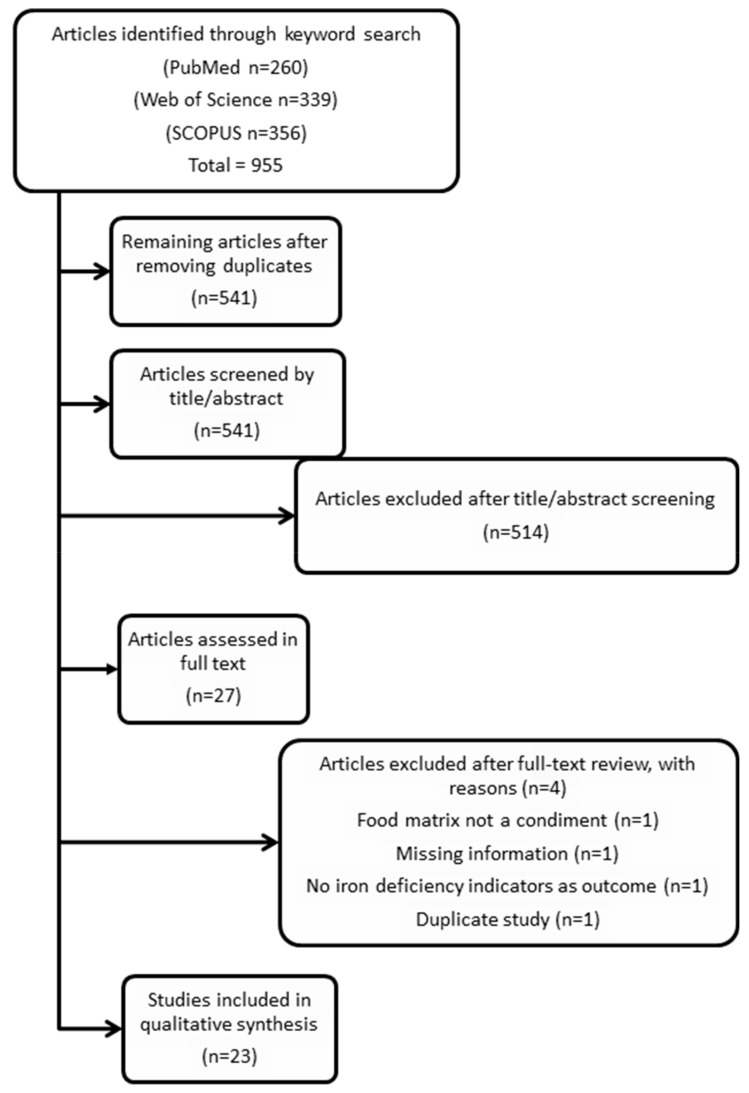
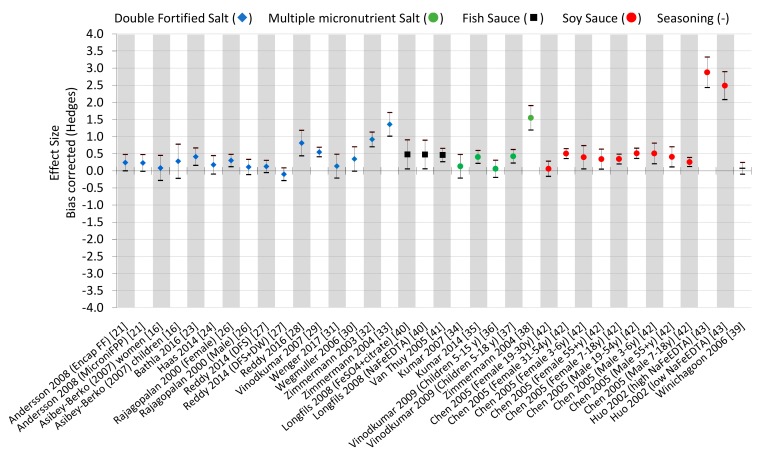
Iron fortification of staple foods is a common practice around the world to reduce the prevalence of iron-deficiency anemia. More recently, fortified condiments, including salts, sauces, and powders, have been tested in various efficacy trials. However, there is limited information on how nutritional, environmental, and experimental factors affect their efficacy and effectiveness. The purpose of the present work was to systematically review performance factors affecting the efficacy of condiment fortification trials. Three databases were searched using a standardized keyword search and included based on four-point inclusion criteria. Studies were evaluated against a quality assessment tool and effect sizes were calculated. Studies were ranked as low or high performing, based on whether or not they significantly improved iron-deficiency outcomes (hemoglobin, anemia prevalence, and ferritin levels). Of the 955 retrieved studies, 23 were included-of which, nine performed poorly, eight performed highly, and six were classified as neither because they did not meet the criteria of assessing the three iron outcomes. Results showed that unsuccessful trials did not consider environmental factors such as parasitic infections, nutritional factors such as micronutrient deficiencies other than iron, consumer acceptability of the product or experimental factors such as monitoring and adherence to the trials. Two common performing factors identified among those studies performing highly vs. those that did not were the control of sensory changes and monitoring of consumption compliance (i.e., dose delivery). The present work can be used as decision-making support for nutrition policy makers when determining the appropriate implementation of condiment fortification programs.
铁强化主食是全世界减少缺铁性贫血患病率的常用方法。最近,各种功效试验中已经测试了强化调味品,包括盐、酱汁和粉末。然而,关于营养、环境和实验因素如何影响其功效和效果的信息有限。本研究的目的是系统地回顾影响调味品强化试验功效的因素。使用标准化关键字搜索对三个数据库进行了搜索,并根据四点纳入标准进行了纳入。根据质量评估工具对研究进行了评估,并计算了效应量。根据是否显著改善缺铁性结局(血红蛋白、贫血患病率和铁蛋白水平),将研究分为低效能或高效能。在检索到的 955 项研究中,有 23 项被纳入其中-其中 9 项表现不佳,8 项表现良好,6 项表现不佳,因为它们不符合评估三种铁结局的标准。结果表明,不成功的试验没有考虑寄生虫感染等环境因素,也没有考虑除铁以外的其他微量营养素缺乏等营养因素,以及消费者对产品的接受程度或监测和遵守试验等实验因素。在那些表现良好的研究与那些表现不佳的研究之间,有两个常见的表现因素,即控制感官变化和监测消费依从性(即剂量传递)。本研究可作为营养政策制定者在确定适当实施调味品强化计划时的决策支持。