Key Laboratory of Geospatial Technology for the Middle and Lower Yellow River Regions, College of Environment and Planning, Henan University, Kaifeng 475004, China.
Zhejiang Key Lab of Crop Germplasm, Department of Agronomy, College of Agriculture and Biotechnology, Zhejiang University, Hangzhou 310058, China.
Int J Mol Sci. 2020 Jan 22;21(3):728. doi: 10.3390/ijms21030728.
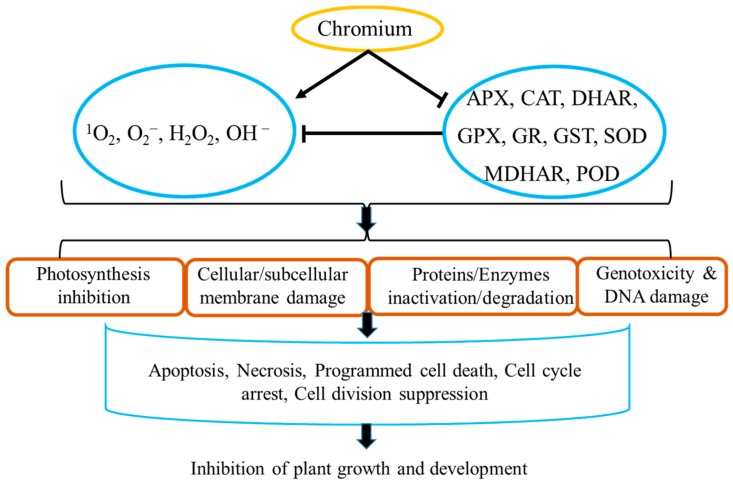
Chromium (Cr) is one of the top seven toxic heavy metals, being ranked 21st among the abundantly found metals in the earth's crust. A huge amount of Cr releases from various industries and Cr mines, which is accumulating in the agricultural land, is significantly reducing the crop development, growth, and yield. Chromium mediates phytotoxicity either by direct interaction with different plant parts and metabolic pathways or it generates internal stress by inducing the accumulation of reactive oxygen species (ROS). Thus, the role of Cr-induced ROS in the phytotoxicity is very important. In the current study, we reviewed the most recent publications regarding Cr-induced ROS, Cr-induced alteration in the enzymatic antioxidant system, Cr-induced lipid peroxidation and cell membrane damage, Cr-induced DNA damage and genotoxicity, Cr-induced ultrastructural changes in cell and subcellular level, and Cr-induced alterations in photosynthesis and photosynthetic apparatus. Taken together, we conclude that Cr-induced ROS and the suppression of the enzymatic antioxidant system actually mediate Cr-induced cytotoxic, genotoxic, ultrastructural, and photosynthetic changes in plants.
铬(Cr)是七种主要有毒重金属之一,在地壳中含量丰富的金属中排名第 21 位。大量的 Cr 从各个工业和 Cr 矿中释放出来,在农业用地中积累,这显著降低了作物的发育、生长和产量。铬通过直接与不同植物部位和代谢途径相互作用,或者通过诱导活性氧(ROS)的积累产生内部应激,介导植物毒性。因此,Cr 诱导的 ROS 在植物毒性中的作用非常重要。在本研究中,我们综述了关于 Cr 诱导的 ROS、Cr 诱导的酶抗氧化系统改变、Cr 诱导的脂质过氧化和细胞膜损伤、Cr 诱导的 DNA 损伤和遗传毒性、Cr 诱导的细胞和亚细胞水平的超微结构变化以及 Cr 诱导的光合作用和光合器官改变的最新出版物。总的来说,我们得出结论,Cr 诱导的 ROS 和酶抗氧化系统的抑制实际上介导了 Cr 诱导的植物细胞毒性、遗传毒性、超微结构和光合作用变化。