Division of Hematology and Medical Oncology, Knight Cancer Institute, Oregon Health & Science University, Portland, Oregon 97239, USA.
Department of Medicine-Hematology, Stanford University, Stanford, California 94305, USA.
Cold Spring Harb Mol Case Stud. 2020 Apr 1;6(2). doi: 10.1101/mcs.a004838. Print 2020 Apr.
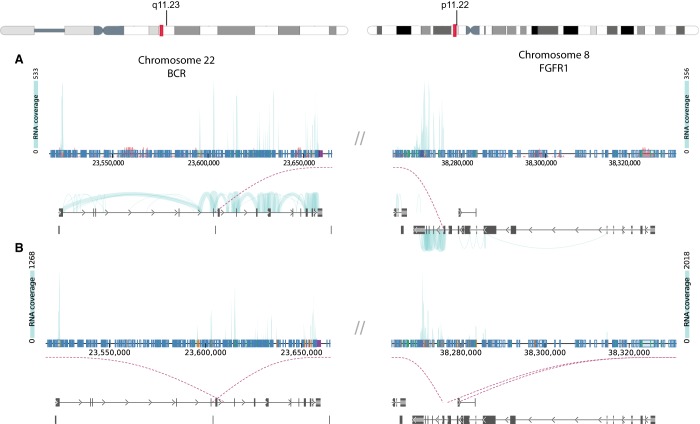
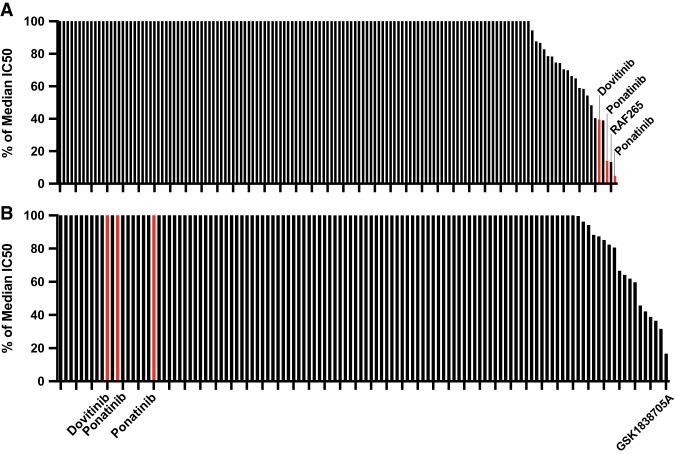
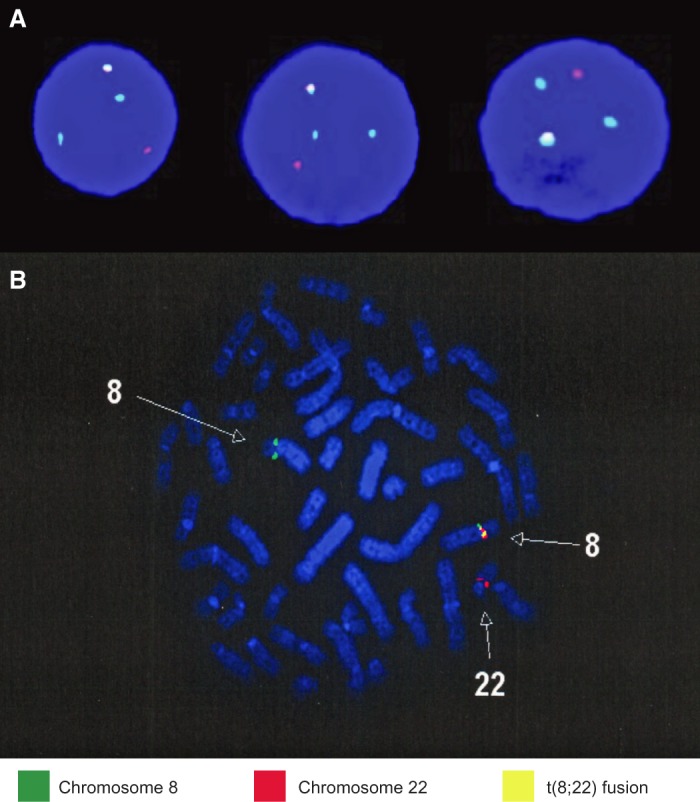
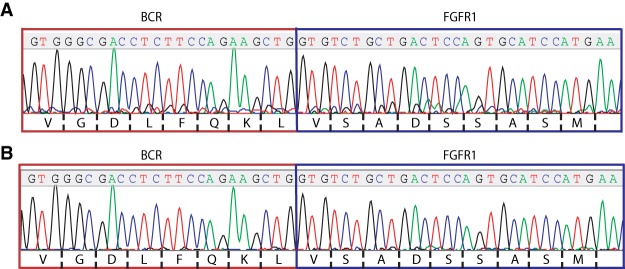
8p11 myeloproliferative syndrome (EMS) represents a unique World Health Organization (WHO)-classified hematologic malignancy defined by translocations of the FGFR1 receptor. The syndrome is a myeloproliferative neoplasm characterized by eosinophilia and lymphadenopathy, with risk of progression to either acute myeloid leukemia (AML) or T- or B-lymphoblastic lymphoma/leukemia. Within the EMS subtype, translocations between () and () have been shown to produce a dominant fusion protein that is notoriously resistant to tyrosine kinase inhibitors (TKIs). Here, we report two cases of EMS identified via RNA sequencing (RNA-seq) and confirmed by fluorescence in situ hybridization (FISH). Sanger sequencing revealed that both cases harbored the exact same breakpoint. In the first case, the patient presented with AML-like disease, and in the second, the patient progressed to B-cell acute lymphoblastic leukemia (B-ALL). Additionally, we observed that that primary leukemia cells from Case 1 demonstrated sensitivity to the tyrosine kinase inhibitors ponatinib and dovitinib that can target FGFR1 kinase activity, whereas primary cells from Case 2 were resistant to both drugs. Taken together, these results suggest that some but not all BCR-FGFR1 fusion positive leukemias may respond to TKIs that target FGFR1 kinase activity.
8p11 骨髓增殖性综合征(EMS)代表了一种独特的世界卫生组织(WHO)分类的血液恶性肿瘤,由 FGFR1 受体易位定义。该综合征是一种骨髓增殖性肿瘤,其特征为嗜酸性粒细胞增多和淋巴结病,有进展为急性髓系白血病(AML)或 T 或 B-淋巴母细胞淋巴瘤/白血病的风险。在 EMS 亚型中,已经证明 ()和 ()之间的易位会产生一种显性融合蛋白,该蛋白对酪氨酸激酶抑制剂(TKI)具有明显的耐药性。在这里,我们通过 RNA 测序(RNA-seq)报告了两例 EMS 病例,并通过荧光原位杂交(FISH)确认。Sanger 测序显示,这两种情况均具有相同的断裂点。在第一个病例中,患者表现为 AML 样疾病,而在第二个病例中,患者进展为 B 细胞急性淋巴细胞白血病(B-ALL)。此外,我们观察到来自病例 1 的原始白血病细胞对可靶向 FGFR1 激酶活性的酪氨酸激酶抑制剂帕纳替尼和多韦替尼表现出敏感性,而来自病例 2 的原始细胞对这两种药物均耐药。总之,这些结果表明,并非所有 BCR-FGFR1 融合阳性白血病都可能对靶向 FGFR1 激酶活性的 TKI 有反应。