Danish Headache Center, Department of Neurology, Rigshospitalet Glostrup, Glostrup, Denmark.
Danish Headache Center, Department of Neurology, Rigshospitalet Glostrup, Glostrup, Denmark
J Med Genet. 2020 Sep;57(9):610-616. doi: 10.1136/jmedgenet-2019-106640. Epub 2020 Jan 24.
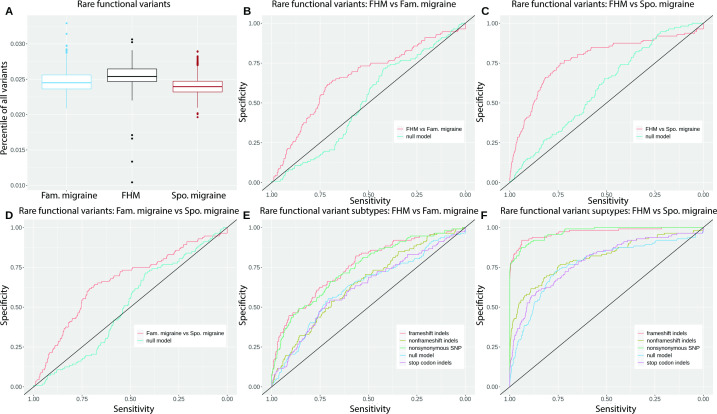
Familial hemiplegic migraine (FHM) is a rare form of migraine with aura that often has an autosomal dominant mode of inheritance. Rare mutations in the , and genes can all cause FHM revealing genetic heterogeneity in the disorder. Furthermore, only a small subset of the affected individuals has a causal mutation. We set out to investigate what differentiates patients with FHM with no mutation in any known FHM gene from patients with common types of migraine in both familial and sporadic cases.
2558 male and female participants from a migraine cohort from the Danish Headache Center were included. 112 had FHM; 743 had familial migraine; and 1703 had sporadic migraine. Using a linear regression model, we analysed for over-representation of rare functional variants in FHM versus familial migraine and sporadic migraine. Post hoc analyses included pathway analysis and testing for tissue specificity.
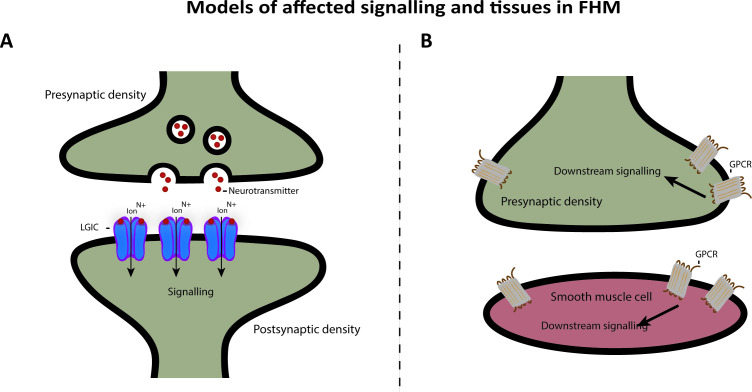
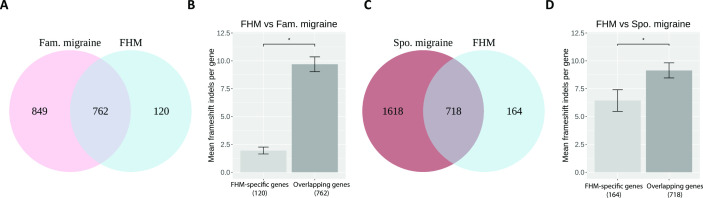
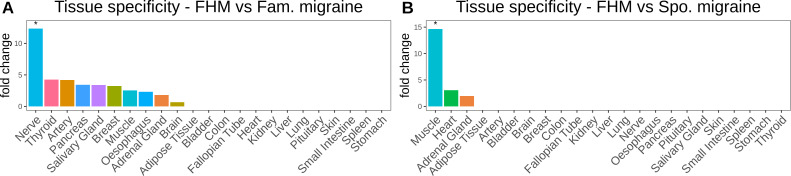
We found that patients with FHM have significantly more rare frameshift indels compared with patients with familial migraine and sporadic migraine. Pathway analysis revealed that the 'ligand-gated ion channel activity' and 'G protein-coupled receptor downstream signalling' pathways were significantly associated with mutated genes. We moreover found that the mutated genes showed tissue specificity towards nervous tissue and muscle tissue.
We show that patients with FHM compared with patients with common types of migraine suffer from a higher load of rare frameshift indels in genes associated with synaptic signalling in the central nervous system and possibly in muscle tissue contributing to vascular dysfunction.
家族性偏瘫性偏头痛(FHM)是一种罕见的有先兆偏头痛形式,通常具有常染色体显性遗传模式。编码钙通道亚基 CACNA1A、ATP1A2 和 SCN1A 的基因中的罕见突变都可导致 FHM,表明该疾病存在遗传异质性。此外,只有一小部分受影响的个体存在因果突变。我们着手研究在任何已知的 FHM 基因中均无突变的 FHM 患者与家族性和散发性常见偏头痛患者有何不同。
我们纳入了来自丹麦头痛中心偏头痛队列的 2558 名男性和女性参与者。其中 112 名患有 FHM;743 名患有家族性偏头痛;1703 名患有散发性偏头痛。我们使用线性回归模型分析 FHM 与家族性偏头痛和散发性偏头痛相比罕见功能变异的过度表达。事后分析包括通路分析和组织特异性测试。
我们发现 FHM 患者的罕见移码缺失/插入明显多于家族性偏头痛和散发性偏头痛患者。通路分析显示,“配体门控离子通道活性”和“G 蛋白偶联受体下游信号”通路与突变基因显著相关。此外,我们发现突变基因对神经组织和肌肉组织具有组织特异性。
与常见类型的偏头痛患者相比,FHM 患者中枢神经系统突触信号和可能的肌肉组织中与血管功能障碍相关的基因中罕见移码缺失/插入的负担更高。