Zhang Yanqiong, Mao Xia, Chen Wenjia, Guo Xiaodong, Yu Liangxiang, Jiang Funeng, Wang Xiaoyue, Li Weijie, Guo Qiuyan, Li Taixian, Lin Na
Institute of Chinese Materia Medica, China Academy of Chinese Medical Sciences, Beijing 100700, China.
Institute of Chinese Materia Medica, China Academy of Chinese Medical Sciences, Beijing 100700, China.
Mol Ther Nucleic Acids. 2020 Mar 6;19:890-904. doi: 10.1016/j.omtn.2019.12.023. Epub 2020 Jan 10.
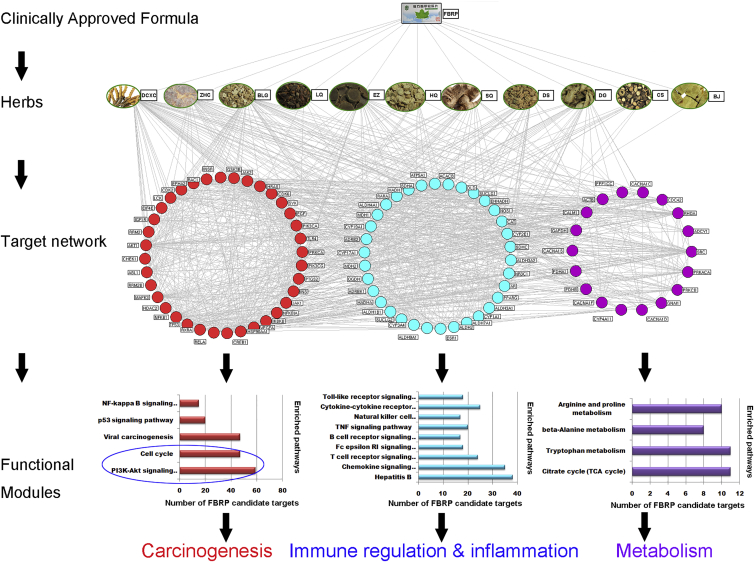
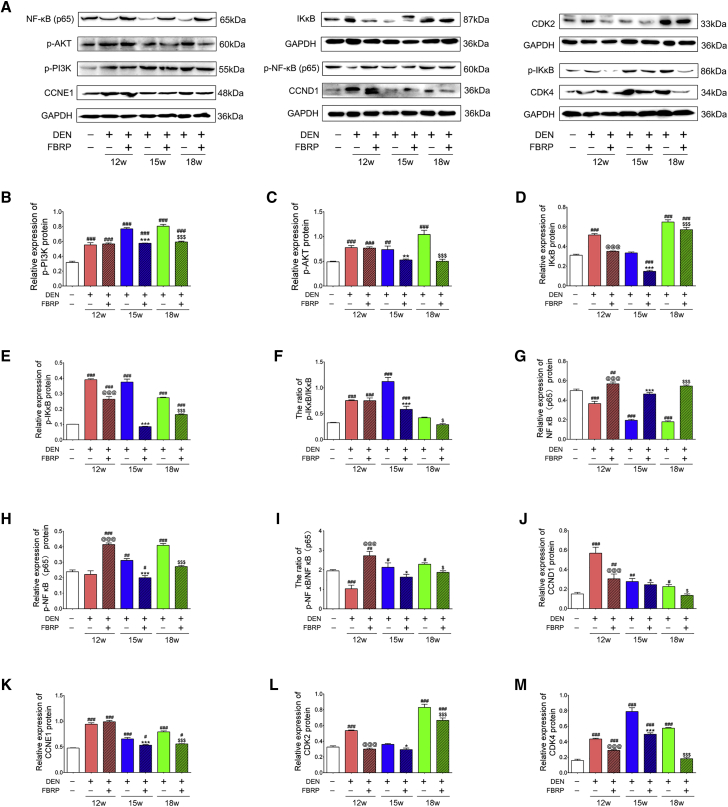
Drug repositioning offers new clinical applications for existing drugs with shorter approval processes and lower costs and risks than de novo experimental drug development. The Fufang-Biejia-Ruangan pill (FBRP) is the first clinically approved anti-fibrosis herbal formula in China. Whether FBRP could be used to treat hepatocellular carcinoma (HCC) remains unclear. Herein, a total of 161 FBRP candidate targets against HCC were identified according to the topological importance in the "hepatic fibrosis-cirrhosis-cancer axis-related gene-FBRP putative target" network, and mostly enriched in phosphatidylinositol 3-kinase (PI3K)/AKT/nuclear factor κB (NF-κB) signaling. Experimentally, FBRP inhibited liver fibrosis and prevented the development of neoplastic lesions at the early stages of hepatocarcinogenesis in a diethylnitrosamine-induced rat HCC model. FBRP inhibited tumor cell proliferation, induced tumor-specific cell death, and suppressed tumor progression in HCC rats while preventing the activation of PI3K, AKT and IKΚB proteins, reducing the nuclear accumulation of NFΚB1 protein, and decreasing the downstream expression of proteins. Consistently, FBRP suppressed HCC cell proliferation and induced cell cycle arrest in vitro. Co-treatment of FBRP with PI3K inhibitor exhibited an additive inhibitory effect on PI3K/AKT/NF-κB activation. Collectively, our data showed the potentials of FBRP in hepatic fibrosis microenvironment regulation and tumor prevention, suggesting that FBRP may be a promising candidate drug for reduction of fibrogenesis and prevention of HCC.
药物重新定位为现有药物提供了新的临床应用,其审批流程比从头开始进行实验性药物开发更短,成本和风险更低。复方鳖甲软肝片(FBRP)是中国首个临床批准的抗纤维化中药方剂。FBRP是否可用于治疗肝细胞癌(HCC)仍不清楚。在此,根据“肝纤维化-肝硬化-癌症轴相关基因-FBRP推定靶点”网络中的拓扑重要性,共鉴定出161个FBRP针对HCC的候选靶点,且大多富集于磷脂酰肌醇3激酶(PI3K)/蛋白激酶B(AKT)/核因子κB(NF-κB)信号通路。实验表明,在二乙基亚硝胺诱导的大鼠HCC模型中,FBRP抑制肝纤维化,并在肝癌发生的早期阶段预防肿瘤性病变的发展。FBRP抑制肿瘤细胞增殖,诱导肿瘤特异性细胞死亡,并抑制HCC大鼠的肿瘤进展,同时阻止PI3K、AKT和IKΚB蛋白的激活,减少NFΚB1蛋白的核内积累,并降低下游蛋白的表达。同样,FBRP在体外抑制HCC细胞增殖并诱导细胞周期停滞。FBRP与PI3K抑制剂联合处理对PI3K/AKT/NF-κB激活表现出相加抑制作用。总体而言,我们的数据显示了FBRP在肝纤维化微环境调节和肿瘤预防方面的潜力,表明FBRP可能是一种有前途的候选药物,可减少纤维生成并预防HCC。