Department of Cellular and Molecular Pharmacology , University of California , 600 16th Street, Genentech Hall , San Francisco , California 94158 , United States.
Department of Pharmaceutical Chemistry , University of California , 600 16th Street, Genentech Hall , San Francisco , California 94158 , United States.
Biochemistry. 2020 Feb 11;59(5):647-651. doi: 10.1021/acs.biochem.9b01036. Epub 2020 Jan 30.
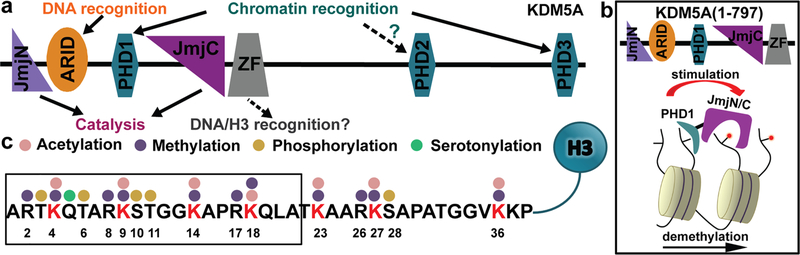
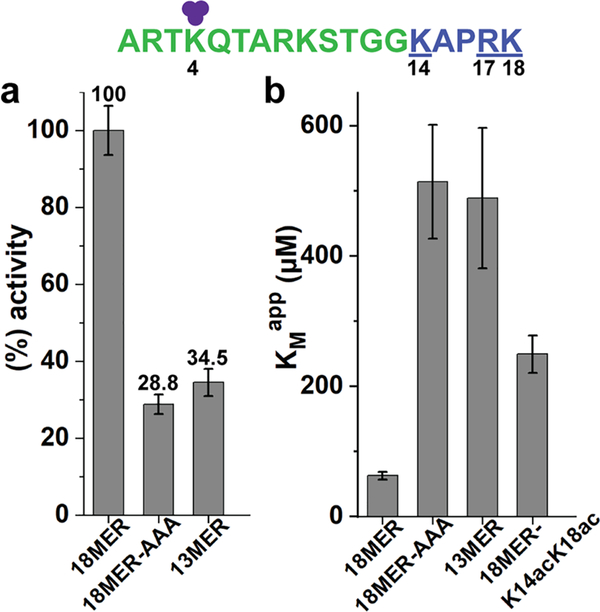
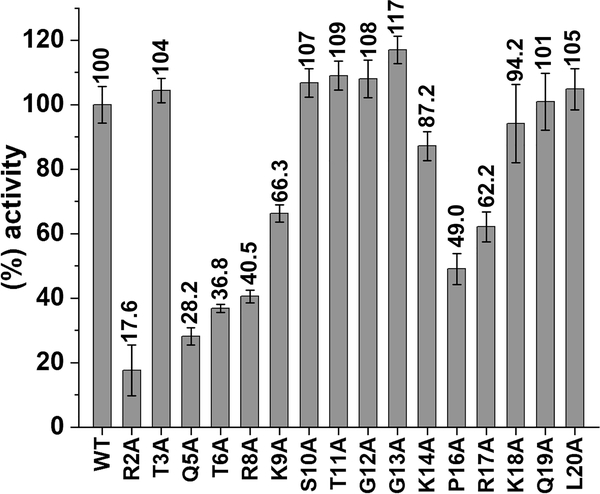
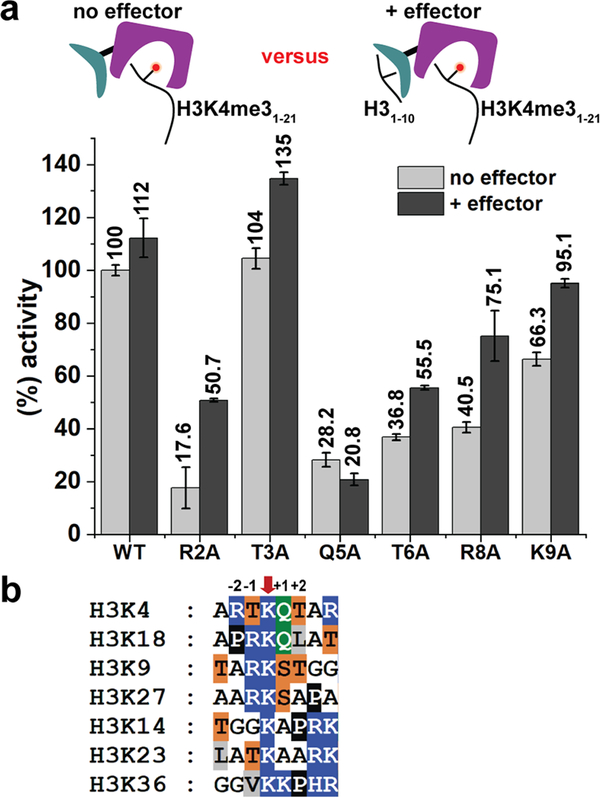
Human lysine demethylase KDM5A is a chromatin-modifying enzyme associated with transcriptional regulation, because of its ability to catalyze removal of methyl groups from methylated lysine 4 of histone H3 (H3K4me3). Amplification of KDM5A is observed in many cancers, including breast cancer, prostate cancer, hepatocellular carcinoma, lung cancer, and gastric cancer. In this study, we employed alanine scanning mutagenesis to investigate substrate recognition of KDM5A and identify the H3 tail residues necessary for KDM5A-catalyzed demethylation. Our data show that the H3Q5 residue is critical for substrate recognition by KDM5A. Our data also reveal that the protein-protein interactions between KDM5A and the histone H3 tail extend beyond the amino acids proximal to the substrate mark. Specifically, demethylation activity assays show that deletion or mutation of residues at positions 14-18 on the H3 tail results in an 8-fold increase in the , compared to wild-type 18mer peptide, suggesting that this distal epitope is important in histone engagement. Finally, we demonstrate that post-translational modifications on this distal epitope can modulate KDM5A-dependent demethylation. Our findings provide insights into H3K4-specific recognition by KDM5A, as well as how chromatin context can regulate KDM5A activity and H3K4 methylation status.
人类赖氨酸去甲基酶 KDM5A 是一种与转录调控相关的染色质修饰酶,因为它能够催化组蛋白 H3 赖氨酸 4 上甲基(H3K4me3)的去除。KDM5A 的扩增在许多癌症中都有观察到,包括乳腺癌、前列腺癌、肝细胞癌、肺癌和胃癌。在这项研究中,我们采用丙氨酸扫描突变来研究 KDM5A 的底物识别,并确定 KDM5A 催化去甲基化所需的 H3 尾部残基。我们的数据表明,H3Q5 残基对于 KDM5A 的底物识别至关重要。我们的数据还揭示了 KDM5A 与组蛋白 H3 尾部之间的蛋白质-蛋白质相互作用超出了底物标记附近的氨基酸。具体而言,去甲基化活性测定表明,H3 尾部位置 14-18 上的残基缺失或突变会导致与野生型 18 mer 肽相比,增加 8 倍的 ,表明这个远端表位在组蛋白结合中很重要。最后,我们证明了这个远端表位上的翻译后修饰可以调节 KDM5A 依赖性去甲基化。我们的研究结果提供了关于 KDM5A 对 H3K4 特异性识别的见解,以及染色质结构如何调节 KDM5A 活性和 H3K4 甲基化状态。