Department of Wildlife, Fisheries, and Conservation Biology, University of Maine, Orono, ME, United States of America.
PLoS One. 2020 Jan 27;15(1):e0221136. doi: 10.1371/journal.pone.0221136. eCollection 2020.
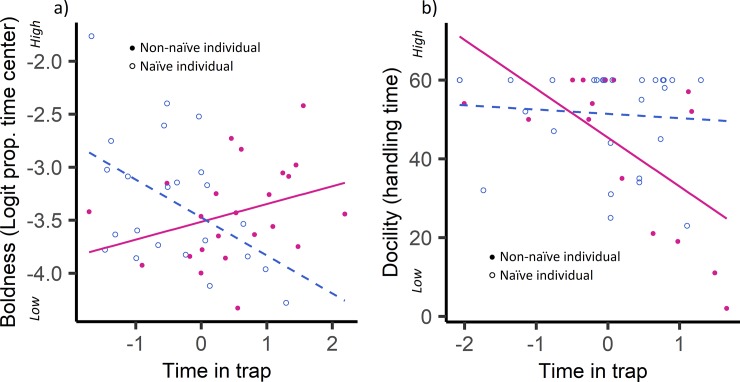
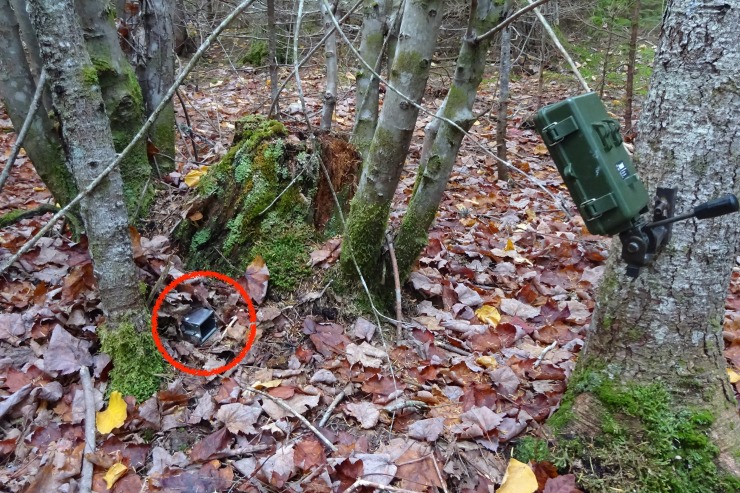
In recent years, consistent individual differences in behavior, or personalities, have been a topic of increasing interest as researchers strive to understand and predict the responses of individuals and populations to anthropogenic changes. Behavioral studies in wild populations often require that animals are live trapped before behavioral observation can occur, and this is especially true in studies investigating animal personalities. However, it is unknown whether the amount of time confined to a live trap may regulate the behavior of trapped individuals. Specifically, if the duration of trap confinement directly influences behavior, then by obtaining wild animals through live trapping we may be confounding the very measurements of greatest interest. To investigate whether the duration of trap confinement influences the behavior of trapped individuals, we performed a study on two small mammal species, focusing specifically on personality traits. We positioned high-definition trail cameras facing Longworth small mammal traps in the field to observe capture events and record the time of capture. We then measured personality in captured deer mice (Peromyscus maniculatus) and southern red-backed voles (Myodes gapperi) using three standardized tests, and through linear and generalized linear models we found that the time an animal had spent confined to a trap before testing did not affect 86% of behaviors exhibited. Our results showed two weak behavioral effects of confinement duration on boldness and docility resulting from an interaction between the duration of confinement and whether or not an individual was naïve to trapping. Our results suggest that behavioral measurements of wild, trapped small mammals are not determined by the time spent confined to a trap. However, researchers should use caution and consider whether an animal is naïve to trapping during analysis since habituation to the live trap may play a role in the effects of confinement duration on behavior.
近年来,行为或个性的一致性个体差异一直是研究人员越来越感兴趣的话题,他们努力理解和预测个体和群体对人为变化的反应。在野外种群中进行行为研究时,通常需要对动物进行活捕,然后才能进行行为观察,而在研究动物个性时更是如此。然而,目前尚不清楚被活捕困住的时间长短是否会调节被捕动物的行为。具体来说,如果被困时间直接影响行为,那么通过活捕获取野生动物,可能会混淆我们最感兴趣的测量结果。为了研究被困时间是否会影响被捕个体的行为,我们对两种小型哺乳动物物种进行了研究,特别关注个性特征。我们在野外将高清轨迹摄像机对准朗沃思小型哺乳动物陷阱,以观察捕获事件并记录捕获时间。然后,我们使用三个标准化测试来测量被捕的鹿鼠(Peromyscus maniculatus)和南方红背田鼠(Myodes gapperi)的个性,并通过线性和广义线性模型发现,在测试之前,动物被限制在陷阱中的时间长短并不影响 86%的表现行为。我们的结果表明,由于被限制时间和个体是否对陷阱陌生之间的相互作用,限制时间对大胆和温顺的两个弱行为效应。我们的结果表明,被活捕困住的野生小型哺乳动物的行为测量结果不受被限制在陷阱中的时间长短的影响。然而,研究人员在分析时应谨慎考虑动物是否对陷阱陌生,因为对活捕的习惯可能会影响限制时间对行为的影响。