Department of Morphology, Universidade Federal do Espirito Santo, Vitoria, Brazil.
Department of Anatomy, Instituto de Ciencias Biomedicas, Universidade de Sao Paulo, São Paulo, Brazil.
PLoS One. 2020 Jan 27;15(1):e0228155. doi: 10.1371/journal.pone.0228155. eCollection 2020.
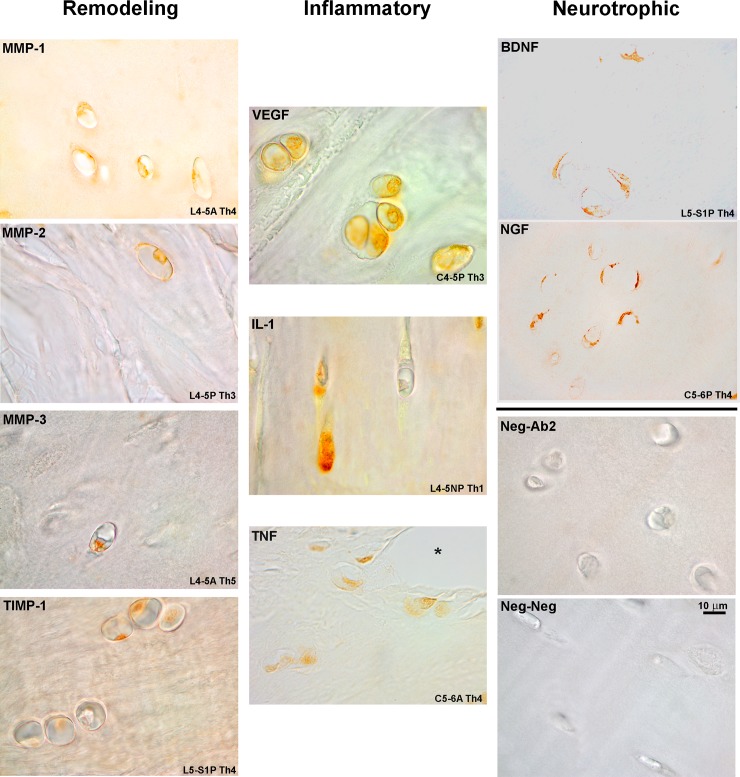
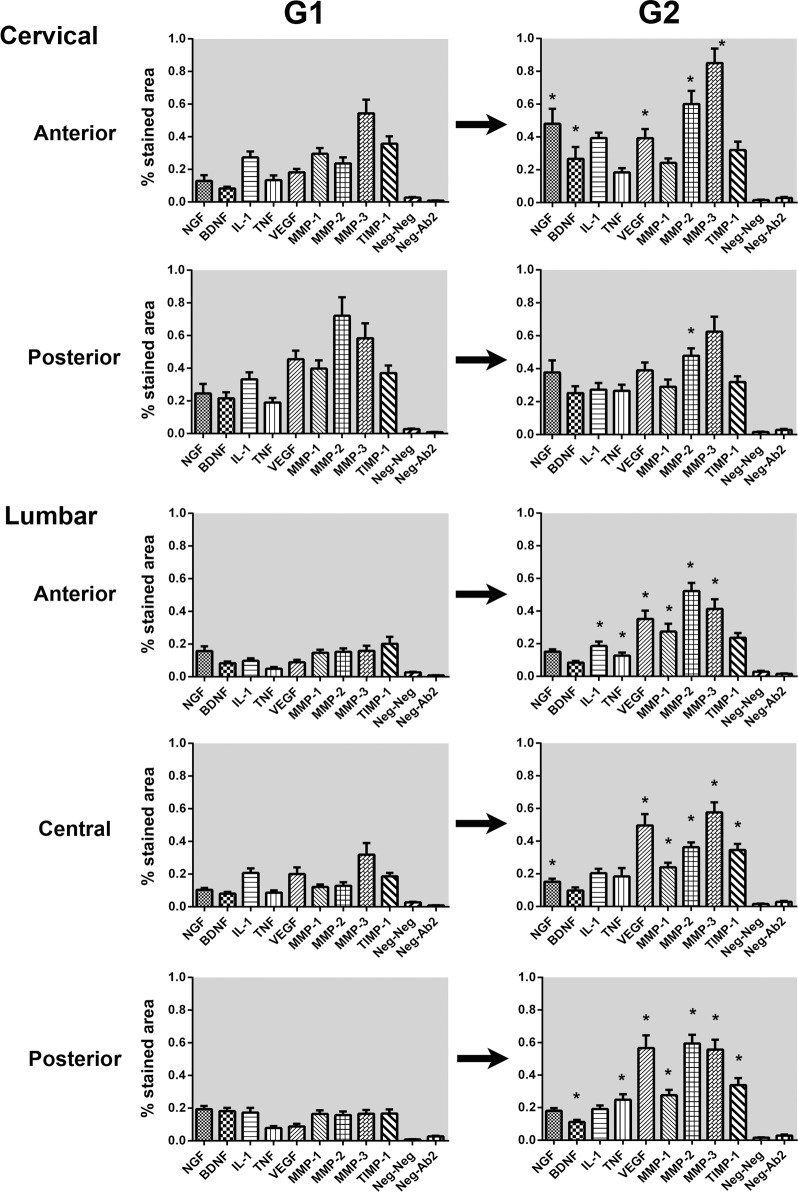
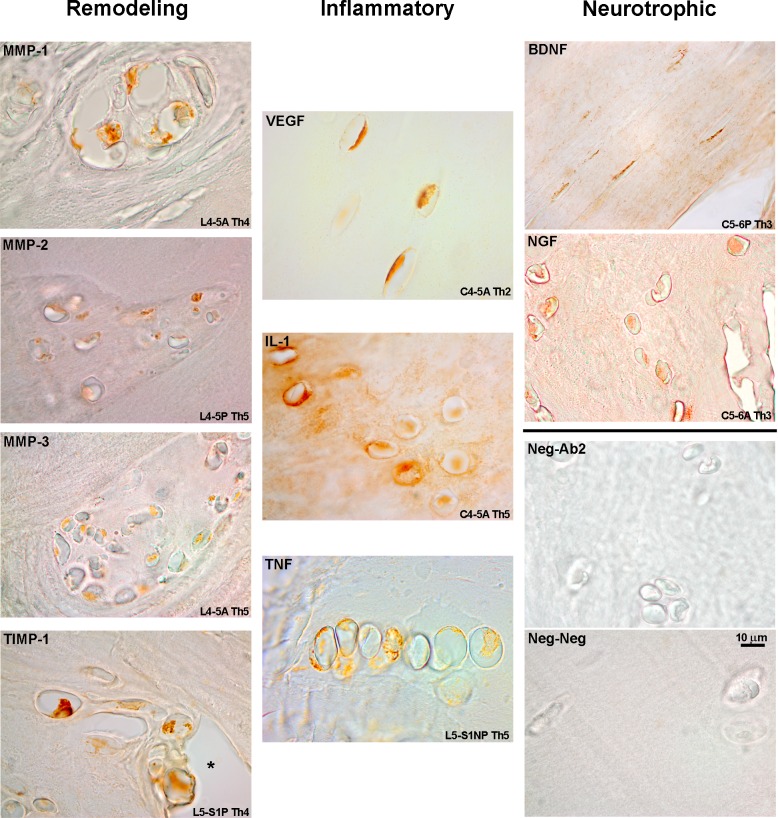
Intervertebral disc (IVD) degeneration is a remodeling process mediated by several growth factors and cytokines. This process has been extensively studied in vitro and with pathologic specimens obtained during surgery for scoliosis or back pain. However, the occurrence and temporal evolution of these molecules during normal aging, particularly in the cervical segment, is not known. Our objective was to study and compare the presence of putative mediators in the IVD of young (<35 years, G1) and elderly (>65 years, G2) presumably asymptomatic individuals. Thirty C4-5 and C5-6 discs and thirty L4-5 and L5-S1 discs per group were collected during the autopsy of individuals whose family members denied a history of neck or back pain. Discs were divided into anterior, central (lumbar only) and posterior sectors for analysis. Immunohistochemistry for TNF-α, IL-1β, VEGF, NGF-β, BDNF, TIMP-1, MMP-1, -2 and -3 was performed and reactivity compared between groups and sectors. All of these molecules were detected in every disc sector of both G1 and G2. Most statistical comparisons (25/45, 55.6%) revealed an increase in mediator expression in G2 in relation to G1. Regional differences in the expression of remodeling enzymes were rare; NGF-β and BDNF had slightly higher expression in the cervical segment of elderly individuals. A senescent profile with elevated VEGF, MMP-2 and MMP-3 was observed across most G2 disc regions and were generally elevated from G1. In conclusion, the mere presence of any of the studied molecules inside the IVD cannot be considered pathologic. Expression of remodeling enzymes and inflammatory mediators is relatively similar across different vertebral segments and disc regions leading to a common degenerated pattern, while neurotrophins have slightly higher expression in cervical discs. These findings support the concept that disc remodeling in different segments follows a similar pathway that can be potentially mediated to avoid structural failure.
椎间盘(IVD)退变是一种由多种生长因子和细胞因子介导的重塑过程。这一过程已经在体外和脊柱侧凸或背痛手术中获得的病理标本中得到了广泛研究。然而,在正常衰老过程中,特别是在颈椎段,这些分子的发生和时间演变尚不清楚。我们的目的是研究和比较年轻(<35 岁,G1 组)和老年(>65 岁,G2 组)无症状个体的 IVD 中假定的介质的存在。在每个尸检过程中,我们从其家庭成员否认有颈部或背部疼痛史的个体中收集了 C4-5 和 C5-6 椎间盘和 L4-5 和 L5-S1 椎间盘各 30 个。将椎间盘分为前、中(仅腰椎)和后区进行分析。对 TNF-α、IL-1β、VEGF、NGF-β、BDNF、TIMP-1、MMP-1、-2 和 -3 进行免疫组织化学染色,并比较两组和各区之间的反应性。所有这些分子都在 G1 和 G2 的每个椎间盘区都有发现。大多数统计比较(25/45,55.6%)表明 G2 中介质表达增加。重塑酶表达的区域差异很少;在老年个体的颈椎段,NGF-β 和 BDNF 的表达略高。在大多数 G2 椎间盘区观察到血管内皮生长因子(VEGF)、基质金属蛋白酶(MMP)-2 和 MMP-3 表达升高的衰老特征,且普遍高于 G1。总之,在 IVD 中存在任何一种研究分子都不能被认为是病理性的。不同椎骨节段和椎间盘区的重塑酶和炎症介质的表达相对相似,导致出现共同的退行性模式,而神经营养因子在颈椎间盘的表达略高。这些发现支持这样一种观点,即不同节段的椎间盘重塑遵循相似的途径,这种途径可能会被潜在地介导以避免结构失效。