Guangdong Medical College, College of Dermatology, Anhui Medical University, Guangzhou, China.
Guangdong Provincial Dermatology Hospital, Guangzhou, China.
BMC Pediatr. 2020 Jan 27;20(1):34. doi: 10.1186/s12887-020-1942-4.
Acrodermatitis enteropathica (AE) is a rare autosomal recessive hereditary skin disease caused by mutations in the SLC39A4 gene and is characterized by periorificial dermatitis, alopecia and diarrhoea due to insufficient zinc absorption. Only one of the three known sets of twins with AE has genetic information. This case reports the discovery of new mutation sites in rare twin patients and draws some interesting conclusions by analysing the relationship between genetic information and clinical manifestations.
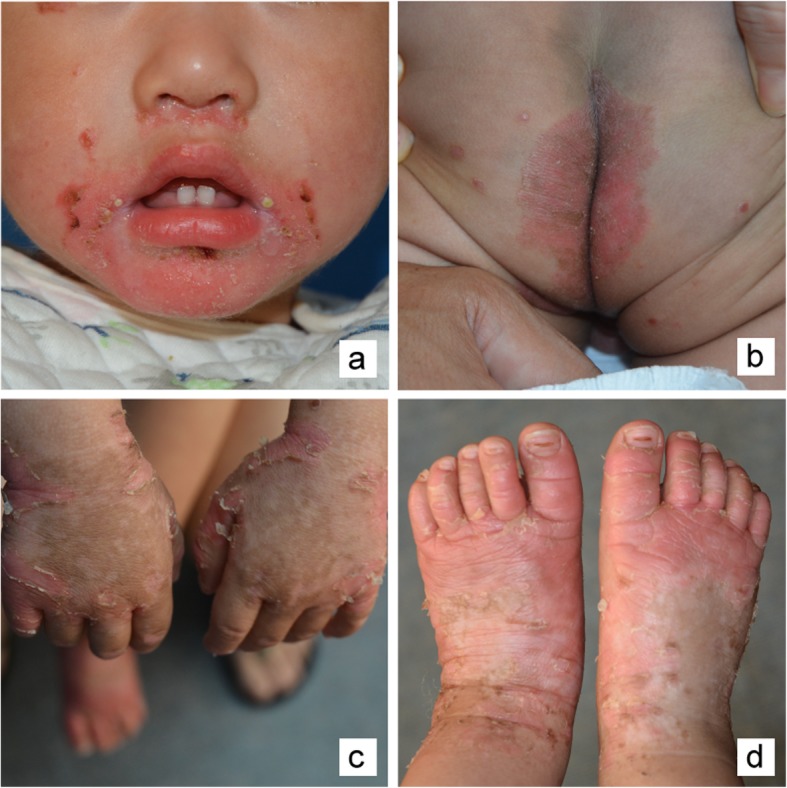
Here, we report a pair of 16-month-old twin boys with AE exhibiting periorificial and acral erythema, scales and blisters, while subsequent laboratory examination showed normal plasma zinc and alkaline phosphatase levels. Further Sanger sequencing demonstrated that the patients were compound heterozygous for two unreported SLC39A4 mutations: a missense mutation in exon 5 (c.926G > T), which led to a substitution of the 309th amino acid residue cysteine with phenylalanine, a splice site mutation occurring in the consensus donor site of intron 5 (c.976 + 2 T > A). A family study revealed that the boys' parents were heterozygous carriers of these two mutations.
We identified a new compound heterozygous mutation in Chinese twins with AE, which consisted of two previous unreported variants in exon 5 and intron 5 of SLC39A4. We propose an up-to-date review that different mutations in SLC39A4 may exhibit different AE manifestations. In conjunction with future research, our work may shed light on genotype-phenotype correlations in AE patients and provide knowledge for genetic counselling and treatment for AE patients.
肠病性肢端皮炎(AE)是一种罕见的常染色体隐性遗传性皮肤病,由 SLC39A4 基因突变引起,其特征为由于锌吸收不足导致的口周皮炎、脱发和腹泻。已知的三对 AE 双胞胎中只有一对具有遗传信息。本病例报告了在罕见的双胞胎患者中发现新的突变位点,并通过分析遗传信息与临床表现之间的关系得出了一些有趣的结论。
本研究报告了一对 16 月龄的双胞胎男孩,患有 AE,表现为口周和肢端红斑、鳞屑和水疱,随后的实验室检查显示血浆锌和碱性磷酸酶水平正常。进一步的 Sanger 测序显示,患者为两个未报道的 SLC39A4 突变的复合杂合子:外显子 5 中的错义突变(c.926G>T),导致第 309 位氨基酸残基半胱氨酸突变为苯丙氨酸;内含子 5 的保守供体部位发生剪接位点突变(c.976+2T>A)。家系研究显示,这对双胞胎的父母均为这两种突变的杂合携带者。
我们在中国的 AE 双胞胎中发现了一个新的复合杂合突变,由 SLC39A4 外显子 5 和内含子 5 中的两个以前未报道的变异组成。我们提出了一个最新的综述,即 SLC39A4 中的不同突变可能表现出不同的 AE 表型。结合未来的研究,我们的工作可能会揭示 AE 患者的基因型-表型相关性,并为 AE 患者的遗传咨询和治疗提供知识。