Dunshee Lucas C, Sullivan Millicent O, Kiick Kristi L
Department of Chemical and Biomolecular Engineering University of Delaware Newark Delaware.
Department of Biomedical Engineering University of Delaware Newark Delaware.
Bioeng Transl Med. 2019 Oct 16;5(1):e10145. doi: 10.1002/btm2.10145. eCollection 2020 Jan.
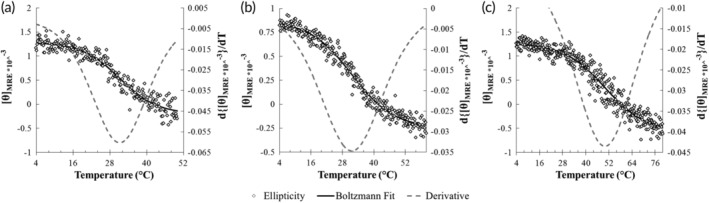
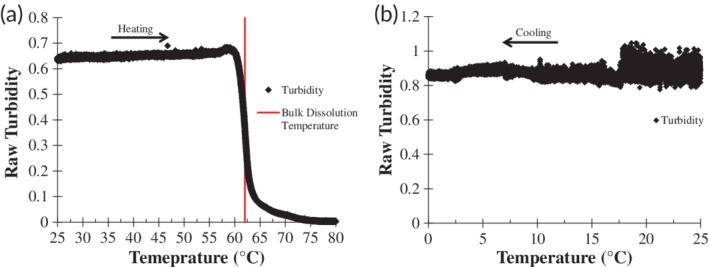
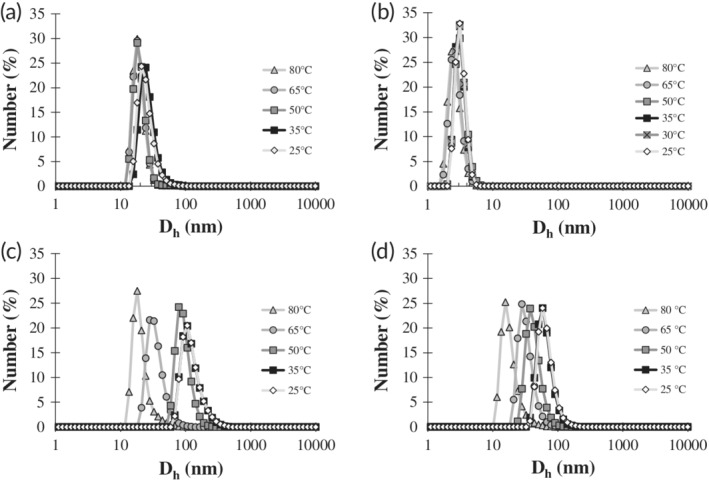
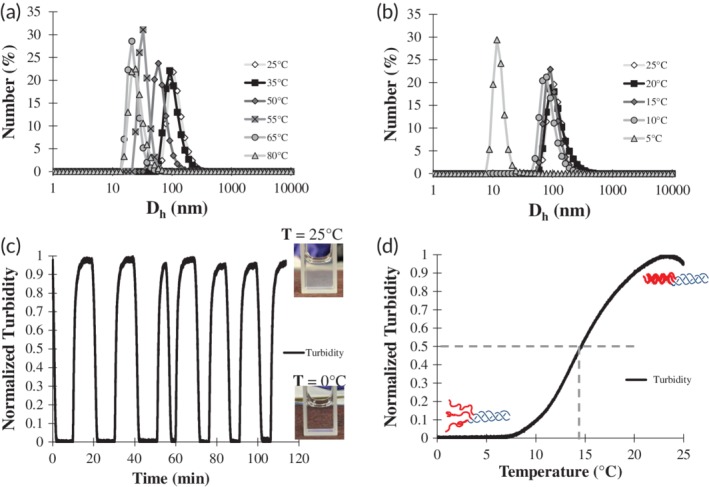
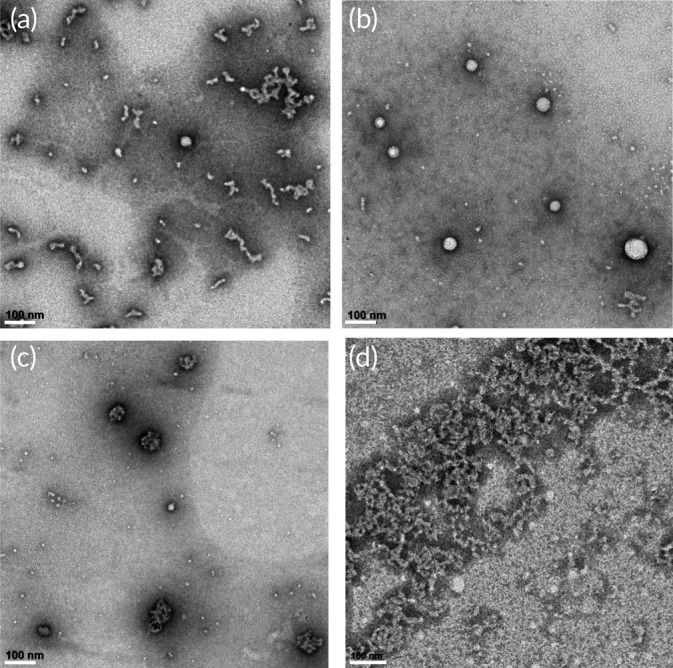
Materials that respond to temporally defined exogenous cues continue to be an active pursuit of research toward on-demand nanoparticle drug delivery applications, and using one or more exogenous temperature stimuli could significantly expand the application of nanoparticle-based drug delivery formulations under both hyperthermal and hypothermal conditions. Previously we have reported the development of a biocompatible and thermoresponsive elastin--collagen-like polypeptide (ELP-CLP) conjugate that is capable of self-assembling into vesicles and encapsulating small molecule therapeutics that can be delivered at different rates via a single temperature stimulus. Herein we report the evaluation of multiple ELP-CLP conjugates, demonstrating that the inverse transition temperature ( ) of the ELP-CLPs can be manipulated by modifying the melting temperature ( ) of the CLP domain, and that the overall hydrophilicity of the ELP-CLP conjugate also may alter the . Based on these design parameters, we demonstrate that the ELP-CLP sequence (VPGFG)-(GPO)GG can self-assemble into stable vesicles at 25°C and dissociate at elevated temperatures by means of the unfolding of the CLP domain above its . We also demonstrate here for the first time the ability of this ELP-CLP vesicle to dissociate via a hypothermic temperature stimulus by means of exploiting the inverse transition temperature ( ) phenomena found in ELPs. The development of design rules for manipulating the thermal properties of these bioconjugates will enable future modifications to either the ELP or CLP sequences to more finely tune the transitions of the conjugates for specific biomedical applications.
能够响应时间定义的外源性线索的材料,仍然是按需纳米颗粒药物递送应用研究的一个活跃领域,并且使用一种或多种外源性温度刺激可以显著扩展基于纳米颗粒的药物递送制剂在高温和低温条件下的应用。此前我们报道了一种生物相容性和热响应性弹性蛋白 - 胶原蛋白样多肽(ELP-CLP)共轭物的开发,它能够自组装成囊泡并包裹小分子治疗剂,这些治疗剂可以通过单一温度刺激以不同速率递送。在此我们报道了对多种ELP-CLP共轭物的评估,表明ELP-CLPs的逆转变温度( )可以通过改变CLP结构域的解链温度( )来调控,并且ELP-CLP共轭物的整体亲水性也可能改变 。基于这些设计参数,我们证明ELP-CLP序列(VPGFG)-(GPO)GG在25°C时可以自组装成稳定的囊泡,并在温度升高时通过CLP结构域在其 以上展开而解离。我们还首次在此证明了这种ELP-CLP囊泡通过利用ELPs中发现的逆转变温度( )现象,能够通过低温刺激而解离。操纵这些生物共轭物热性质的设计规则的开发,将使未来能够对ELP或CLP序列进行修饰,以更精细地调节共轭物的转变,用于特定的生物医学应用。