Department of Neurology, The First Affiliated Hospital of Guangxi Medical University, Nanning, Guangxi, China (mainland).
Department of Rehabilitation, Guangxi International Zhuang Medicine Hospital, Nanning, Guangxi, China (mainland).
Med Sci Monit. 2020 Jan 28;26:e919311. doi: 10.12659/MSM.919311.
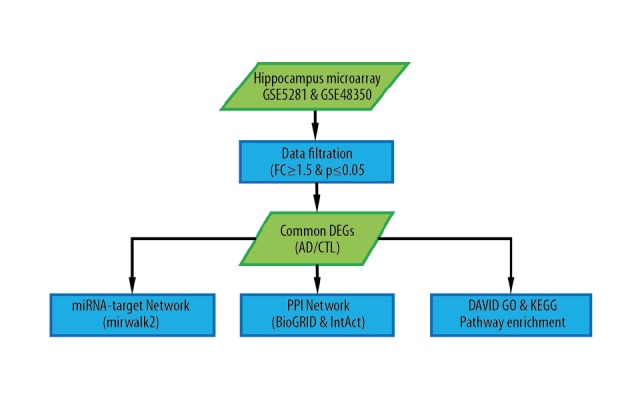
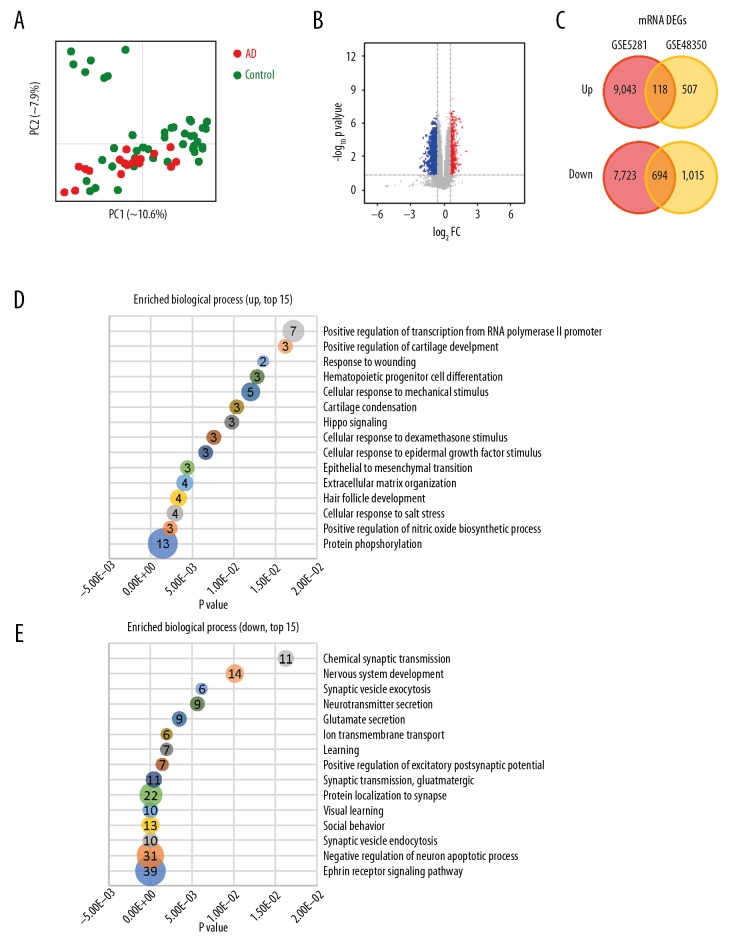
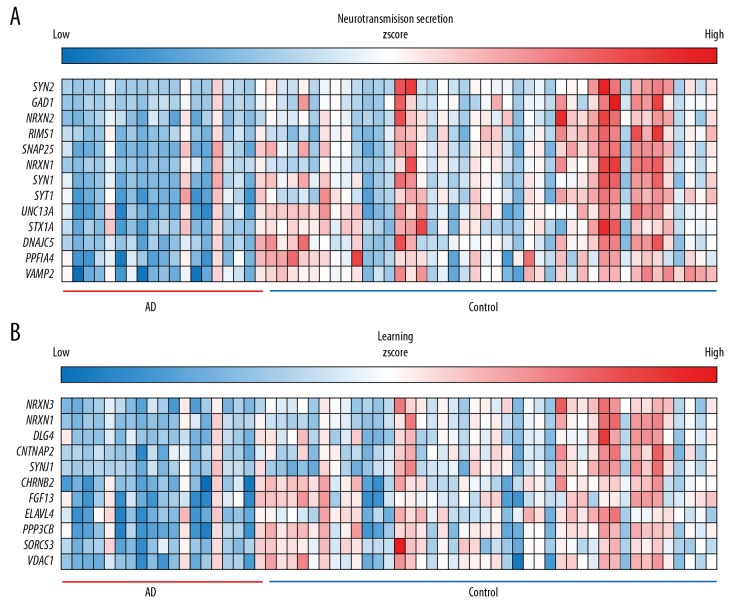
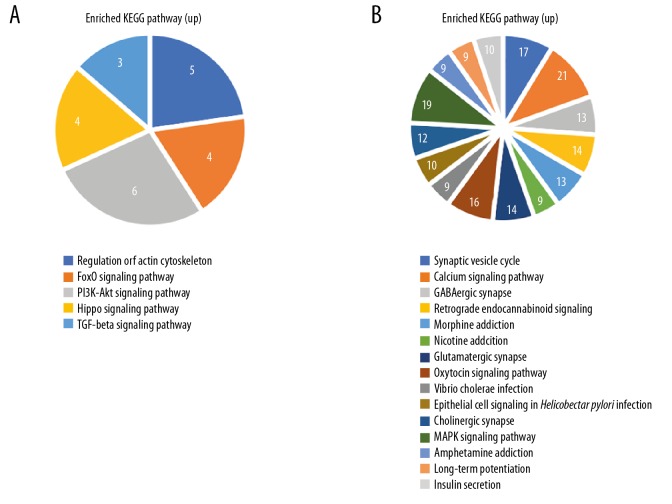
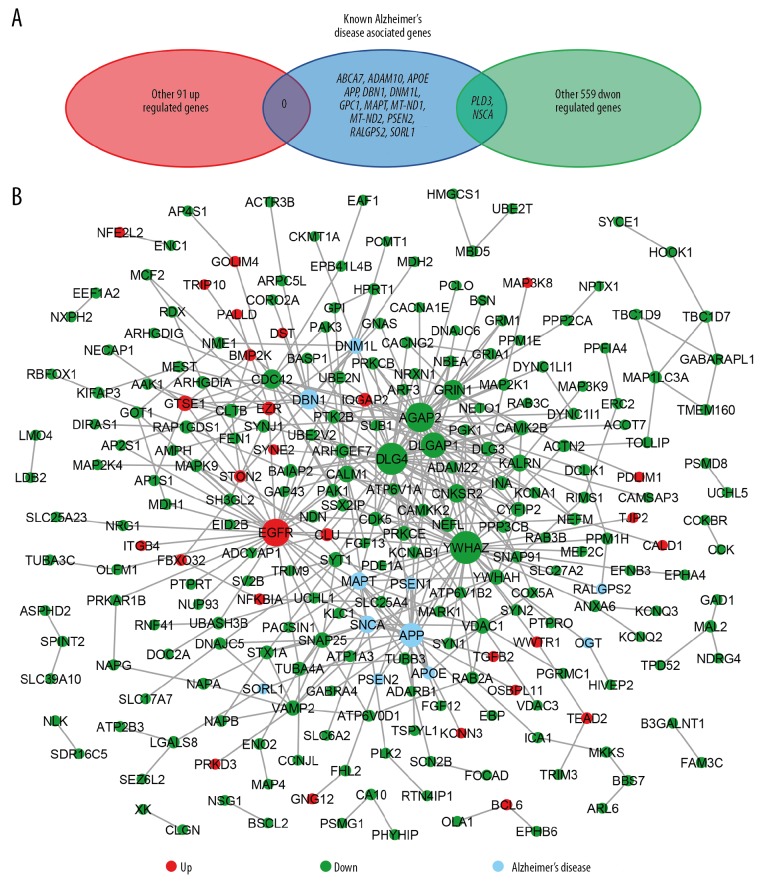
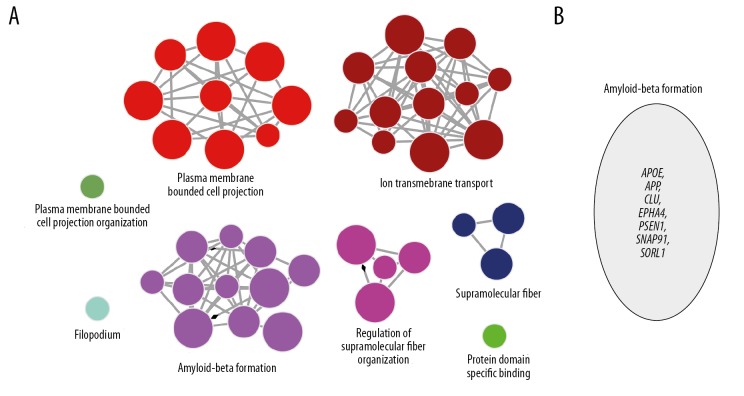
BACKGROUND Alzheimer disease (AD) is a typical progressive and destructive neurodegenerative disease that has been studied extensively. However, genetic features and molecular mechanisms underlying AD remain unclear. Here we used bioinformatics to investigate the candidate nuclear genes involved in the molecular mechanisms of AD. MATERIAL AND METHODS First, we used Gene Expression Omnibus (GEO) database to obtain the expression profiles of the mRNAs from hippocampus microarray and identify differentially expressed genes (DEGs) the plier algorithm. Second, functional annotation and visualization of the DEGs were conducted by the Gene Ontology (GO) and Kyoto Encyclopedia of Genes and Genomes (KEGG) enrichment analysis. Finally, BioGRID, IntAct, STRING, and Cytoscape were utilized to construct a protein-protein interaction (PPI) network. Hub genes were analytically obtained from the PPI network and the microRNA (miRNA)-target network. RESULTS Two hippocampus microarrays (GSE5281 and GSE48350) were obtained from the GEO database, comprising 161 and 253 cases separately. Among these, 118 upregulated genes and 694 downregulated genes were identified. The upregulated DEGs were mainly involved in positive regulation of transcription from RNA polymerase II promoter, positive regulation of cartilage development, and response to wounding. The downregulated DEGs were enriched in chemical synaptic transmission, neurotransmitter secretion, and learning. By combining the results of PPI and miRNA-target network, 8 genes and 2 hub miRNAs were identified, including YWHAZ, DLG4, AGAP2, EGFR, TGFBR3, PSD3, RDX, BRWD1, and hsa-miR-106b-5p and hsa-miR-93-5p. These target genes are highly enriched in various key pathways, such as amyloid-beta formation, regulation of cardiocyte differentiation, and actin cytoskeleton reorganization. CONCLUSIONS In this study, YWHAZ, DLG4, AGAP2, EGFR, TGFBR3, PSD3, RDX, and BRWD1 were identified as candidate genes for future molecular studies in AD, which is expected to improve our understanding of its cause and potential molecular mechanisms. Nuclear genes, DEGs, and related networks identified by integrated bioinformatics analysis may serve as diagnostic and therapeutic targets for AD.
阿尔茨海默病(AD)是一种典型的进行性和破坏性神经退行性疾病,已得到广泛研究。然而,AD 的遗传特征和分子机制仍不清楚。在这里,我们使用生物信息学方法来研究 AD 分子机制中的候选核基因。
首先,我们使用基因表达综合数据库(GEO)获得来自海马体微阵列的 mRNA 表达谱,并使用 plier 算法识别差异表达基因(DEGs)。其次,通过基因本体论(GO)和京都基因与基因组百科全书(KEGG)富集分析对 DEGs 进行功能注释和可视化。最后,使用 BioGRID、IntAct、STRING 和 Cytoscape 构建蛋白质-蛋白质相互作用(PPI)网络。从 PPI 网络和 microRNA(miRNA)-靶网络中分析获得枢纽基因。
从 GEO 数据库中获得了两个海马体微阵列(GSE5281 和 GSE48350),分别包含 161 例和 253 例病例。其中,鉴定出 118 个上调基因和 694 个下调基因。上调的 DEGs 主要参与 RNA 聚合酶 II 启动子的正向转录调控、软骨发育的正向调控和创伤反应。下调的 DEGs 富集于化学突触传递、神经递质分泌和学习。通过结合 PPI 和 miRNA-靶网络的结果,鉴定出 8 个基因和 2 个枢纽 miRNA,包括 YWHAZ、DLG4、AGAP2、EGFR、TGFBR3、PSD3、RDX 和 BRWD1,以及 hsa-miR-106b-5p 和 hsa-miR-93-5p。这些靶基因高度富集于各种关键途径,如淀粉样β形成、心肌细胞分化调控和肌动蛋白细胞骨架重组。
在这项研究中,鉴定出 YWHAZ、DLG4、AGAP2、EGFR、TGFBR3、PSD3、RDX 和 BRWD1 为 AD 未来分子研究的候选基因,有望增进我们对其病因和潜在分子机制的理解。通过整合生物信息学分析鉴定的核基因、DEGs 和相关网络可能成为 AD 的诊断和治疗靶点。