Haemostasis Research Unit, University College London, London, United Kingdom.
Department of Haematology, University College London Hospitals NHS Foundation Trust (UCLH), London, United Kingdom.
Blood Adv. 2020 Jan 28;4(2):398-407. doi: 10.1182/bloodadvances.2019000979.
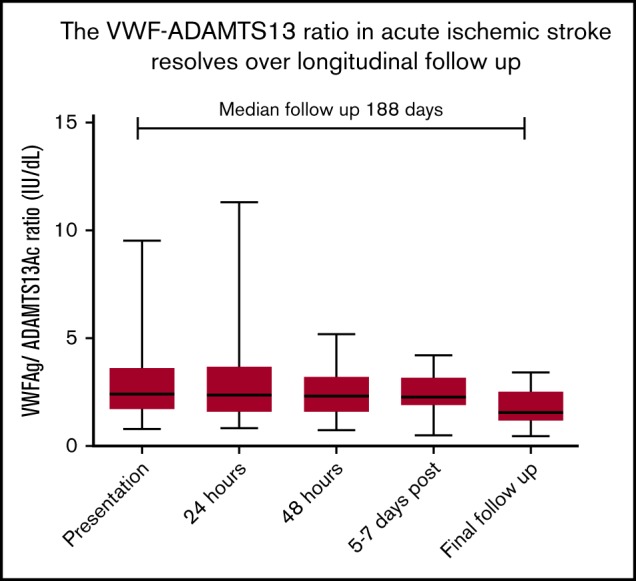
Acute ischemic stroke (IS) and transient ischemic attack (TIA) are associated with raised von Willebrand factor (VWF) and decreased ADAMTS13 activity (ADAMTS13Ac). Their impact on mortality and morbidity is unclear. We conducted a prospective investigation of the VWF-ADAMTS13 axis in 292 adults (acute IS, n = 103; TIA, n = 80; controls, n = 109) serially from presentation until >6 weeks. The National Institutes of Health Stroke Score (NIHSS) and modified Rankin scale (mRS) were used to assess stroke severity. Presenting median VWF antigen (VWF:Ag)/ADAMTS13Ac ratios were: IS, 2.42 (range, 0.78-9.53); TIA, 1.89 (range, 0.41-8.14); and controls, 1.69 (range, 0.25-15.63). Longitudinally, the median VWF:Ag/ADAMTS13Ac ratio decreased (IS, 2.42 to 1.66; P = .0008; TIA, 1.89 to 0.65; P < .0001). The VWF:Ag/ADAMTS13Ac ratio was higher at presentation in IS patients who died (3.683 vs 2.014; P < .0001). A presenting VWF:Ag/ADAMTS13Ac ratio >2.6 predicted mortality (odds ratio, 6.33; range, 2.22-18.1). Those with a VWF:Ag/ADAMTS13Ac ratio in the highest quartile (>3.091) had 31% increased risk mortality. VWF:Ag/ADAMTS13Ac ratio at presentation of ischemic brain injury was associated with higher mRS (P = .021) and NIHSS scores (P = .029) at follow-up. Thrombolysis resulted in prompt reduction of the VWF:Ag/ADAMTS13Ac ratio and significant improvement in mRS on follow-up. A raised VWF:Ag/ADAMTS13Ac ratio at presentation of acute IS or TIA is associated with increased mortality and poorer functional outcome. A ratio of 2.6 seems to differentiate outcome. Prompt reduction in the ratio in thrombolysed patients was associated with decreased mortality and morbidity. The VWF:Ag/ADAMTS13Ac ratio is a biomarker for the acute impact of an ischemic event and longer-term outcome.
急性缺血性脑卒中(IS)和短暂性脑缺血发作(TIA)与血管性血友病因子(VWF)升高和 ADAMTS13 活性降低(ADAMTS13Ac)有关。但其对死亡率和发病率的影响尚不清楚。我们对 292 例成人(急性 IS,n=103;TIA,n=80;对照组,n=109)进行了前瞻性研究,从发病到>6 周进行连续检测 VWF-ADAMTS13 轴。采用国立卫生研究院卒中量表(NIHSS)和改良 Rankin 量表(mRS)评估卒中严重程度。入院时中位 VWF 抗原(VWF:Ag)/ADAMTS13Ac 比值为:IS,2.42(范围,0.78-9.53);TIA,1.89(范围,0.41-8.14);对照组,1.69(范围,0.25-15.63)。纵向来看,VWF:Ag/ADAMTS13Ac 比值下降(IS,2.42 至 1.66;P=0.0008;TIA,1.89 至 0.65;P<0.0001)。IS 患者死亡时入院 VWF:Ag/ADAMTS13Ac 比值较高(3.683 比 2.014;P<0.0001)。入院时 VWF:Ag/ADAMTS13Ac 比值>2.6 预测死亡率(比值比,6.33;范围,2.22-18.1)。VWF:Ag/ADAMTS13Ac 比值处于最高四分位数(>3.091)的患者死亡风险增加 31%。缺血性脑损伤发病时 VWF:Ag/ADAMTS13Ac 比值与随访时 mRS(P=0.021)和 NIHSS 评分(P=0.029)较高有关。溶栓治疗后 VWF:Ag/ADAMTS13Ac 比值迅速降低,mRS 随访时显著改善。急性 IS 或 TIA 发病时 VWF:Ag/ADAMTS13Ac 比值升高与死亡率增加和功能结局较差相关。比值为 2.6 似乎可以区分结局。溶栓治疗患者比值迅速降低与死亡率和发病率降低相关。VWF:Ag/ADAMTS13Ac 比值是缺血性事件急性期和长期预后的生物标志物。