Department of Internal Medicine, Seoul National University Hospital, Seoul, Korea.
Department of Internal Medicine, Seoul National University College of Medicine, Seoul, Korea.
PLoS One. 2020 Jan 28;15(1):e0228361. doi: 10.1371/journal.pone.0228361. eCollection 2020.
Glomerular hyperfiltration may be a clinical phenotype of endothelial dysfunction. Endothelial dysfunction may cause vascular dementia through the deterioration of cerebral blood flow. We aimed to identify the risk of dementia in people with glomerular hyperfiltration.
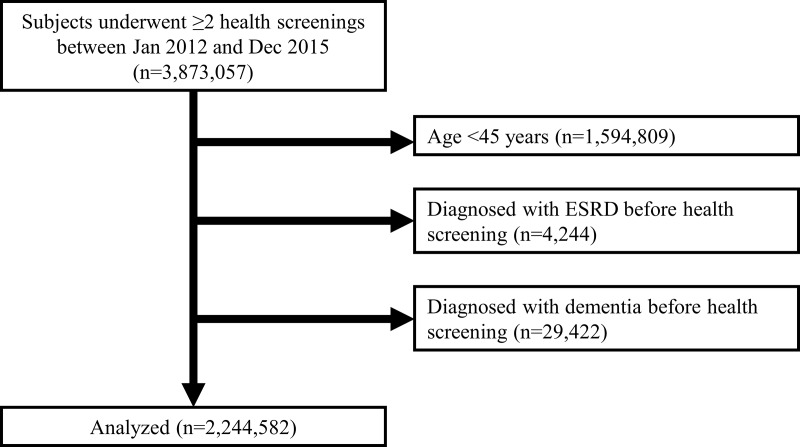
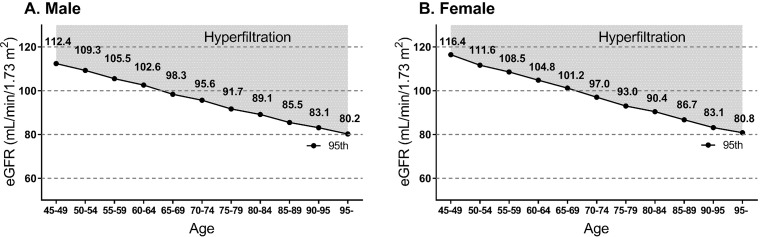
Using the Korean National Health Information Database, we included subjects aged ≥45 years who underwent national health screening examinations between 2012 and 2015 and who had no previous history of end-stage renal disease or dementia (n = 2,244,582). The primary exposure was glomerular hyperfiltration. We divided the subjects into groups by sex and five-year age intervals and categorized each group into 8 intervals according to estimated glomerular filtration (eGFR). The subjects with an eGFR ≥95th percentile in each group were defined as the hyperfiltration group. The outcomes were development of all types of dementia, Alzheimer's dementia and vascular dementia. Multivariable Cox proportional hazards models were used to analyze the hazard ratios (HRs) for outcomes.
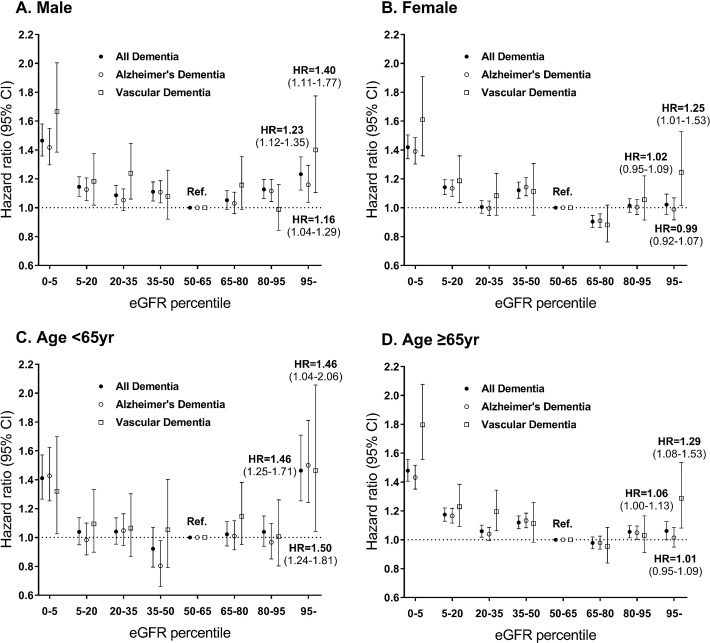
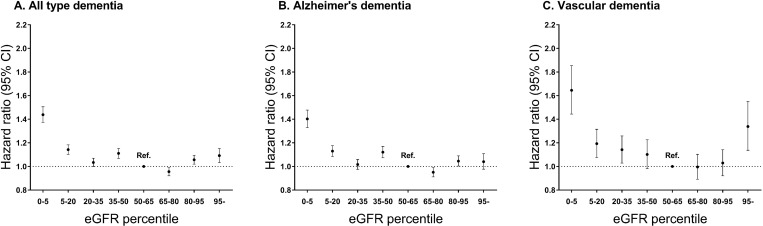
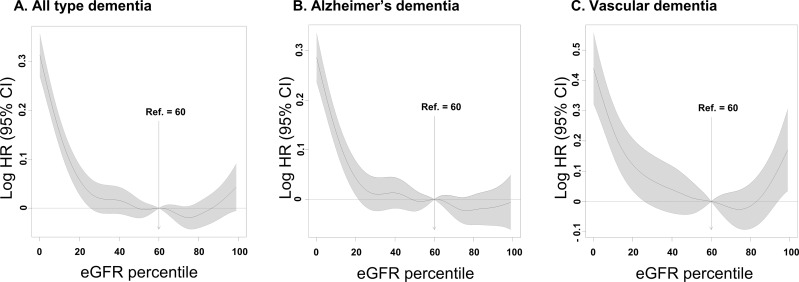
The Hyperfiltration group showed a higher risk for the development of all types of dementia [adjusted HR 1.09 (95% CI, 1.03-1.15)] and vascular dementia [adjusted HR 1.33 (95% CI, 1.14-1.55)] than the reference group. However, the association between hyperfiltration and Alzheimer's dementia was not statistically significant.
Glomerular hyperfiltration may be associated with dementia. In this respect, subjects with glomerular hyperfiltration should be monitored more closely for signs and symptoms of dementia.
肾小球高滤过可能是内皮功能障碍的临床表型。内皮功能障碍可能通过脑血流恶化导致血管性痴呆。我们旨在确定肾小球高滤过人群发生痴呆的风险。
利用韩国国家健康信息数据库,纳入 2012 年至 2015 年期间接受国家健康检查且无终末期肾病或痴呆既往史的年龄≥45 岁的受试者(n=2,244,582)。主要暴露为肾小球高滤过。我们按性别和 5 年年龄间隔将受试者分组,并根据估计肾小球滤过率(eGFR)将每个组分为 8 个间隔。每个组中 eGFR≥第 95 百分位数的受试者被定义为高滤过组。结局为所有类型痴呆、阿尔茨海默病痴呆和血管性痴呆的发生。采用多变量 Cox 比例风险模型分析结局的风险比(HR)。
与参考组相比,高滤过组发生所有类型痴呆[校正 HR 1.09(95%CI,1.03-1.15)]和血管性痴呆[校正 HR 1.33(95%CI,1.14-1.55)]的风险更高。然而,高滤过与阿尔茨海默病痴呆之间的关联无统计学意义。
肾小球高滤过可能与痴呆有关。在这方面,肾小球高滤过的受试者应更密切地监测痴呆的症状和体征。