• 文献检索
  • 文档翻译
  • 深度研究
  • 学术资讯
  • Suppr Zotero 插件Zotero 插件
  • 邀请有礼
  • 套餐&价格
  • 历史记录
应用&插件
Suppr Zotero 插件Zotero 插件浏览器插件Mac 客户端Windows 客户端微信小程序
定价
高级版会员购买积分包购买API积分包
服务
文献检索文档翻译深度研究API 文档MCP 服务
关于我们
关于 Suppr公司介绍联系我们用户协议隐私条款
关注我们

Suppr 超能文献

核心技术专利:CN118964589B侵权必究
粤ICP备2023148730 号-1Suppr @ 2026

文献检索

告别复杂PubMed语法,用中文像聊天一样搜索,搜遍4000万医学文献。AI智能推荐,让科研检索更轻松。

立即免费搜索

文件翻译

保留排版,准确专业,支持PDF/Word/PPT等文件格式,支持 12+语言互译。

免费翻译文档

深度研究

AI帮你快速写综述,25分钟生成高质量综述,智能提取关键信息,辅助科研写作。

立即免费体验

心力衰竭病因与超声心动图重构程度及心脏再同步治疗结局之间的关联

Association between heart failure aetiology and magnitude of echocardiographic remodelling and outcome of cardiac resynchronization therapy.

作者信息

Kloosterman Mariëlle, van Stipdonk Antonius M W, Ter Horst Iris, Rienstra Michiel, Van Gelder Isabelle C, Vos Marc A, Prinzen Frits W, Meine Matthias, Vernooy Kevin, Maass Alexander H

机构信息

Department of Cardiology, University of Groningen, University Medical Centre Groningen, PO Box 30.001, Groningen, 9700, RB, The Netherlands.

Department of Cardiology, Maastricht University Medical Center, Maastricht, the Netherlands.

出版信息

ESC Heart Fail. 2020 Apr;7(2):645-653. doi: 10.1002/ehf2.12624. Epub 2020 Jan 28.

DOI:10.1002/ehf2.12624
PMID:31991067
原文链接:https://pmc.ncbi.nlm.nih.gov/articles/PMC7160473/
Abstract

AIMS

Echocardiographic response after cardiac resynchronization therapy (CRT) is often lesser in ischaemic cardiomyopathy (ICM) than non-ischaemic dilated cardiomyopathy (NIDCM) patients. We assessed the association of heart failure aetiology on the amount of reverse remodelling and outcome of CRT.

METHODS AND RESULTS

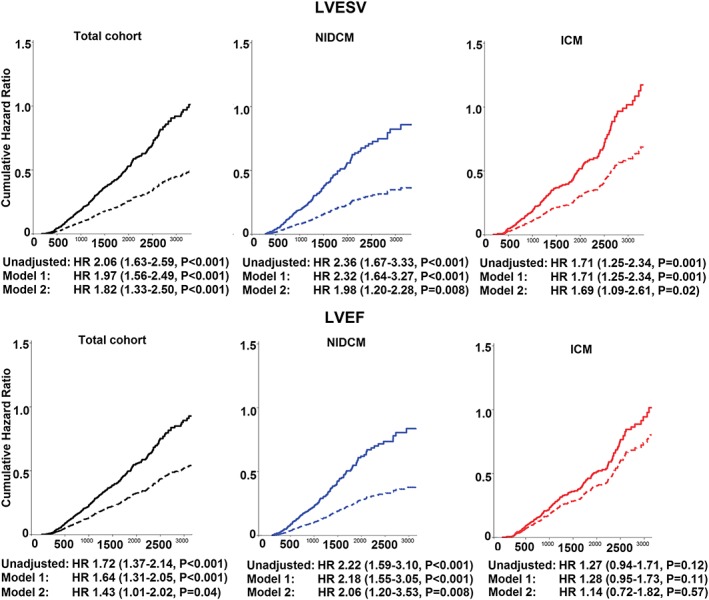
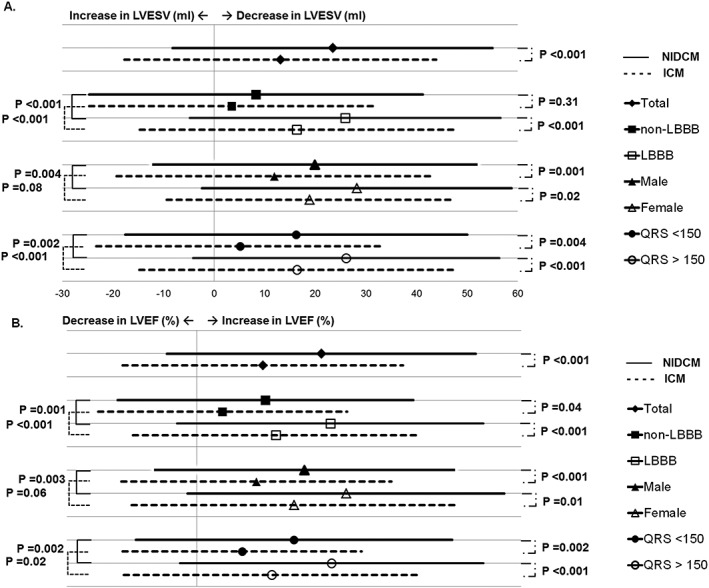
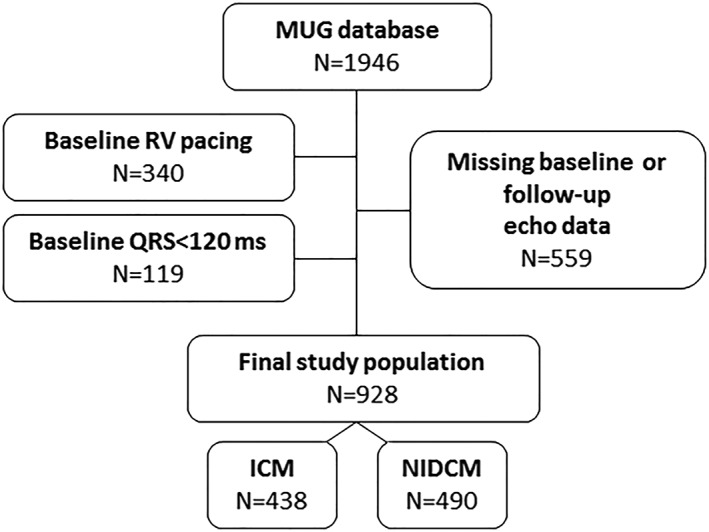
Nine hundred twenty-eight CRT patients were retrospectively included. Reverse remodelling and endpoint occurrence (all-cause mortality, heart transplantation, or left ventricular assist device implantation) was assessed. Two response definitions [≥15% reduction left ventricular end systolic volume (LVESV) and ≥5% improvement left ventricular ejection fraction] and the most accurate cut-off for the amount of reverse remodelling that predicted endpoint freedom were assessed. Mean follow-up was 3.8 ± 2.4 years. ICM was present in 47%. ICM patients who were older (69 ± 7 vs. 63 ± 11), more often men (83% vs. 58%), exhibited less LVESV reduction (13 ± 31% vs. 23 ± 32%) and less left ventricular ejection fraction improvement (5 ± 11% vs. 10 ± 12%) than NIDCM patients (all P < 0.001). Nevertheless, every 1% LVESV reduction was associated with a relative reduction in endpoint occurrence: NIDCM 1.3%, ICM 0.9%, and absolute risk reduction was similar (0.4%). The most accurate cut-off of LVESV reduction that predicted endpoint freedom was 17.1% in NIDCM and 13.2% in ICM.

CONCLUSIONS

ICM patients achieve less reverse remodelling than NIDCM, but the prognostic gain in terms of survival time is the same for every single percentage of reverse remodelling that does occur. The assessment and expected magnitude of reverse remodelling should take this effect of heart failure aetiology into account.

摘要

目的

心脏再同步治疗(CRT)后,缺血性心肌病(ICM)患者的超声心动图反应通常比非缺血性扩张型心肌病(NIDCM)患者小。我们评估了心力衰竭病因与逆向重构程度及CRT结局之间的关联。

方法与结果

回顾性纳入928例CRT患者。评估逆向重构和终点事件的发生情况(全因死亡率、心脏移植或左心室辅助装置植入)。评估了两种反应定义[左心室收缩末期容积(LVESV)降低≥15%和左心室射血分数提高≥5%]以及预测终点事件未发生的逆向重构程度的最准确截断值。平均随访时间为3.8±2.4年。47%的患者为ICM。与NIDCM患者相比,ICM患者年龄更大(69±7岁对63±11岁),男性比例更高(83%对58%),LVESV降低幅度更小(13±31%对23±32%),左心室射血分数提高幅度更小(5±11%对10±12%)(所有P<0.001)。然而,LVESV每降低1%,终点事件发生的相对风险就会降低:NIDCM为1.3%,ICM为0.9%,绝对风险降低相似(0.4%)。预测终点事件未发生的LVESV降低的最准确截断值在NIDCM中为17.1%,在ICM中为13.2%。

结论

ICM患者的逆向重构程度低于NIDCM,但就生存时间而言,每发生1%的逆向重构,其预后获益是相同的。在评估逆向重构及其预期程度时,应考虑心力衰竭病因的这种影响。
https://cdn.ncbi.nlm.nih.gov/pmc/blobs/fb55/7160473/ed0fbee21999/EHF2-7-645-g003.jpg
https://cdn.ncbi.nlm.nih.gov/pmc/blobs/fb55/7160473/1fdb6b8e23d8/EHF2-7-645-g001.jpg
https://cdn.ncbi.nlm.nih.gov/pmc/blobs/fb55/7160473/6ee76e4cdc17/EHF2-7-645-g002.jpg
https://cdn.ncbi.nlm.nih.gov/pmc/blobs/fb55/7160473/ed0fbee21999/EHF2-7-645-g003.jpg
https://cdn.ncbi.nlm.nih.gov/pmc/blobs/fb55/7160473/1fdb6b8e23d8/EHF2-7-645-g001.jpg
https://cdn.ncbi.nlm.nih.gov/pmc/blobs/fb55/7160473/6ee76e4cdc17/EHF2-7-645-g002.jpg
https://cdn.ncbi.nlm.nih.gov/pmc/blobs/fb55/7160473/ed0fbee21999/EHF2-7-645-g003.jpg

相似文献

1
Association between heart failure aetiology and magnitude of echocardiographic remodelling and outcome of cardiac resynchronization therapy.心力衰竭病因与超声心动图重构程度及心脏再同步治疗结局之间的关联
ESC Heart Fail. 2020 Apr;7(2):645-653. doi: 10.1002/ehf2.12624. Epub 2020 Jan 28.
2
Profound differences in prognostic impact of left ventricular reverse remodeling after cardiac resynchronization therapy relate to heart failure etiology.心脏再同步治疗后左心室逆重构对预后的影响存在显著差异,与心力衰竭的病因有关。
Heart Rhythm. 2018 Jan;15(1):130-136. doi: 10.1016/j.hrthm.2017.08.021. Epub 2017 Aug 24.
3
Impact of Left Ventricular vs Biventricular Pacing on Reverse Remodelling: Insights From the Evaluation of Resynchronization Therapy for Heart Failure (EARTH) Trial.左心室与双心室起搏对逆向重构影响的比较:心力衰竭再同步治疗评估研究(EARTH 试验)的相关见解。
Can J Cardiol. 2017 Oct;33(10):1274-1282. doi: 10.1016/j.cjca.2017.07.478. Epub 2017 Jul 31.
4
Impact of QRS complex duration and morphology on left ventricular reverse remodelling and left ventricular function improvement after cardiac resynchronization therapy.QRS 波群持续时间和形态对心脏再同步治疗后左心室逆向重构和左心室功能改善的影响。
Eur J Heart Fail. 2017 Sep;19(9):1145-1151. doi: 10.1002/ejhf.769. Epub 2017 Feb 8.
5
Response to preventive cardiac resynchronization therapy in patients with ischaemic and nonischaemic cardiomyopathy in MADIT-CRT.缺血性和非缺血性心肌病患者接受心脏再同步化治疗预防的反应:MADIT-CRT 研究。
Eur Heart J. 2011 Jul;32(13):1622-30. doi: 10.1093/eurheartj/ehq407. Epub 2010 Nov 12.
6
The effect of iron deficiency on cardiac resynchronization therapy: results from the RIDE-CRT Study.缺铁对心脏再同步治疗的影响:RIDE-CRT研究结果
ESC Heart Fail. 2020 Jun;7(3):1072-1084. doi: 10.1002/ehf2.12675. Epub 2020 Mar 18.
7
Differential effect of cardiac resynchronization therapy in patients with diabetes mellitus: a long-term retrospective cohort study.心脏再同步治疗对糖尿病患者的差异效应:一项长期回顾性队列研究。
ESC Heart Fail. 2020 Oct;7(5):2773-2783. doi: 10.1002/ehf2.12876. Epub 2020 Jul 11.
8
Left ventricular remodelling and change in left ventricular global longitudinal strain after cardiac resynchronization therapy: prognostic implications.左心室重构和心脏再同步治疗后左心室整体纵向应变的变化:预后意义。
Eur Heart J Cardiovasc Imaging. 2019 Oct 1;20(10):1112-1119. doi: 10.1093/ehjci/jez072.
9
"Real world" experience in Cardiac Resynchronization Therapy at a Swiss Tertiary Care Center.瑞士一家三级护理中心心脏再同步治疗的“真实世界”经验。
Swiss Med Wkly. 2017 Apr 18;147:w14425. doi: 10.4414/smw.2017.14425. eCollection 2017.
10
Adrenergic receptor gene polymorphism and left ventricular reverse remodelling after cardiac resynchronization therapy: preliminary results.肾上腺素能受体基因多态性与心脏再同步化治疗后左心室逆向重构:初步结果。
Europace. 2013 Oct;15(10):1475-81. doi: 10.1093/europace/eut136. Epub 2013 May 31.

引用本文的文献

1
Special Issue: Latest Advances in Delivery and Outcomes of Cardiac Resynchronization Therapy and Conduction System Pacing.特刊:心脏再同步治疗与传导系统起搏的递送及结果的最新进展
J Clin Med. 2023 May 14;12(10):3453. doi: 10.3390/jcm12103453.
2
Better outcome at lower costs after implementing a CRT-care pathway: comprehensive evaluation of real-world data.实施 CRT 护理路径后成本更低、效果更好:真实世界数据的综合评估。
ESC Heart Fail. 2022 Aug;9(4):2518-2527. doi: 10.1002/ehf2.13958. Epub 2022 May 31.
3
Delayed Improvement of Left Ventricular Function in Newly Diagnosed Heart Failure Depends on Etiology-A PROLONG-II Substudy.

本文引用的文献

1
QRS Area Is a Strong Determinant of Outcome in Cardiac Resynchronization Therapy.QRS 面积是心脏再同步治疗结局的重要决定因素。
Circ Arrhythm Electrophysiol. 2018 Dec;11(12):e006497. doi: 10.1161/CIRCEP.118.006497.
2
Profound differences in prognostic impact of left ventricular reverse remodeling after cardiac resynchronization therapy relate to heart failure etiology.心脏再同步治疗后左心室逆重构对预后的影响存在显著差异,与心力衰竭的病因有关。
Heart Rhythm. 2018 Jan;15(1):130-136. doi: 10.1016/j.hrthm.2017.08.021. Epub 2017 Aug 24.
3
Refining success of cardiac resynchronization therapy using a simple score predicting the amount of reverse ventricular remodelling: results from the Markers and Response to CRT (MARC) study.
新发心力衰竭患者左心室功能的延迟改善取决于病因——PROLONG-II 亚研究。
Sensors (Basel). 2022 Mar 5;22(5):2037. doi: 10.3390/s22052037.
4
Identifying CRT responders: Moving from electrical to mechanical dyssynchrony.识别心脏再同步治疗反应者:从电失同步转向机械失同步。
J Nucl Cardiol. 2022 Oct;29(5):2649-2651. doi: 10.1007/s12350-022-02914-9. Epub 2022 Feb 9.
5
Sex differences in prognosis of significant secondary mitral regurgitation.重度二尖瓣反流患者预后的性别差异。
ESC Heart Fail. 2021 Oct;8(5):3539-3546. doi: 10.1002/ehf2.13503. Epub 2021 Aug 6.
6
CMR-Based Risk Stratification of Sudden Cardiac Death and Use of Implantable Cardioverter-Defibrillator in Non-Ischemic Cardiomyopathy.基于 CMR 的非缺血性心肌病患者心源性猝死风险分层与植入式心脏复律除颤器的应用。
Int J Mol Sci. 2021 Jul 1;22(13):7115. doi: 10.3390/ijms22137115.
7
Reverse Remodeling in Human Heart Failure after Cardiac Resynchronization Therapy Is Associated With Reduced RHO-Kinase Activation.心脏再同步治疗后人类心力衰竭的逆向重构与RHO激酶激活减少有关。
Front Pharmacol. 2021 Apr 23;12:565724. doi: 10.3389/fphar.2021.565724. eCollection 2021.
8
Cardiac Resynchronization Therapy in Non-Ischemic Cardiomyopathy: Role of Multimodality Imaging.非缺血性心肌病中的心脏再同步治疗:多模态成像的作用
Diagnostics (Basel). 2021 Mar 30;11(4):625. doi: 10.3390/diagnostics11040625.
9
What Are the Expectations for Cardiac Resynchronization Therapy? A Validation of Two Response Definitions.心脏再同步治疗的期望是什么?两种反应定义的验证。
J Clin Med. 2021 Feb 1;10(3):514. doi: 10.3390/jcm10030514.
利用简单的评分预测逆室重构程度来优化心脏再同步治疗的效果:来自标志物和心脏再同步治疗反应(MARC)研究的结果。
Europace. 2018 Feb 1;20(2):e1-e10. doi: 10.1093/europace/euw445.
4
2016 ESC Guidelines for the diagnosis and treatment of acute and chronic heart failure: The Task Force for the diagnosis and treatment of acute and chronic heart failure of the European Society of Cardiology (ESC)Developed with the special contribution of the Heart Failure Association (HFA) of the ESC.2016欧洲心脏病学会急性和慢性心力衰竭诊断与治疗指南:欧洲心脏病学会(ESC)急性和慢性心力衰竭诊断与治疗工作组编写,欧洲心脏病学会心力衰竭协会(HFA)提供特别贡献。
Eur Heart J. 2016 Jul 14;37(27):2129-2200. doi: 10.1093/eurheartj/ehw128. Epub 2016 May 20.
5
Superresponse to cardiac resynchronization therapy.心脏再同步治疗的超反应
Circulation. 2014 Jul 1;130(1):87-90. doi: 10.1161/CIRCULATIONAHA.113.006124.
6
2013 ESC guidelines on cardiac pacing and cardiac resynchronization therapy: the task force on cardiac pacing and resynchronization therapy of the European Society of Cardiology (ESC). Developed in collaboration with the European Heart Rhythm Association (EHRA).2013年欧洲心脏病学会(ESC)心脏起搏与心脏再同步治疗指南:欧洲心脏病学会(ESC)心脏起搏与心脏再同步治疗特别工作组。与欧洲心律协会(EHRA)合作制定。
Europace. 2013 Aug;15(8):1070-118. doi: 10.1093/europace/eut206. Epub 2013 Jun 24.
7
Cardiac resynchronization therapy (CRT): clinical trials, guidelines, and target populations.心脏再同步治疗(CRT):临床试验、指南和目标人群。
Heart Rhythm. 2012 Aug;9(8 Suppl):S3-S13. doi: 10.1016/j.hrthm.2012.04.026. Epub 2012 Apr 20.
8
Response to preventive cardiac resynchronization therapy in patients with ischaemic and nonischaemic cardiomyopathy in MADIT-CRT.缺血性和非缺血性心肌病患者接受心脏再同步化治疗预防的反应:MADIT-CRT 研究。
Eur Heart J. 2011 Jul;32(13):1622-30. doi: 10.1093/eurheartj/ehq407. Epub 2010 Nov 12.
9
Cardiac-resynchronization therapy for mild-to-moderate heart failure.心脏再同步治疗轻中度心力衰竭。
N Engl J Med. 2010 Dec 16;363(25):2385-95. doi: 10.1056/NEJMoa1009540. Epub 2010 Nov 14.
10
Differential outcome of cardiac resynchronization therapy in ischemic cardiomyopathy and idiopathic dilated cardiomyopathy.缺血性心肌病和特发性扩张型心肌病中心脏再同步治疗的不同结果。
Heart Rhythm. 2011 Mar;8(3):377-82. doi: 10.1016/j.hrthm.2010.11.013. Epub 2010 Nov 9.