Department of Cellular and Physiological Sciences, University of British Columbia, 3307 - 2350 Health Sciences Mall, Vancouver, BC, V6T 1Z3, Canada.
Department of Pediatrics, University of California San Diego, La Jolla, USA.
J Neuroinflammation. 2020 Jan 28;17(1):39. doi: 10.1186/s12974-020-1717-8.
Evidence suggests that cytokine imbalances may be at the root of deficits that occur in numerous neurodevelopmental disorders, including schizophrenia and autism spectrum disorder. Notably, while clinical studies have demonstrated maternal cytokine imbalances with alcohol consumption during pregnancy-and data from animal models have identified immune disturbances in alcohol-exposed offspring-to date, immune alterations in alcohol-exposed children have not been explored. Thus, here we hypothesized that perturbations in the immune environment as a result of prenatal alcohol exposure will program the developing immune system, and result in immune dysfunction into childhood. Due to the important role of cytokines in brain development/function, we further hypothesized that child immune profiles might be associated with their neurodevelopmental status.
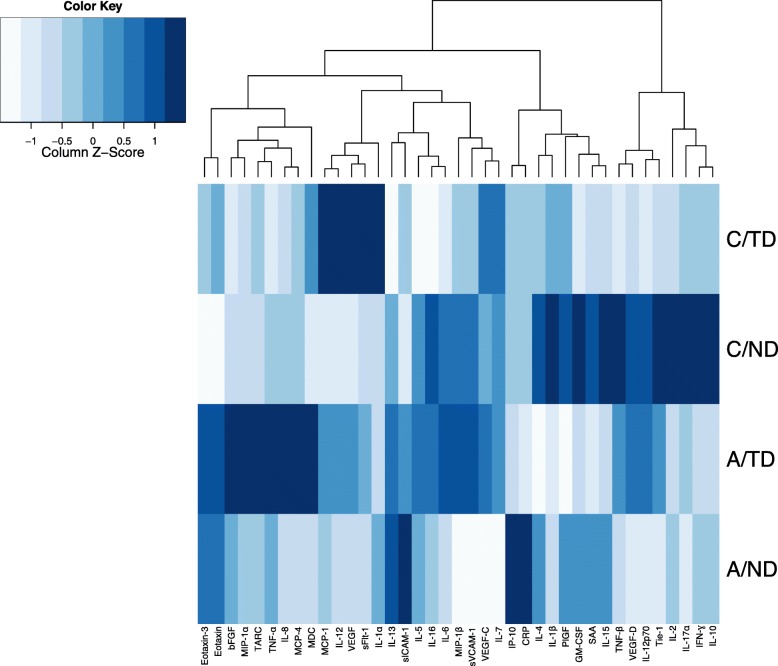
As part of a longitudinal study in Ukraine, children of mothers reporting low/no alcohol consumption or moderate-to-heavy alcohol consumption during pregnancy were enrolled in the study and received neurodevelopmental assessments. Group stratification was based on maternal alcohol consumption and child neurodevelopmental status resulting in the following groups: A/TD, alcohol-consuming mother, typically developing child; A/ND, alcohol-consuming mother, neurodevelopmental delay in the child; C/TD, control mother (low/no alcohol consumption), typically development child; and C/ND, control mother, neurodevelopmental delay in the child. Forty cytokines/chemokines were measured in plasma and data were analyzed using regression and constrained principle component analysis.
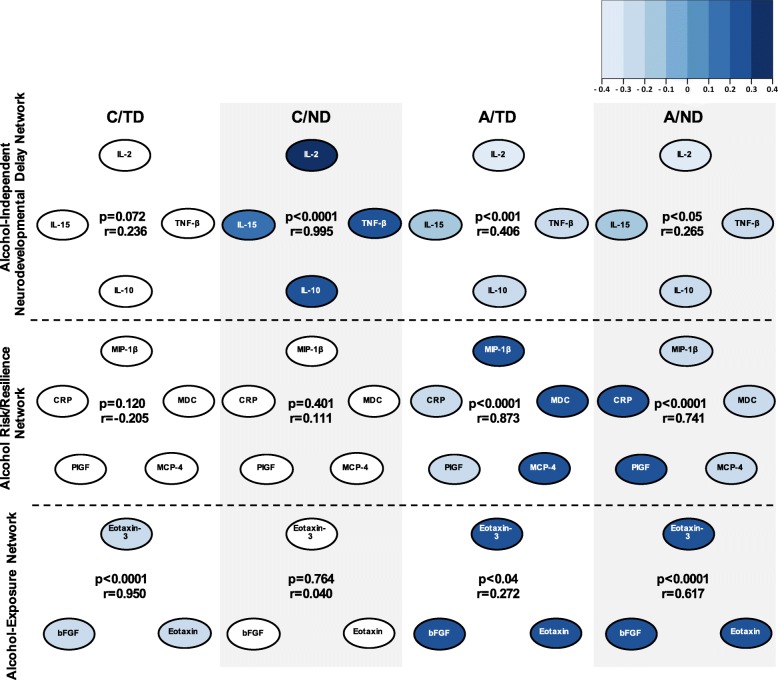
Analyses revealed differential cytokine network activity associated with both prenatal alcohol exposure and neurodevelopmental status. Specifically, alcohol-exposed children showed activation of a cytokine network including eotaxin-3, eotaxin, and bFGF, irrespective of neurodevelopmental status. However, another cytokine network was differentially activated based on neurodevelopmental outcome: A/TD showed activation of MIP-1β, MDC, and MCP-4, and inhibition of CRP and PlGF, with opposing pattern of activation/inhibition detected in the A/ND group. By contrast, in the absence of alcohol-exposure, activation of a network including IL-2, TNF-β, IL-10, and IL-15 was associated with neurodevelopmental delay.
Taken together, this comprehensive assessment of immune markers allowed for the identification of unique immune milieus that are associated with alcohol exposure as well as both alcohol-related and alcohol-independent neurodevelopmental delay. These findings are a critical step towards establishing unique immune biomarkers for alcohol-related and alcohol-independent neurodevelopmental delay.
有证据表明,细胞因子失衡可能是包括精神分裂症和自闭症谱系障碍在内的多种神经发育障碍的根源。值得注意的是,虽然临床研究已经证明了母亲在怀孕期间因饮酒而导致细胞因子失衡,并且动物模型的数据已经确定了酒精暴露后代的免疫紊乱,但迄今为止,尚未探讨酒精暴露儿童的免疫改变。因此,在这里我们假设,由于产前酒精暴露而导致的免疫环境的改变将编程发育中的免疫系统,并导致儿童时期的免疫功能障碍。由于细胞因子在大脑发育/功能中的重要作用,我们进一步假设儿童的免疫特征可能与其神经发育状况相关。
作为乌克兰一项纵向研究的一部分,招募了报告母亲在怀孕期间低/无饮酒或中度至重度饮酒的儿童,并对其进行了神经发育评估。分组基于母亲的饮酒情况和儿童的神经发育状况,结果分为以下几组:A/TD,饮酒母亲,儿童发育正常;A/ND,饮酒母亲,儿童神经发育迟缓;C/TD,控制母亲(低/无饮酒),儿童发育正常;C/ND,控制母亲,儿童神经发育迟缓。在血浆中测量了 40 种细胞因子/趋化因子,并使用回归和约束主成分分析对数据进行了分析。
分析显示,与产前酒精暴露和神经发育状况相关的细胞因子网络活性存在差异。具体而言,无论神经发育状况如何,酒精暴露的儿童都表现出包括嗜酸性粒细胞趋化因子-3、嗜酸性粒细胞趋化因子和碱性成纤维细胞生长因子在内的细胞因子网络的激活。然而,根据神经发育结果,另一个细胞因子网络被不同地激活:A/TD 显示 MIP-1β、MDC 和 MCP-4 的激活,以及 CRP 和 PlGF 的抑制,而 A/ND 组则检测到相反的激活/抑制模式。相比之下,在没有酒精暴露的情况下,包括白细胞介素-2、肿瘤坏死因子-β、白细胞介素-10 和白细胞介素-15 在内的网络的激活与神经发育迟缓有关。
综上所述,这项对免疫标志物的综合评估使我们能够识别与酒精暴露以及与酒精相关和与酒精无关的神经发育迟缓相关的独特免疫环境。这些发现是确定与酒精相关和与酒精无关的神经发育迟缓的独特免疫生物标志物的重要一步。