Department of Biosciences, University Salzburg, 5020, Salzburg, Austria.
Evolutionary Ecology of Plants, Faculty of Biology, Philipps-University Marburg, 35043, Marburg, Germany.
Sci Rep. 2020 Jan 28;10(1):1366. doi: 10.1038/s41598-020-58388-7.
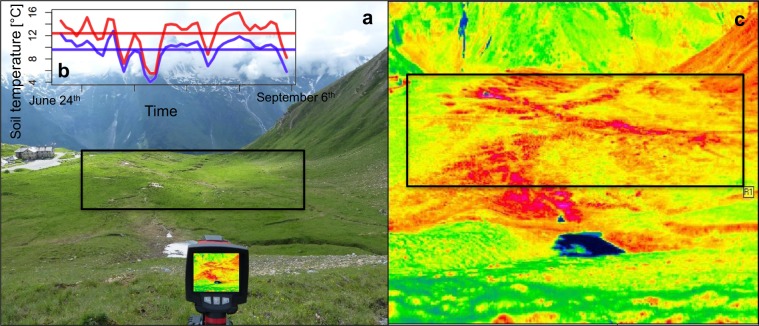
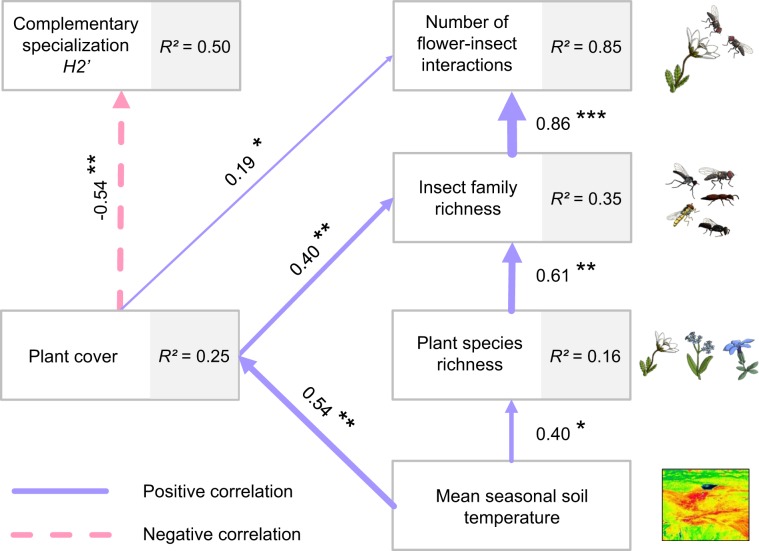
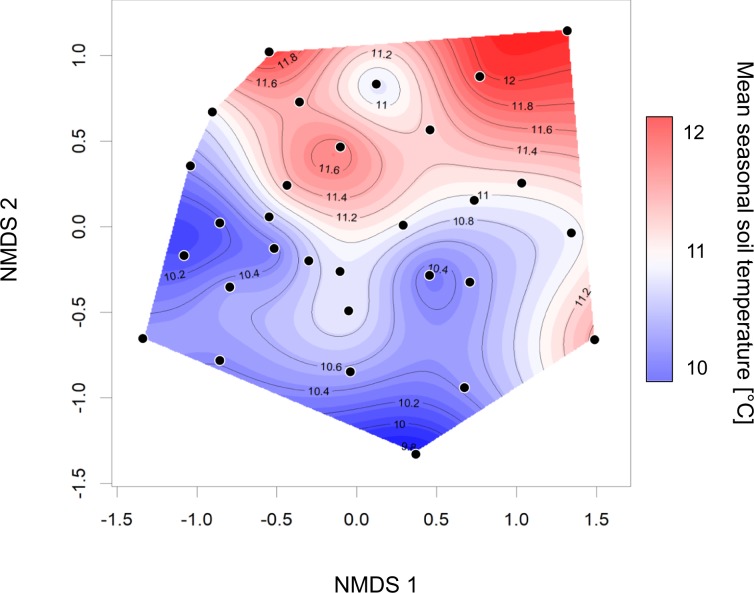
High-alpine ecosystems are commonly assumed to be particularly endangered by climate warming. Recent research, however, suggests that the heterogeneous topography of alpine landscapes provide microclimatic niches for alpine plants (i.e. soil temperatures that support the establishment and reproduction of species). Whether the microclimatic heterogeneity also affects diversity or species interactions on higher trophic levels remains unknown. Here we show that variation in mean seasonal soil temperature within an alpine pasture is within the same range as in plots differing in nearly 500 m in elevation. This pronounced heterogeneity of soil temperature among plots affected the spatial distribution of flowering plant species in our study area with a higher plant richness and cover in warmer plots. This increased plant productivity in warmer plots positively affected richness of flower visitor taxa as well as interaction frequency. Additionally, flower-visitor networks were more generalized in plots with higher plant cover. These results suggest that soil temperature directly affects plant diversity and productivity and indirectly affects network stability. The strong effect of heterogeneous soil temperature on plant communities and their interaction partners may also mitigate climate warming impacts by enabling plants to track their suitable temperature niches within a confined area.
高山生态系统通常被认为特别容易受到气候变暖的影响。然而,最近的研究表明,高山景观的异质地形为高山植物提供了微气候小生境(即支持物种建立和繁殖的土壤温度)。微气候异质性是否也会影响更高营养级别的多样性或种间相互作用尚不清楚。在这里,我们表明,高山草甸内平均季节性土壤温度的变化范围与海拔相差近 500 米的样地内的温度变化范围相同。这种土壤温度在样地之间的显著差异影响了我们研究区域内开花植物物种的空间分布,较温暖的样地具有更高的植物丰富度和盖度。较温暖样地中植物生产力的增加,对传粉者类群的丰富度以及相互作用频率均产生了积极影响。此外,在植物盖度较高的样地中,花访客网络更为多样化。这些结果表明,土壤温度直接影响植物多样性和生产力,并间接影响网络稳定性。不均匀的土壤温度对植物群落及其相互作用伙伴的强烈影响,也可能通过使植物在有限的区域内追踪其适宜的温度小生境,从而减轻气候变暖的影响。