Legenbauer Tanja, Müller Astrid, de Zwaan Martina, Herpertz Stephan
Department for Child and Adolescent Psychiatry, Psychosomatic and Psychotherapy, LWL University Hospital of the Ruhr-University Bochum, Hamm, Germany.
Department of Psychosomatic Medicine and Psychotherapy, Hannover Medical School, Hannover, Germany.
Front Psychiatry. 2020 Jan 14;10:945. doi: 10.3389/fpsyt.2019.00945. eCollection 2019.
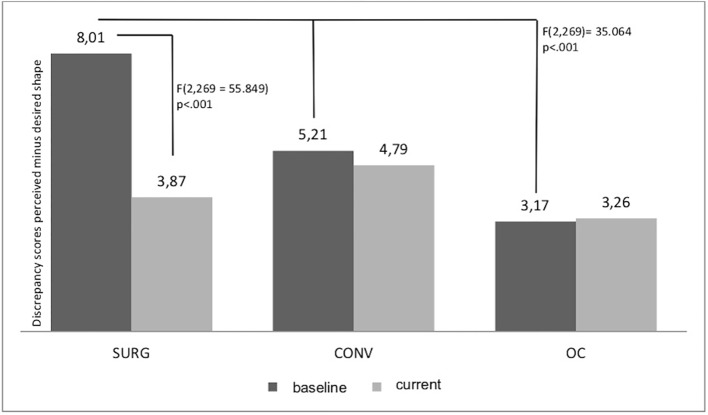
Recently, there has been an increasing focus on body image dissatisfaction (BID), both as a motivational factor for seeking bariatric surgery and as a factor influencing weight loss outcome after surgery. Although associations have been reported between BID, emotional distress and successful weight loss, conclusions are limited due to methodological issues such as non-weight-specific assessment tools for body image and neglect of behavioral components (e.g. body avoidance, BA). The present study seeks to report on BID and BA 9 years after bariatric surgery using a cross-sectional data set from the 9-year follow-up assessment of the Essen-Bochum Obesity Treatment Study (EBOTS). In total, N = 291 participants of the original EBOTS sample were included in the present analyses (N = 78 bariatric surgery patients, SURG; N = 124 patients of a conventional treatment program, CONV; and N = 83 individuals with obesity not seeking treatment, OC). Current body image facets (BID and BA) were captured at the 9-year follow-up assessment silhouette scales adapted for use in samples with obesity. Moreover, BID was assessed retrospectively to obtain baseline attitudes. Possible influences of eating disorder symptoms and depression/anxiety were controlled for and assessed standardized self-report measures. The results imply an improvement in BID in the SURG group, but not in the CONV and OC groups. The level of BA in relation to clothing was significantly higher in the CONV group compared to both the SURG and OC group. Current BID as well as BA were positively associated with current body weight as well as depression, anxiety, and levels of disinhibited eating. A positive change from baseline to current levels of BID was associated with successful weight loss, independently of treatment. The findings emphasize the role of the different components of body image after surgery for mental health features, and suggest a robust relationship between BID and weight loss (success). Thus, it might be helpful to address BID in treatment. However, further research, particularly in the form of prospective studies, is necessary to determine the direction of influence.
最近,人们越来越关注身体形象不满(BID),它既是寻求减肥手术的一个动机因素,也是影响术后体重减轻结果的一个因素。尽管已有报道称BID、情绪困扰与成功减肥之间存在关联,但由于方法学问题,如身体形象的非体重特异性评估工具以及对行为成分(如身体回避,BA)的忽视,结论有限。本研究旨在利用埃森-波鸿肥胖治疗研究(EBOTS)9年随访评估的横断面数据集,报告减肥手术后9年的BID和BA情况。本分析总共纳入了原始EBOTS样本中的291名参与者(N = 78名减肥手术患者,SURG;N = 124名接受传统治疗方案的患者,CONV;以及N = 83名未寻求治疗的肥胖个体,OC)。在9年随访评估中,使用适用于肥胖样本的轮廓量表来获取当前的身体形象方面(BID和BA)。此外,通过回顾性评估BID以获得基线态度。使用标准化的自我报告测量方法对饮食失调症状和抑郁/焦虑的可能影响进行了控制和评估。结果表明,SURG组的BID有所改善,但CONV组和OC组没有。与SURG组和OC组相比,CONV组在服装方面的BA水平显著更高。当前的BID以及BA与当前体重、抑郁、焦虑和无节制饮食水平呈正相关。从基线到当前BID水平的积极变化与成功减肥相关,与治疗无关。这些发现强调了手术后身体形象的不同组成部分对心理健康特征的作用,并表明BID与减肥(成功)之间存在密切关系。因此,在治疗中解决BID问题可能会有所帮助。然而,需要进一步的研究,特别是前瞻性研究,以确定影响的方向。