Zakharova M Yu, Belyanina T A, Sokolov A V, Kiselev I S, Mamedov A E
Shemyakin-Ovchinnikov Institute of Bioorganic Chemistry, Russian Academy of Sciences, Moscow, 117997 Russia.
Pirogov Russian National Research Medical University, Moscow, 117997 Russia.
Acta Naturae. 2019 Oct-Dec;11(4):4-12. doi: 10.32607/20758251-2019-11-4-4-12.
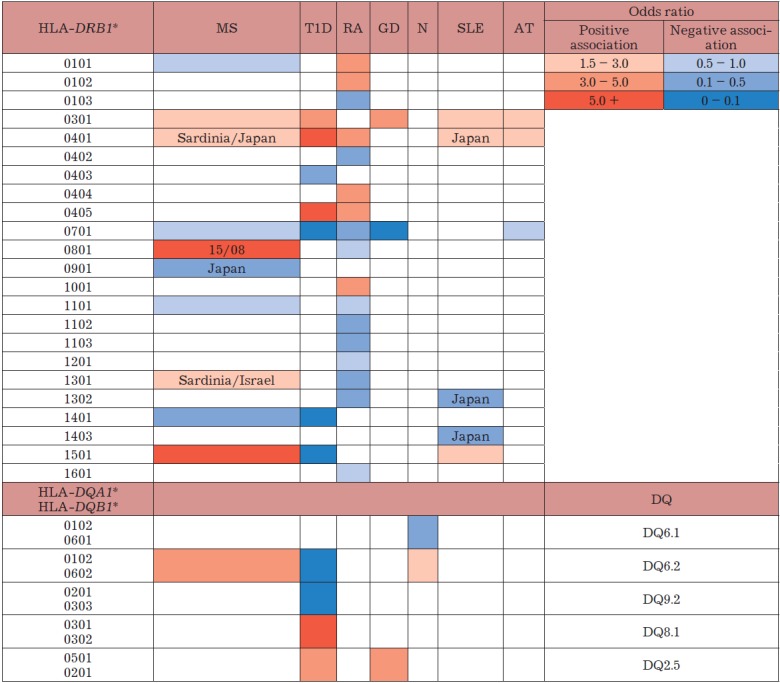
Genetic studies of patients with autoimmune diseases have shown that one of the most important roles in the developing of these diseases is played by a cluster of genes of the major histocompatibility complex (MHC), as compared with other genome areas. Information on the specific contribution of MHC alleles, mostly MHC class II ones, to the genetic predisposition to autoimmune diseases is crucial for understanding their pathogenesis. This review dwells on the most relevant aspects of this problem: namely, the correlation between carriage of certain MHC II alleles and an increased (positively associated allele) or reduced (negatively associated allele) probability of developing the most common autoimmune diseases, such as type 1 diabetes, rheumatoid arthritis, multiple sclerosis, systemic lupus erythematosus, autoimmune thyroiditis, etc. The most universal haplotypes, DR3-DQ2 and DR4-DQ8, are positively associated with many of these diseases, while the universal allele HLA-*0701 is protective.
对自身免疫性疾病患者的基因研究表明,与其他基因组区域相比,主要组织相容性复合体(MHC)的一组基因在这些疾病的发生发展中发挥着最重要的作用之一。关于MHC等位基因,主要是MHC II类等位基因对自身免疫性疾病遗传易感性的具体贡献的信息,对于理解其发病机制至关重要。本综述详述了该问题最相关的方面:即携带某些MHC II等位基因与发生最常见自身免疫性疾病(如1型糖尿病、类风湿性关节炎、多发性硬化症、系统性红斑狼疮、自身免疫性甲状腺炎等)的概率增加(正相关等位基因)或降低(负相关等位基因)之间的相关性。最常见的单倍型DR3-DQ2和DR4-DQ8与许多这些疾病呈正相关,而通用等位基因HLA-*0701具有保护作用。