Department of Surgery, Seoul National University College of Medicine, Seoul, South Korea.
Department of Surgery, Gyeongsang National University Hospital, Jinju, South Korea.
World J Surg. 2020 May;44(5):1569-1577. doi: 10.1007/s00268-020-05382-9.
Scarce data are available on the characteristics of postoperative organ failure (POF) and mortality after gastrectomy. We aimed to describe the causes of organ failure and mortality related to gastrectomy for gastric cancer and to identify patients with POF who are at a risk of failure to rescue (FTR).
The study examined patients with POF or in-hospital mortality in Seoul National University Hospital between 2005 and 2014. We identified patients at a high risk of FTR by analyzing laboratory findings, complication data, intensive care unit records, and risk scoring including Acute Physiology and Chronic Health Evaluation (APACHE) IV, Sequential Organ Failure Assessment (SOFA) score, and Simplified Acute Physiology Score (SAPS) 3 at ICU admission.
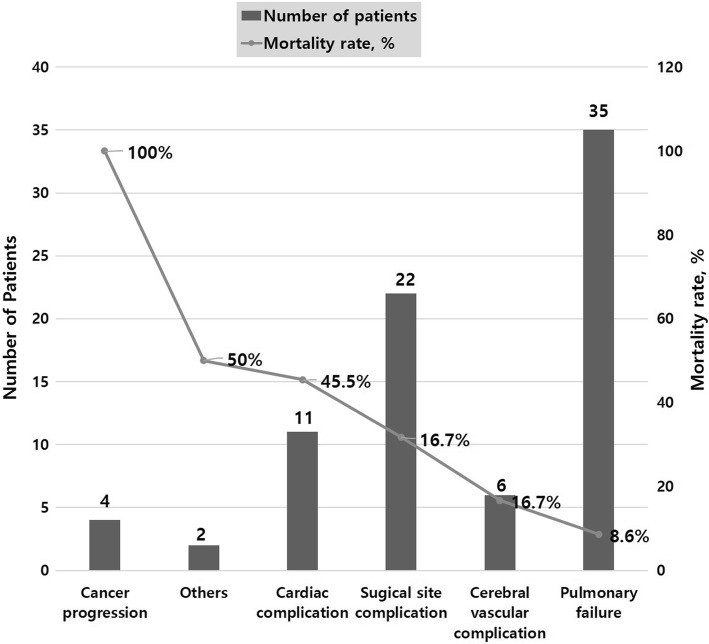
Among the 7304 patients who underwent gastrectomy, 80 (1.1%) were identified with Clavien-Dindo classification (CDC) grade ≥ IVa. The numbers of patients with CDC grade IVa, IVb, and V were 48 (0.66%), 11 (0.15%), and 21 (0.29%), respectively. Pulmonary failure (43.8%), surgical site complication (27.5%), and cardiac failure (13.8%) were the most common causes of POF and mortality. Cancer progression (100%) and cardiac events (45.5%) showed high FTR rates. In univariate analysis, acidosis, hypoalbuminemia, SOFA, APACHE IV, and SAPS 3 were identified as risk factors for FTR (P < 0.05). Finally, SAPS 3 was identified as an independent predictive factor for FTR.
Cancer progression and acute cardiac failure were the most lethal causes of FTR. SAPS 3 is an independent predictor of FTR among POF patients after gastrectomy.
关于胃癌胃切除术后器官衰竭(POF)和死亡率的特征,数据十分有限。本研究旨在描述与胃癌胃切除术后相关的器官衰竭的原因和死亡率,并确定发生治疗失败风险(FTR)的 POF 患者。
本研究纳入了 2005 年至 2014 年期间在首尔国立大学医院发生 POF 或院内死亡的患者。通过分析实验室检查结果、并发症数据、重症监护病房记录以及包括急性生理学和慢性健康评估(APACHE)IV 评分、序贯器官衰竭评估(SOFA)评分和简化急性生理学评分(SAPS)3 在内的风险评分,确定具有高 FTR 风险的患者。
在接受胃切除术的 7304 例患者中,有 80 例(1.1%)发生了 Clavien-Dindo 分级(CDC)≥IVa 的并发症。IVa、IVb 和 V 级患者的数量分别为 48 例(0.66%)、11 例(0.15%)和 21 例(0.29%)。肺部衰竭(43.8%)、手术部位并发症(27.5%)和心力衰竭(13.8%)是 POF 和死亡率的最常见原因。癌症进展(100%)和心脏事件(45.5%)的 FTR 发生率较高。单因素分析显示,酸中毒、低白蛋白血症、SOFA、APACHE IV 和 SAPS 3 是 FTR 的危险因素(P<0.05)。最后,SAPS 3 被确定为 POF 患者 FTR 的独立预测因素。
癌症进展和急性心力衰竭是 FTR 最致命的原因。SAPS 3 是胃切除术后 POF 患者 FTR 的独立预测因素。