Papanikolaou Alexandros, Panitsa Maria
Division of Plant Biology, Department of Biology, University of Patras, Patras, Greece Division of Plant Biology, Department of Biology, University of Patras Patras Greece.
Biodivers Data J. 2020 Jan 15;8:e48704. doi: 10.3897/BDJ.8.e48704. eCollection 2020.
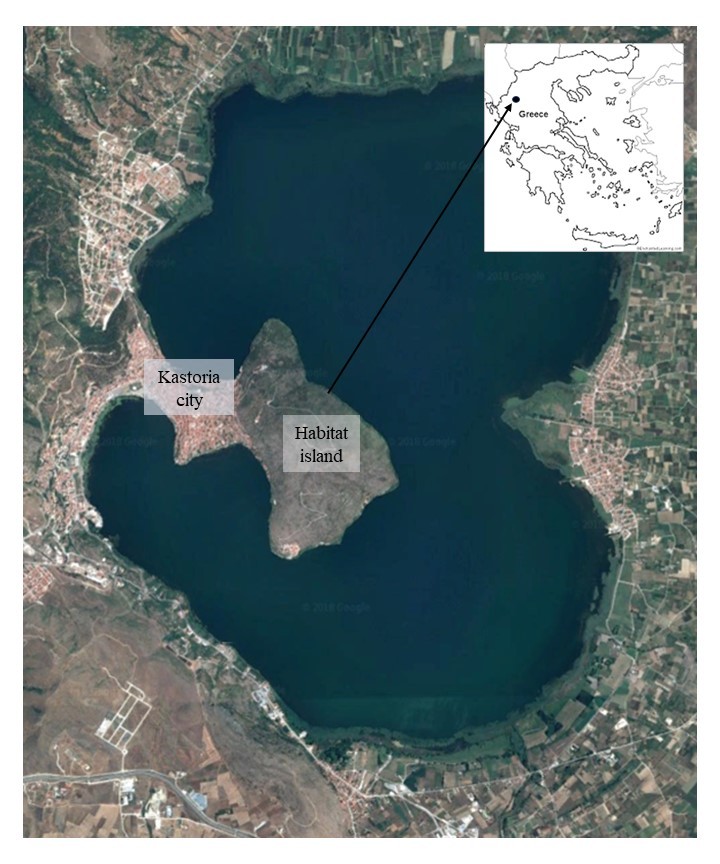
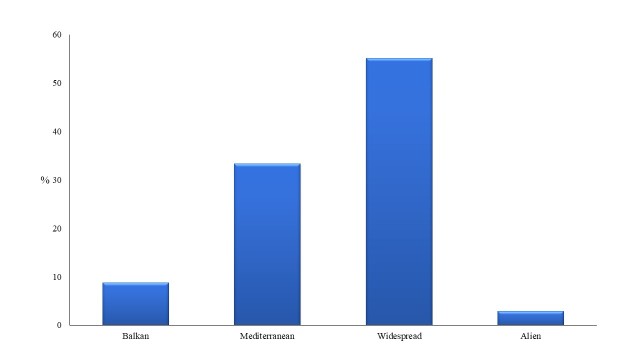
Lake Kastoria is one of the potentially "ancient" Balkan lakes that has a great environmental importance and ecological value, attracts high touristic interest and is under various anthropogenic pressures. It belongs to a Natura 2000 Special Protection Area and a Site of Community Interest. The city of Kastoria is located at the western part of the lake and just next to it, towards the centre of the lake, is a peninsula, a habitat island. In the framework of research concerning the flora of lake islands of Greece, one of the main objectives of the present study is to fill a gap concerning plant species richness of the habitat island within the protected Lake Kastoria, which is surrounded by the lake except for its north-western part where the border of the city of Kastoria is located. Floristic analysis of the habitat island of Lake Kastoria is in large measure accounted, concerning chorology with emphasis on Balkan endemics (8.7%), life forms, by hemicryptophytes (36.1%), therophytes (33.2%), phanerophytes (16.4%) and geophytes (10.9%) and, for habitats, by taxa preferring agricultural and ruderal ones (53.3%). Another objective is to compare its floristic composition to the one of the island within the protected urban Lake Pamvotis - one of the very few lake islands in Greece - focusing on the influence of urbanisation. The α- and β- diversity are measured in order to reveal floristic differences. Beta diversity partitioning in turnover and nestedness showed that the β-diversity is mostly expressed as compositional turnover. The role of the society in combination with long-term programmes for the study of plant species richness, functional diversity and patterns of species assemblages over time are necessary for the effective management and protection of protected areas, including lake insular areas.
卡斯托里亚湖是巴尔干地区具有潜在“古老”特征的湖泊之一,具有重大的环境意义和生态价值,吸引了大量游客,同时也面临着各种人为压力。它属于“自然2000”特别保护区和具有社区重要性的地点。卡斯托里亚市位于湖的西部,紧挨着湖,在湖中心方向有一个半岛,即一个栖息地岛屿。在关于希腊湖泊岛屿植物区系的研究框架内,本研究的主要目标之一是填补受保护的卡斯托里亚湖内栖息地岛屿植物物种丰富度方面的空白,该岛屿除了其西北部位于卡斯托里亚市边界处外,四周均被湖水环绕。对卡斯托里亚湖栖息地岛屿的植物区系分析在很大程度上涉及植物分布学,重点关注巴尔干特有种(8.7%)、生活型,其中半隐生植物占比最大(36.1%),一年生植物占33.2%,高位芽植物占16.4%,地下芽植物占10.9%,以及栖息地方面,偏好农业和杂草丛生环境的分类群占比(53.3%)。另一个目标是将其植物区系组成与受保护的城市帕姆沃蒂斯湖内的岛屿(希腊为数不多的湖泊岛屿之一)的植物区系组成进行比较,重点关注城市化的影响。通过测量α多样性和β多样性来揭示植物区系差异。β多样性在周转率和嵌套性方面的划分上的划分表明,β多样性主要表现为组成周转率。社会的作用以及长期研究植物物种丰富度、功能多样性和物种组合随时间变化模式的项目对于包括湖泊岛屿地区在内的保护区的有效管理和保护是必要的。