Juengst Shannon B, Nabasny Andrew, Terhorst Lauren
Department of Physical Medicine & Rehabilitation, University of Texas Southwestern Medical Center, Dallas, TX, United States.
Department of Occupational Therapy, University of Pittsburgh, Pittsburgh, PA, United States.
Front Neurol. 2020 Jan 9;10:1342. doi: 10.3389/fneur.2019.01342. eCollection 2019.
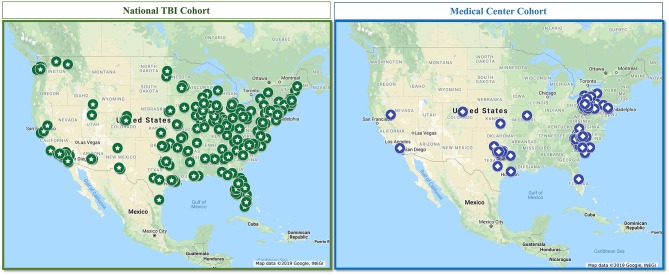
Our understanding of neurobehavioral symptoms after traumatic brain injury (TBI) largely relies on data gathered in studies conducted at academic medical centers or large clinical centers with research infrastructure. Though this often provides a well-characterized clinical sample, it may also introduce bias based on geographic locations served by these institutions and personal factors associated with patient access to these institutions. We collected neurobehavioral symptoms via the self-reported Behavioral Assessment Screening Tool (BAST) in a National TBI Cohort ( = 263) and a Medical Center TBI Cohort ( = 218) of English-speaking community-dwelling adults with chronic TBI. The primary focus of the present study was to compare demographics and neurobehavioral symptom reporting across the two cohorts and to discuss the implications of any such differences on interpretation of symptom scores. Across all BAST subscales (Negative Affect, Fatigue, Executive Function, Impulsivity, and Substance Abuse), participants in the National TBI Cohort reported significantly more frequent symptoms than those in the Medical Center TBI Cohort ('s < 0.001). Participants in the National TBI Cohort were more likely to be non-White and Hispanic compared to the Medical Center TBI Cohort, and those with mild TBI in the National TBI Cohort were more likely to have less than a high school education than those with mild TBI in the Medical Center TBI Cohort. Individuals with TBI recruited through academic and clinical institutions may not be representative of individuals with TBI living across the United States.
我们对创伤性脑损伤(TBI)后神经行为症状的理解,很大程度上依赖于在学术医疗中心或拥有研究基础设施的大型临床中心所开展研究中收集的数据。尽管这通常能提供一个特征明确的临床样本,但也可能会因这些机构所服务的地理位置以及与患者能否进入这些机构相关的个人因素而引入偏差。我们通过自我报告的行为评估筛查工具(BAST),在一个全国性创伤性脑损伤队列(n = 263)和一个医疗中心创伤性脑损伤队列(n = 218)中收集了神经行为症状,这两个队列的研究对象均为患有慢性创伤性脑损伤、说英语、居住在社区的成年人。本研究的主要重点是比较两个队列的人口统计学特征和神经行为症状报告情况,并讨论任何此类差异对症状评分解释的影响。在所有BAST分量表(消极情绪、疲劳、执行功能、冲动性和药物滥用)上,全国性创伤性脑损伤队列中的参与者报告的症状频率显著高于医疗中心创伤性脑损伤队列中的参与者(p值 < 0.001)。与医疗中心创伤性脑损伤队列相比,全国性创伤性脑损伤队列中的参与者更有可能是非白人和西班牙裔,并且全国性创伤性脑损伤队列中患有轻度创伤性脑损伤的参与者比医疗中心创伤性脑损伤队列中患有轻度创伤性脑损伤的参与者更有可能未接受过高中教育。通过学术机构和临床机构招募的创伤性脑损伤患者可能无法代表全美国的创伤性脑损伤患者。