Paffendorf Barbara A M, Qassrawi Rawan, Meys Andrea M, Trimborn Laura, Schrader Andrea
Botanical Institute, Department of Biology, University of Cologne, Cologne, Germany.
RWTH Aachen University, Institute for Biology I, Aachen, Germany.
PeerJ. 2020 Jan 20;8:e8303. doi: 10.7717/peerj.8303. eCollection 2020.
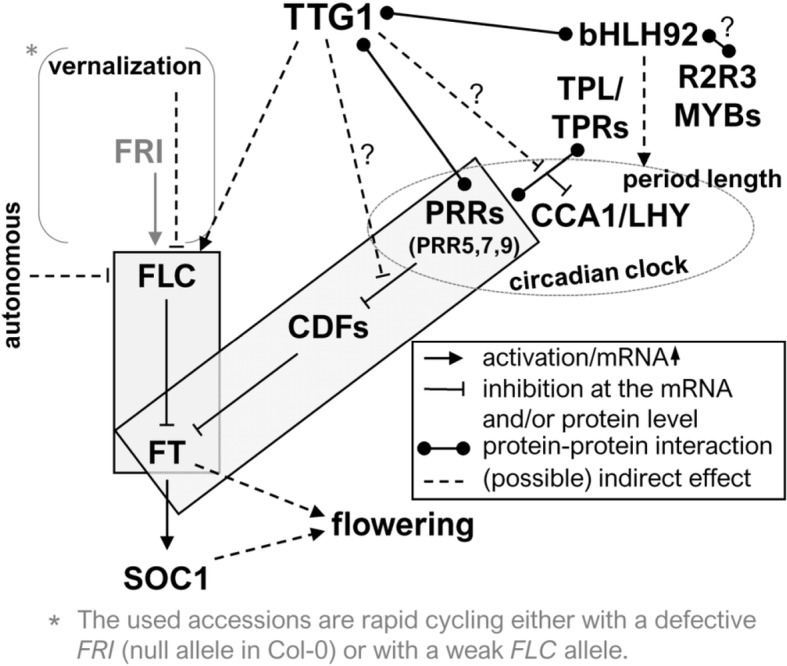
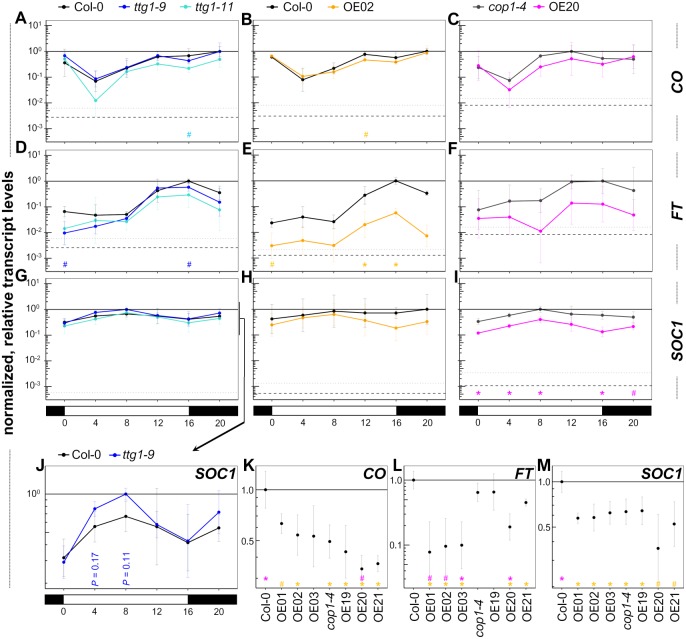
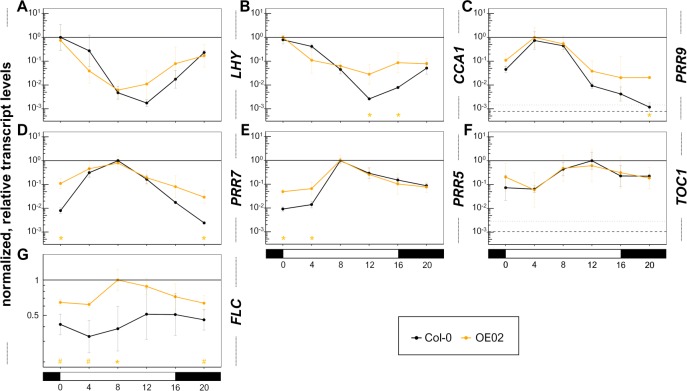
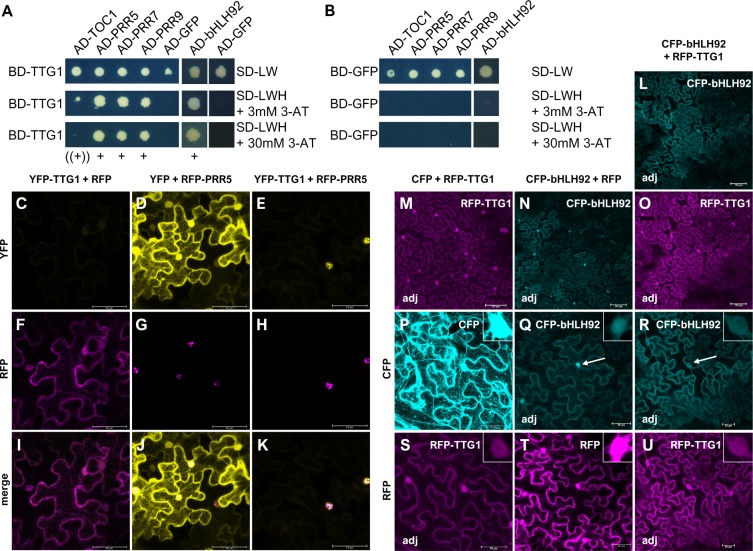
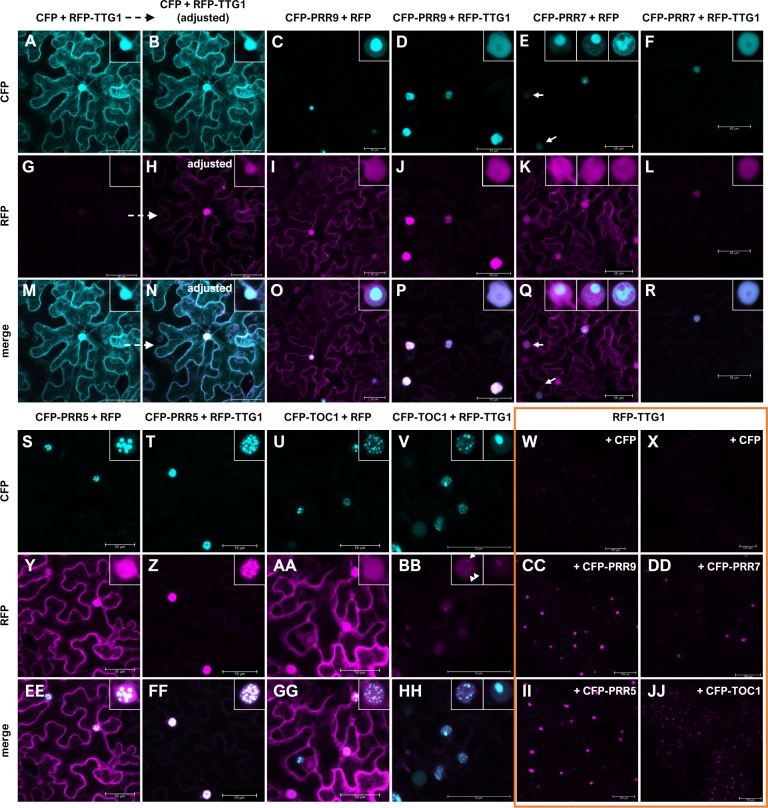
Pleiotropic regulatory factors mediate concerted responses of the plant's trait network to endogenous and exogenous cues. TRANSPARENT TESTA GLABRA 1 (TTG1) is such a factor that has been predominantly described as a regulator of early developmental traits. Although its closest homologs LIGHT-REGULATED WD1 (LWD1) and LWD2 affect photoperiodic flowering, a role of TTG1 in flowering time regulation has not been reported. Here we reveal that TTG1 is a regulator of flowering time in and changes transcript levels of different targets within the flowering time regulatory pathway. mutants flower early and TTG1 overexpression lines flower late at long-day conditions. Consistently, TTG1 can suppress the transcript levels of the floral integrators and and can act as an activator of circadian clock components. Moreover, TTG1 might form feedback loops at the protein level. The TTG1 protein interacts with PSEUDO RESPONSE REGULATOR (PRR)s and basic HELIX-LOOP-HELIX 92 (bHLH92) in yeast. , the respective pairs exhibit interesting patterns of localization including a recruitment of TTG1 by PRR5 to subnuclear foci. This mechanism proposes additional layers of regulation by TTG1 and might aid to specify the function of bHLH92. Within another branch of the pathway, TTG1 can elevate () transcript levels. FLC mediates signals from the vernalization, ambient temperature and autonomous pathway and the circadian clock is pivotal for the plant to synchronize with diurnal cycles of environmental stimuli like light and temperature. Our results suggest an unexpected positioning of TTG1 upstream of and upstream of the circadian clock. In this light, this points to an adaptive value of the role of TTG1 in respect to flowering time regulation.
多效性调控因子介导植物性状网络对内源和外源信号的协同响应。透明种皮光滑1(TTG1)就是这样一个因子,它主要被描述为早期发育性状的调控因子。尽管其最接近的同源物光调节WD1(LWD1)和LWD2影响光周期开花,但TTG1在开花时间调控中的作用尚未见报道。在此,我们揭示TTG1是[植物名称未给出]开花时间的调控因子,并改变开花时间调控途径中不同靶标的转录水平。[突变体名称未给出]突变体在长日照条件下早花,而TTG1过表达株系晚花。一致地,TTG1可以抑制开花整合因子[具体名称未给出]和[具体名称未给出]的转录水平,并可作为生物钟组分的激活剂。此外,TTG1可能在蛋白质水平形成反馈环。TTG1蛋白在酵母中与伪响应调节因子(PRR)和基本螺旋-环-螺旋92(bHLH92)相互作用。[具体植物名称未给出]中,各自的配对表现出有趣的定位模式,包括PRR5将TTG1招募到核内小体。这种机制提出了TTG1额外的调控层次,可能有助于明确bHLH92的功能。在该途径的另一个分支中,TTG1可以提高[具体基因名称未给出](FLC)的转录水平。FLC介导来自春化、环境温度和自主途径的信号,生物钟对于植物与光和温度等环境刺激的昼夜循环同步至关重要。我们的结果表明TTG1在FLC上游和生物钟上游有意外的定位。据此,这表明TTG1在开花时间调控方面的作用具有适应性价值。