Jullien Sophie, Pradhan Dinesh, Bassat Quique
1ISGlobal, Hospital Clínic, Universitat de Barcelona, Barcelona, Spain.
Jigme Dorji Wangchuck National Referral Hospital, Thimphu, Bhutan.
Pneumonia (Nathan). 2020 Jan 25;12:1. doi: 10.1186/s41479-019-0065-x. eCollection 2020.
Pneumonia is the single largest cause of death in under-five children worldwide. We conducted a systematic review to identify the knowledge gaps around childhood pneumonia in Bhutan.
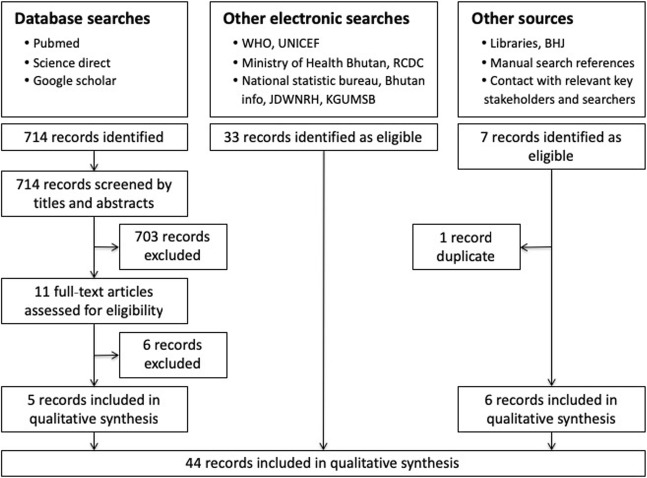
We searched PubMed, ScienceDirect and Google scholar from conception to 3rd December 2018, World Health Organization, UNICEF, Bhutan's Ministry of Health and other local databases for relevant reports. We included any report describing pneumonia in Bhutanese children with regards to the burden of the disease, aetiology, related risk factors, clinical and prognostic characteristics, surveillance systems and national preventive strategies. Two review authors identified the records. We summarized the findings narratively.
We included 44 records. Although with notable decreasing trends, pneumonia is still accountable for a high burden and mortality rate in Bhutanese children. The national surveillance system focuses mainly on influenza identification but has recently introduced other viral aetiology to monitor. We found very scarce or no data with regard to the bacterial aetiology, related risk factors and clinico-radiological and prognostic characteristics.
There is a dearth of data regarding the epidemiological, microbiological, clinical and radiological characteristics of pneumonia in children in Bhutan, leading to challenges while implementing evidence-based management and effective national preventive strategies.
肺炎是全球五岁以下儿童死亡的单一最大原因。我们进行了一项系统综述,以确定不丹儿童肺炎相关的知识空白。
我们检索了PubMed、ScienceDirect和谷歌学术,检索时间从建库至2018年12月3日,还检索了世界卫生组织、联合国儿童基金会、不丹卫生部及其他地方数据库以获取相关报告。我们纳入了任何描述不丹儿童肺炎的报告,内容涉及疾病负担、病因、相关危险因素、临床和预后特征、监测系统及国家预防策略。两名综述作者筛选记录。我们对研究结果进行了叙述性总结。
我们纳入了44篇记录。尽管呈显著下降趋势,但肺炎在不丹儿童中仍造成高负担和高死亡率。国家监测系统主要侧重于流感识别,但最近引入了其他病毒病因进行监测。我们发现关于细菌病因、相关危险因素以及临床放射学和预后特征的数据非常稀少或没有。
不丹儿童肺炎的流行病学、微生物学、临床和放射学特征方面的数据匮乏,这给实施循证管理和有效的国家预防策略带来了挑战。