Méquinion Mathieu, Foldi Claire J, Andrews Zane B
Monash Biomedicine Discovery Institute and Department of Physiology, Monash University, Clayton, VIC, Australia.
Front Nutr. 2020 Jan 9;6:190. doi: 10.3389/fnut.2019.00190. eCollection 2019.
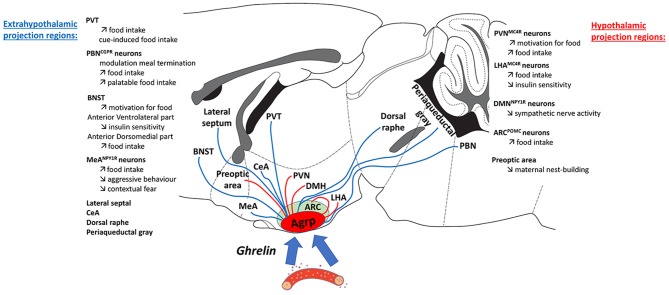
Anorexia Nervosa (AN) is viewed as primarily a psychiatric disorder owing to the considerable behavioral and genetic overlap with mood disorders and other psychiatric traits. However, the recent reconceptualization of AN as one of both psychiatric and metabolic etiology suggests that metabolic circuits conveying hunger, or sensitive to signals of hunger, may be a critical nexus linking metabolic dysfunction to mood disturbances. Within the brain, hunger is primarily percieved by Agouti-related (AgRP) neurons and hunger increases plasma concentrations of the hormone ghrelin, which targets ghrelin receptors on AgRP neurons to facilitate metabolic adaptations to low energy availability. However, beyond the fundamental role in maintaining hunger signaling, AgRP neurons regulate a diverse range of behaviors such as motivation, locomotor activity, negative reinforcement, anxiety, and obsession and a key factor involved in the manifestation of these behavioral changes in response to activation is the presence or absence of food availability. These changes can be considered adaptive in that they promote affective food-seeking strategies in environments with limited food availability. However, it also suggests that these neurons, so well-studied for their metabolic control, shape mood-related behaviors in a context-dependent manner and dysfunctional control leads not only to metabolic problems but also potentially mood-related problems. The purpose of this review is to underline the potential role of AgRP neurons and ghrelin signaling in both the metabolic and behavioral changes observed in anorexia nervosa. We aim to highlight the most recent studies on AgRP neurons and ghrelin signaling and integrate their metabolic and behavioral roles in normal function and highlight how dysfunction may contribute to the development of AN.
神经性厌食症(AN)主要被视为一种精神疾病,因为它在行为和基因方面与情绪障碍及其他精神特质存在相当大的重叠。然而,最近将AN重新概念化为一种具有精神和代谢病因的疾病,这表明传递饥饿感或对饥饿信号敏感的代谢回路可能是将代谢功能障碍与情绪紊乱联系起来的关键纽带。在大脑中,饥饿主要由刺鼠相关蛋白(AgRP)神经元感知,饥饿会增加血浆中胃饥饿素的浓度,胃饥饿素作用于AgRP神经元上的胃饥饿素受体,以促进对低能量供应的代谢适应。然而,除了在维持饥饿信号方面的基本作用外,AgRP神经元还调节多种行为,如动机、运动活动、负强化、焦虑和强迫,而激活后这些行为变化表现中涉及的一个关键因素是食物供应的有无。这些变化可以被认为是适应性的,因为它们在食物供应有限的环境中促进了情感性的觅食策略。然而,这也表明,这些因其代谢控制而被深入研究的神经元,以上下文依赖的方式塑造与情绪相关的行为,功能失调不仅会导致代谢问题,还可能导致与情绪相关的问题。本综述的目的是强调AgRP神经元和胃饥饿素信号在神经性厌食症中观察到的代谢和行为变化中的潜在作用。我们旨在突出关于AgRP神经元和胃饥饿素信号的最新研究,并整合它们在正常功能中的代谢和行为作用,同时强调功能失调可能如何导致AN的发展。