Department of Cardiology, The Second Affiliated Hospital of Wenzhou Medical University, Wenzhou, Zhejiang 325000, China.
Biomed Res Int. 2020 Jan 2;2020:1710452. doi: 10.1155/2020/1710452. eCollection 2020.
This study aims to investigate the coronary microcirculatory resistance and prognosis of patients with acute myocardial infarction (AMI) concomitant with hyperhomocysteinemia (HHcy) after an elective percutaneous coronary intervention (PCI).
A total of 101 patients that underwent elective PCI between May 2015 and July 2018 due to AMI were consecutively enrolled in this study. Patients were divided into a HHcy group (53) and a normal Hcy group (control; 48) based on their plasma homocysteine concentration. The characteristics of coronary angiography, the index of microcirculatory resistance (IMR) of infarct-related vessels (IRV), changes in left ventricular end diastolic diameter (LVEDd) and left ventricular ejection fraction (LVEF) before and after PCI, and the incidence of major adverse cardiovascular events (MACE) three months after PCI were compared between these groups.
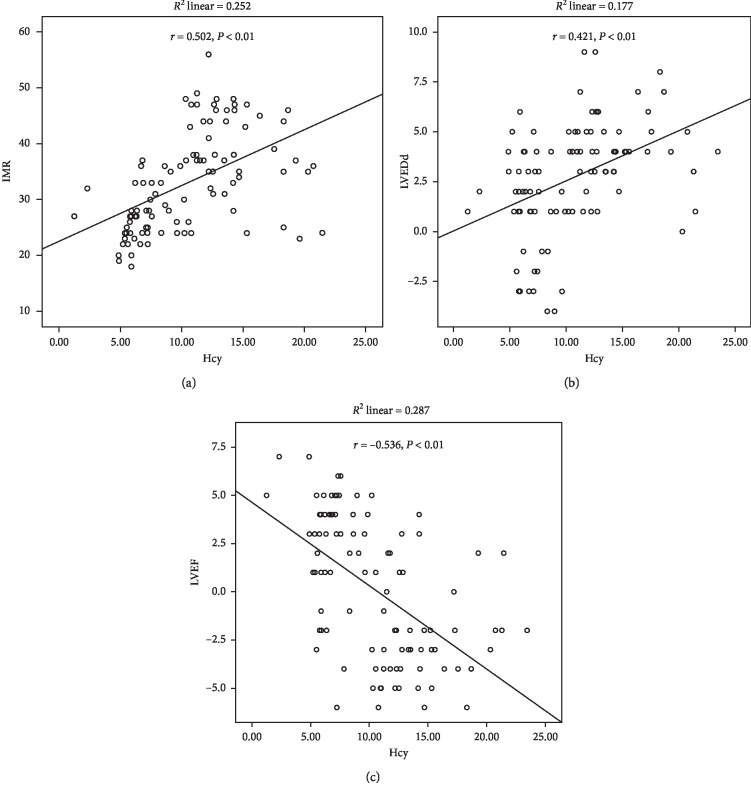
Compared to the results from the Hcy group, the HHcy group had a higher IMR. The HHcy group had significantly higher LVEDd and a lower LVEF than the Hcy group 3 months after PCI. Additionally, the incidence of MACE at three months after PCI was higher in the HHcy group than in the Hcy group. Pearson correlation analysis revealed a positive correlation with IMR in the HHcy group. Furthermore, there was a difference in the LVEDd measured at one day after PCI and at three months after PCI in the HHcy group.
AMI patients concomitant with HHcy that undergo elective PCI are prone to coronary microcirculatory dysfunction and have a poor cardiac function and poor prognosis at three months after PCI.
本研究旨在探讨择期经皮冠状动脉介入治疗(PCI)后伴高同型半胱氨酸血症(HHcy)的急性心肌梗死(AMI)患者的冠状动脉微循环阻力和预后。
连续纳入 2015 年 5 月至 2018 年 7 月因 AMI 接受择期 PCI 的 101 例患者。根据血浆同型半胱氨酸浓度,将患者分为 HHcy 组(53 例)和正常 Hcy 组(对照组;48 例)。比较两组患者冠状动脉造影特点、梗死相关血管(IRV)的微循环阻力指数(IMR)、PCI 前后左心室舒张末期直径(LVEDd)和左心室射血分数(LVEF)的变化以及 PCI 后 3 个月主要不良心血管事件(MACE)的发生率。
与 Hcy 组相比,HHcy 组的 IMR 更高。PCI 后 3 个月,HHcy 组的 LVEDd 明显升高,LVEF 明显降低。此外,HHcy 组 PCI 后 3 个月的 MACE 发生率高于 Hcy 组。Pearson 相关分析显示,HHcy 组 IMR 与 LVEDd 呈正相关。此外,HHcy 组 PCI 后 1 天和 3 个月的 LVEDd 测量值存在差异。
行择期 PCI 的伴 HHcy 的 AMI 患者易发生冠状动脉微循环功能障碍,PCI 后 3 个月心功能较差,预后较差。