Li Chao, Geng Yanfang, Zhu Xiaodan, Zhang Linghua, Hong Zhantong, Guo Xiaoling, Xia Chenglai
Foshan Fetal Medicine Research Institute, Foshan Women and Children Hospital Affiliated to Southern Medical University, Foshan.
Department of Science & Education Division, Huangpu, The First Affiliated Hospital, Sun Yat-Sen University, Guangzhou, Guangdong, China.
Medicine (Baltimore). 2020 Jan;99(5):e18975. doi: 10.1097/MD.0000000000018975.
Spinal muscular atrophy (SMA) was the second most fatal autosomal recessive hereditary disease in clinic. There had been no detailed study to characterize the prevalence of SMA carrier among people in China. So, we conducted a systematic review and meta-analysis to obtain a reliable estimation of the prevalence of SMA carrier to characterize its epidemiology for the first time.
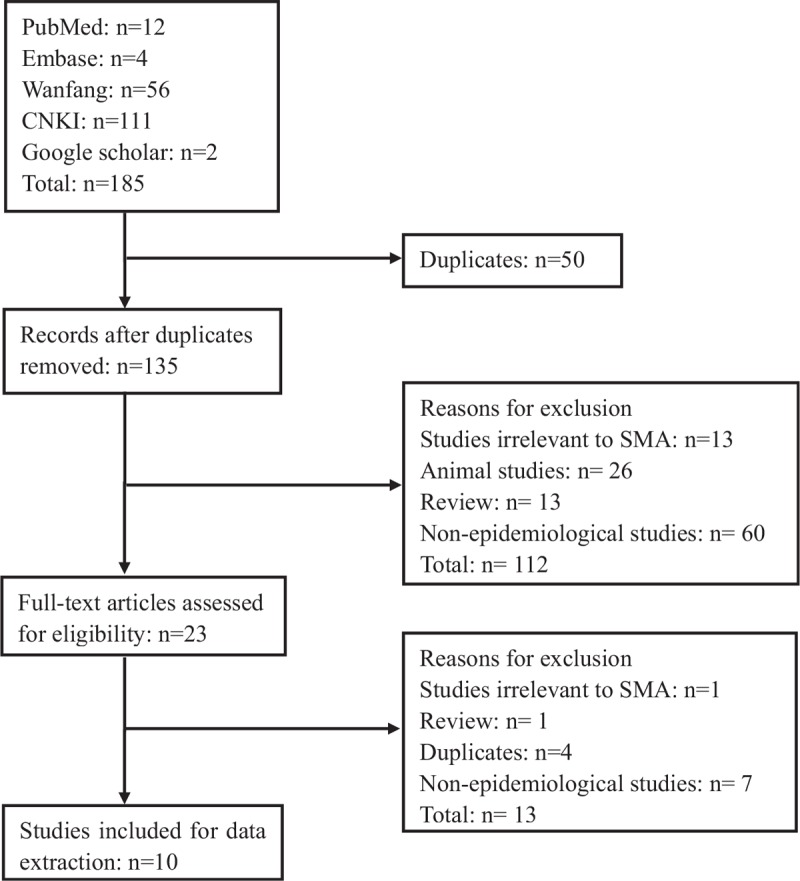
We systematically searched for articles in kinds of important electronic databases, including PubMed, Embase, Wanfang Database and China National Knowledge Infrastructure (CNKI) to identify all relevant literatures about carrier rates of SMA in China. The prevalence was performed by forest plot choosing random effect models. The publication bias was evaluated by means of funnel plots and Egger test. The sensitivity analysis was carried out by the method of omitting any literature at a time. Combined with the results of subgroup analysis, the source of heterogeneity was also discussed absolutely.
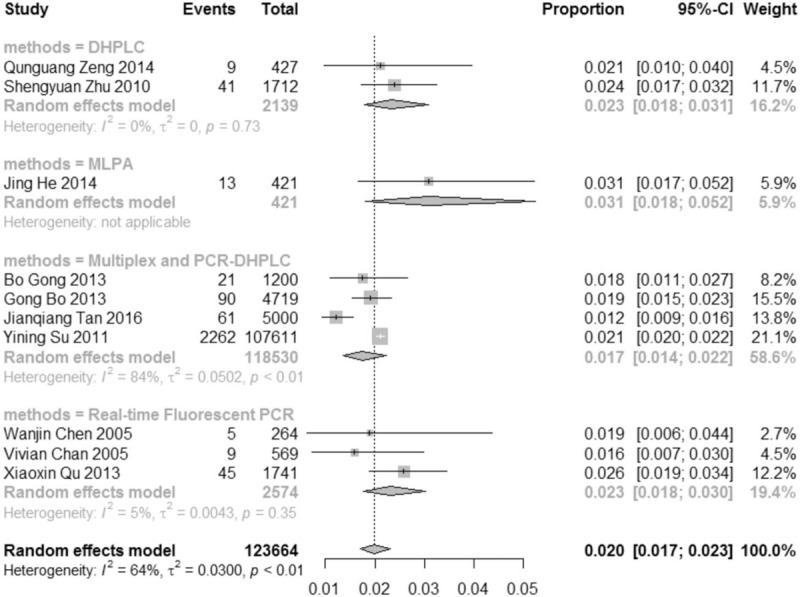
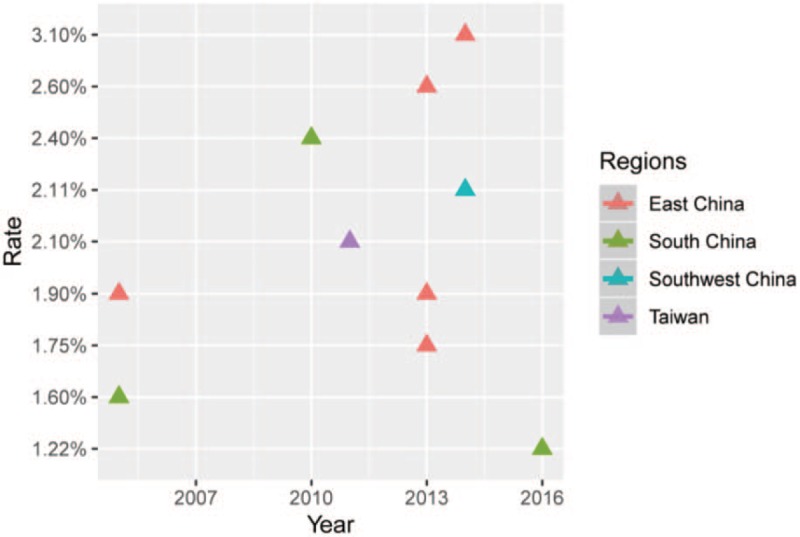
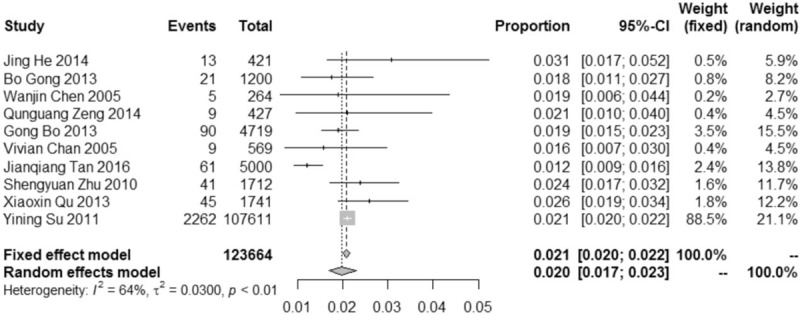
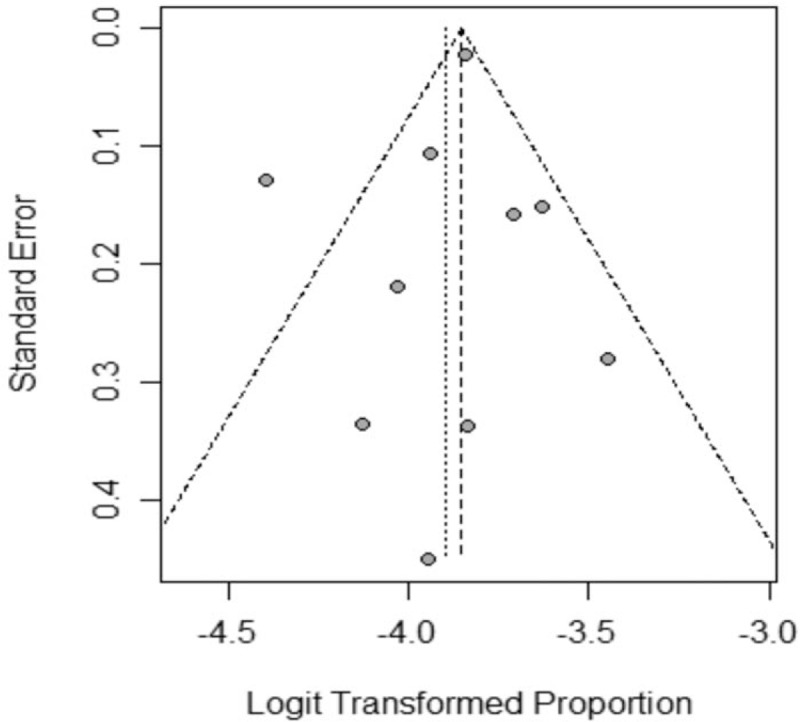
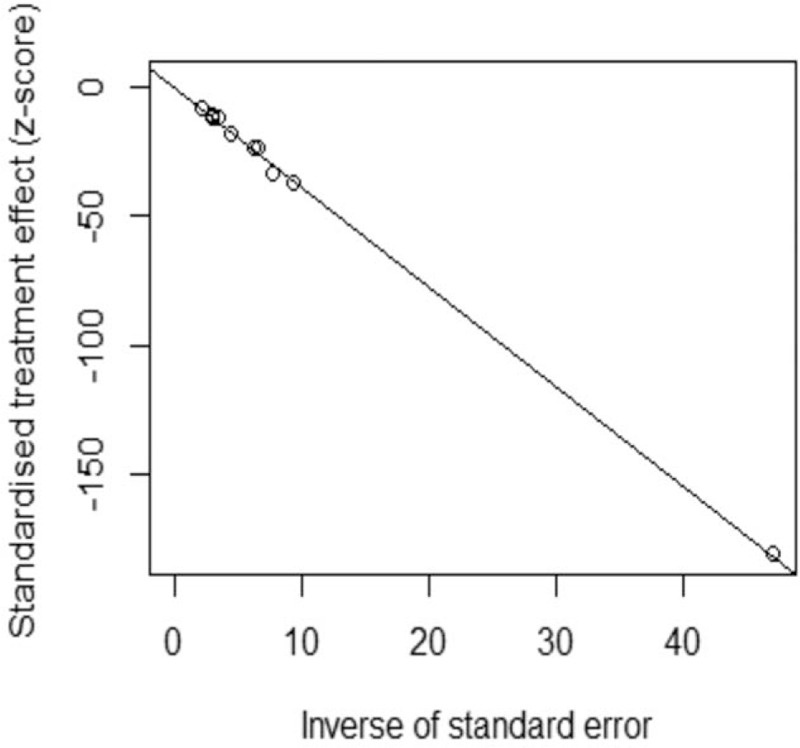
A total of 10 studies published between 2005 and 2016 were included in our analysis at last. The sample size ranged from 264 to 107,611 in included studies. The random effect models of meta-analysis showed that the overall carrier rate of SMA was 2.0% (95% confidence interval [CI], 1.7%-2.3%) in a heterogeneous set of studies (I = 64%). There was a gradual rise trend observed in the SMA carrier rate during the study period. The funnel plots and Egger test (Coef = 0.02, t = -0.45, P = .667 > .05) showed no obvious potential risk of publication bias.
The overall carrying rate of SMA was high as 2.0% and may be on a slow upward trend. So it was recommended that the countries should take active and effective measures to roll out routine prenatal screening and health genetic counseling for SMA as early as possible. What is more, further studies also need to be conducted to explore the etiology and epidemic factors of SMA to better control the risk of this common birth defect.
脊髓性肌萎缩症(SMA)是临床上第二大致命的常染色体隐性遗传性疾病。此前尚无针对中国人群中SMA携带者患病率特征的详细研究。因此,我们进行了一项系统评价和荟萃分析,以首次获得SMA携带者患病率的可靠估计值,从而描述其流行病学特征。
我们系统检索了各种重要的电子数据库,包括PubMed、Embase、万方数据库和中国知网,以识别所有关于中国SMA携带者率的相关文献。采用随机效应模型通过森林图计算患病率。通过漏斗图和Egger检验评估发表偏倚。采用每次剔除一篇文献的方法进行敏感性分析。结合亚组分析结果,对异质性来源也进行了全面讨论。
最终纳入了我们分析的共有2005年至2016年间发表的10项研究。纳入研究的样本量从264到107,611不等。荟萃分析的随机效应模型显示,在一组异质性研究(I=64%)中,SMA的总体携带者率为2.0%(95%置信区间[CI],1.7%-2.3%)。在研究期间观察到SMA携带者率有逐渐上升的趋势。漏斗图和Egger检验(系数=0.02,t=-0.45,P=0.667>.05)显示无明显的发表偏倚潜在风险。
SMA的总体携带率高达2.0%,且可能呈缓慢上升趋势。因此,建议各国尽早采取积极有效的措施开展SMA的常规产前筛查和健康遗传咨询。此外,还需要进一步开展研究以探索SMA的病因和流行因素,从而更好地控制这种常见出生缺陷的风险。