Al Otair Hadil A, BaHammam Ahmed S
Department of Clinical Sciences, University of Sharjah, Sharjah, UAE.
Department of Medicine, The University Sleep Disorders Center, College of Medicine, King Saud University, Riyadh, Saudi Arabia.
Ann Thorac Med. 2020 Jan-Mar;15(1):1-8. doi: 10.4103/atm.ATM_24_19. Epub 2020 Jan 2.
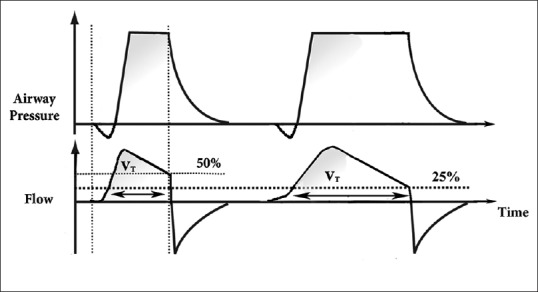
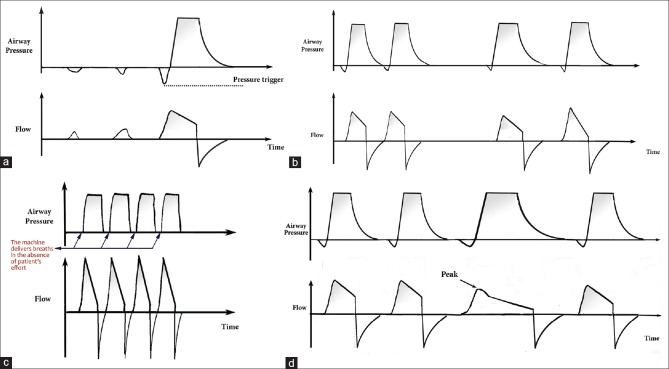
Patient-ventilator asynchrony (PVA) is common in patients receiving noninvasive ventilation (NIV). This occurs primarily when the triggering and cycling-off of ventilatory assistance are not synchronized with the patient's inspiratory efforts and could result in increased work of breathing and niv failure. In general, five types of asynchrony can occur during NIV: ineffective inspiratory efforts, double-triggering, auto-triggering, short-ventilatory cycling, and long-ventilatory cycling. Many factors that affect PVA are mostly related to the degree of air leakage, level of pressure support, and the type and properties of the interface used. Careful monitoring and adjustment of these factors are essential to reduce PVA and improve patient comfort. In this article, we discuss the machine and interface-related factors that influence PVA during NIV and its effect on the respiratory mechanics during pressure support ventilation, which is the ventilatory mode used most commonly during NIV. For that, we critically evaluated studies that assessed ventilator- and interface-related factors that influence PVA during NIV and proposed therapeutic solutions.
患者-呼吸机不同步(PVA)在接受无创通气(NIV)的患者中很常见。这种情况主要发生在通气辅助的触发和停止与患者的吸气努力不同步时,可能会导致呼吸功增加和无创通气失败。一般来说,无创通气期间可能会出现五种不同步类型:无效吸气努力、双重触发、自动触发、短通气周期和长通气周期。许多影响PVA的因素大多与漏气程度、压力支持水平以及所用接口的类型和特性有关。仔细监测和调整这些因素对于减少PVA和提高患者舒适度至关重要。在本文中,我们讨论了在无创通气期间影响PVA的机器和接口相关因素及其对压力支持通气期间呼吸力学的影响,压力支持通气是无创通气期间最常用的通气模式。为此,我们严格评估了评估无创通气期间影响PVA的呼吸机和接口相关因素的研究,并提出了治疗方案。