Dagur Raghubendra Singh, Liao Ke, Sil Susmita, Niu Fang, Sun Zhiqiang, Lyubchenko Yuri L, Peeples Eric S, Hu Guoku, Buch Shilpa
Department of Pharmacology and Experimental Neuroscience, University of Nebraska Medical Center, Omaha, NE, USA.
Department of Pharmaceutical Sciences, University of Nebraska Medical Center, Omaha, NE, USA.
J Extracell Vesicles. 2019 Dec 20;9(1):1703249. doi: 10.1080/20013078.2019.1703249. eCollection 2020.
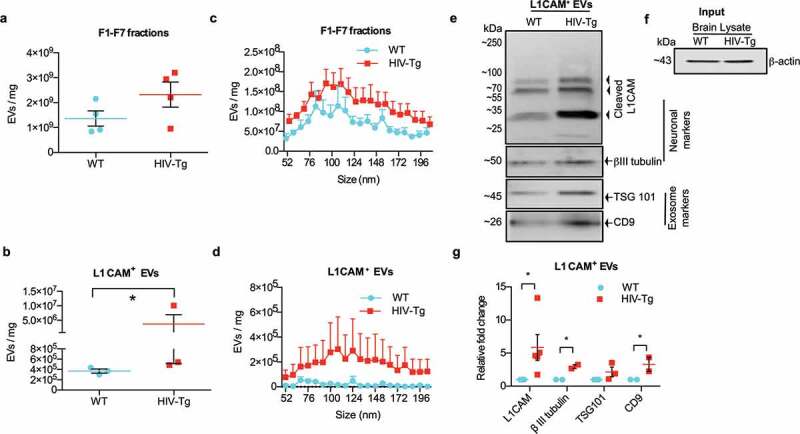
Despite the efficacy of combination antiretroviral therapy (ART) in controlling human immunodeficiency virus (HIV-1) replication, cytotoxic viral proteins such as HIV-1 transactivator of transcription (Tat) persist in tissues such as the brain. Although HIV-1 does not infect neuronal cells, it is susceptible to viral Tat protein-mediated toxicity, leading to neuroinflammation that underlies HIV-associated neurocognitive disorders (HAND). Given the role of extracellular vesicles (EVs) in both cellular homoeostasis and under pathological conditions, we sought to investigate the alterations in the quantity of neuronal-derived EVs in the brain - as defined by the presence of cell adhesion molecule L1 (L1CAM) and to evaluate the presence of L1CAM EVs in the peripheral circulation of HIV-1 transgenic (HIV-1 Tg) rats. The primary goal of this study was to investigate the effect of long-term exposure of HIV-1 viral proteins on the release of neuronal EVs in the brain and their transfer in the systemic compartment. Brain and serum EVs were isolated from both wild type and HIV-1 Tg rats using differential ultracentrifugation with further purification using the Optiprep gradient method. The subpopulation of neuronal EVs was further enriched using immunoprecipitation. The current findings demonstrated increased presence of L1CAM neuronal-derived EVs both in the brain and serum of HIV-1 Tg rats.
尽管联合抗逆转录病毒疗法(ART)在控制人类免疫缺陷病毒(HIV-1)复制方面具有疗效,但诸如HIV-1转录激活因子(Tat)等细胞毒性病毒蛋白仍存在于大脑等组织中。尽管HIV-1不会感染神经元细胞,但它易受病毒Tat蛋白介导的毒性影响,导致神经炎症,而神经炎症是HIV相关神经认知障碍(HAND)的基础。鉴于细胞外囊泡(EVs)在细胞稳态和病理条件下都发挥作用,我们试图研究大脑中神经元来源的EVs数量的变化——以细胞粘附分子L1(L1CAM)的存在来定义,并评估HIV-1转基因(HIV-1 Tg)大鼠外周循环中L1CAM EVs的存在情况。本研究的主要目标是调查长期暴露于HIV-1病毒蛋白对大脑中神经元EVs释放及其在全身循环中转移的影响。使用差速超速离心法从野生型和HIV-1 Tg大鼠中分离脑和血清EVs,并使用Optiprep梯度法进一步纯化。通过免疫沉淀进一步富集神经元EVs的亚群。目前的研究结果表明,HIV-1 Tg大鼠的大脑和血清中L1CAM神经元来源的EVs含量增加。