Department of Neurosciences, Center for Developmental Psychiatry, KU Leuven, Leuven, Belgium.
Leuven Autism Research (LAuRes), KU Leuven, Leuven, Belgium.
J Child Psychol Psychiatry. 2020 Sep;61(9):1019-1029. doi: 10.1111/jcpp.13201. Epub 2020 Jan 31.
Difficulties with facial expression processing may be associated with the characteristic social impairments in individuals with autism spectrum disorder (ASD). Emotional face processing in ASD has been investigated in an abundance of behavioral and EEG studies, yielding, however, mixed and inconsistent results.
We combined fast periodic visual stimulation (FPVS) with EEG to assess the neural sensitivity to implicitly detect briefly presented facial expressions among a stream of neutral faces, in 23 boys with ASD and 23 matched typically developing (TD) boys. Neutral faces with different identities were presented at 6 Hz, periodically interleaved with an expressive face (angry, fearful, happy, sad in separate sequences) every fifth image (i.e., 1.2 Hz oddball frequency). These distinguishable frequency tags for neutral and expressive stimuli allowed direct and objective quantification of the expression-categorization responses, needing only four sequences of 60 s of recording per condition.
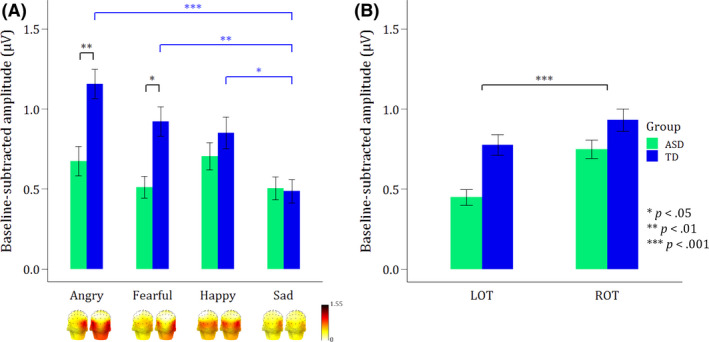
Both groups show equal neural synchronization to the general face stimulation and similar neural responses to happy and sad faces. However, the ASD group displays significantly reduced responses to angry and fearful faces, compared to TD boys. At the individual subject level, these neural responses allow to predict membership of the ASD group with an accuracy of 87%. Whereas TD participants show a significantly lower sensitivity to sad faces than to the other expressions, ASD participants show an equally low sensitivity to all the expressions.
Our results indicate an emotion-specific processing deficit, instead of a general emotion-processing problem: Boys with ASD are less sensitive than TD boys to rapidly and implicitly detect angry and fearful faces. The implicit, fast, and straightforward nature of FPVS-EEG opens new perspectives for clinical diagnosis.
面部表情处理困难可能与自闭症谱系障碍(ASD)个体的特征性社交障碍有关。在大量行为和 EEG 研究中已经研究了 ASD 中的情绪面孔处理,但结果却是混合的和不一致的。
我们结合快速周期性视觉刺激(FPVS)和 EEG 来评估神经对隐含检测的敏感性,即在中性面孔流中快速呈现短暂的面部表情,研究对象为 23 名 ASD 男孩和 23 名匹配的典型发育(TD)男孩。不同身份的中性面孔以 6 Hz 的频率呈现,每五个图像(即 1.2 Hz 奇数频率)周期性地与一个表达性面孔(愤怒、恐惧、快乐、悲伤分别呈现)交替出现。这些可区分的中性和表达性刺激的频率标记允许对表达分类反应进行直接和客观的量化,每个条件仅需要四个 60 秒的记录序列。
两组对一般面孔刺激都表现出相同的神经同步性,对快乐和悲伤面孔的神经反应也相似。然而,与 TD 男孩相比,ASD 组对愤怒和恐惧面孔的反应明显减少。在个体受试者水平上,这些神经反应可以以 87%的准确率预测 ASD 组的成员身份。虽然 TD 参与者对悲伤面孔的敏感性明显低于其他表情,但 ASD 参与者对所有表情的敏感性同样较低。
我们的研究结果表明存在特定于情绪的处理缺陷,而不是一般的情绪处理问题:与 TD 男孩相比,ASD 男孩对快速和隐含地检测愤怒和恐惧面孔的敏感性较低。FPVS-EEG 的隐含、快速和直接性质为临床诊断开辟了新的视角。