Department of Internal Medicine, Hanyang University College of Medicine, 222-1 Wangsimni-ro, Seongdong-gu, Seoul, 04763, South Korea.
Department of Biostatistics, Yonsei University, Wonju College of Medicine, Wonju, Gangwon-do, South Korea.
BMC Public Health. 2020 Jan 31;20(1):151. doi: 10.1186/s12889-020-8266-z.
There are few data available about hardcore smokers and their behavioral characteristics among the lung cancer screening (LCS) population. The study investigated the burden of hardcore smokers within the LCS population, and determine the characteristics of hardcore smokers using nationally representative data in South Korea.
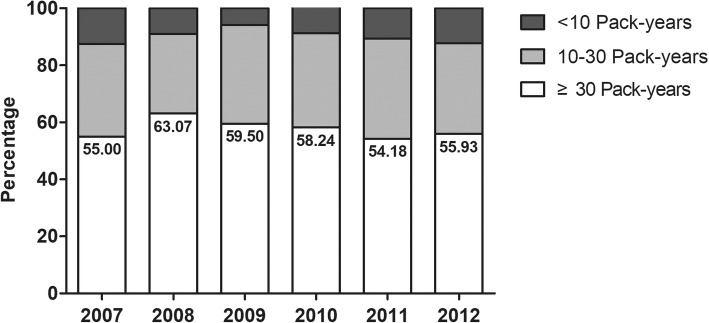
We used data from 2007 to 2012 from the Korean National Health and Nutrition Examination Survey. This study enrolled current male smokers aged 55-74 years. Among them, subjects eligible for LCS were defined as these populations with smoking histories of at least 30 PY. Hardcore smoking was defined as smoking >15 cigarettes per day, with no plan to quit, and having made no attempt to quit. Multivariate logistic regression analyses were used to estimate associations between hardcore smokers and various sociodemographic and other variables.
The proportion of hardcore smokers among those who met LCS eligibility criteria decreased from 2007 to 2012 (from 39.07 to 29.47% of the population) but did not change significantly thereafter (P = 0.2770), and that proportion was consistently 10-15% higher than that of hardcore smokers among all male current smokers. The proportion without any plan to quit smoking decreased significantly from 54.35% in 2007 to 38.31% in 2012. However, the smokers who had made no intentional quit attempt in the prior year accounted for more than half of those eligible for LCS, and the proportion of such smokers did not change significantly during the study period (50.83% in 2007 and 51.03% in 2012). Multivariate logistic regression analyses showed that hardcore smokers were older (OR = 1.05, 95% confidence interval [CI] 1.01-1.09) than non-hardcore smokers. Hardcore smokers exhibited higher proportion of depression (OR = 6.55, 95% CI 1.75-24.61) and experienced extreme stress more frequently (OR = 1.93, 95% CI 1.13-3.29). Smokers who did not receive smoking cessation education within the past year were significantly more likely to be hardcore smokers (OR = 4.15, 95% CI 1.30-13.22).
It is important to identify a subset of smokers unwilling or minimally motivated to quit within the context of lung cancer screening. Anti-smoking education should be enhanced to influence hardcore smokers' behavior.
关于肺癌筛查人群中的铁杆吸烟者及其行为特征,相关数据较少。本研究使用全国代表性数据,调查了肺癌筛查人群中铁杆吸烟者的负担,并确定了铁杆吸烟者的特征。
我们使用了 2007 年至 2012 年韩国国家健康和营养检查调查的数据。本研究纳入了年龄在 55-74 岁的当前男性吸烟者。其中,符合肺癌筛查条件的人群被定义为吸烟史至少 30 年的人群。铁杆吸烟者被定义为每天吸烟>15 支,没有戒烟计划,也没有尝试戒烟。采用多变量逻辑回归分析来估计铁杆吸烟者与各种社会人口学和其他变量之间的关系。
符合肺癌筛查条件的人群中,铁杆吸烟者的比例从 2007 年至 2012 年呈下降趋势(从人群的 39.07%降至 29.47%),但此后变化不显著(P=0.2770),且该比例始终比所有当前男性吸烟者中的铁杆吸烟者高 10-15%。没有戒烟计划的吸烟者比例从 2007 年的 54.35%显著下降至 2012 年的 38.31%。然而,在过去一年中没有进行任何戒烟尝试的吸烟者占符合肺癌筛查条件人群的一半以上,并且在研究期间,这一比例没有明显变化(2007 年为 50.83%,2012 年为 51.03%)。多变量逻辑回归分析表明,铁杆吸烟者年龄较大(OR=1.05,95%置信区间 [CI] 1.01-1.09),而非铁杆吸烟者年龄较小。铁杆吸烟者中,抑郁比例较高(OR=6.55,95%CI 1.75-24.61),经历极端压力的频率更高(OR=1.93,95%CI 1.13-3.29)。在过去一年中未接受戒烟教育的吸烟者成为铁杆吸烟者的可能性显著增加(OR=4.15,95%CI 1.30-13.22)。
在肺癌筛查背景下,确定一小部分不愿意或最小程度地有动机戒烟的吸烟者很重要。应该加强反吸烟教育,以影响铁杆吸烟者的行为。