Department of Ophthalmology, Ophthalmology Institute Dr. Gama Pinto, Lisbon, Portugal.
Department of Ophthalmology, Federal University of Sao Paulo, Sao Paulo, Brazil.
Sci Rep. 2020 Jan 31;10(1):1603. doi: 10.1038/s41598-020-58243-9.
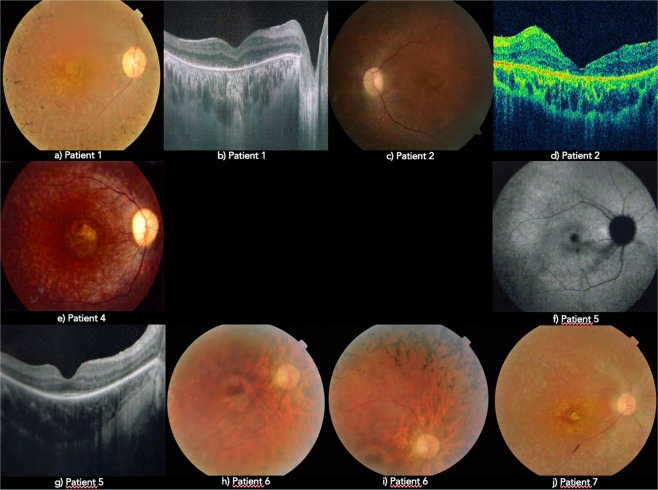
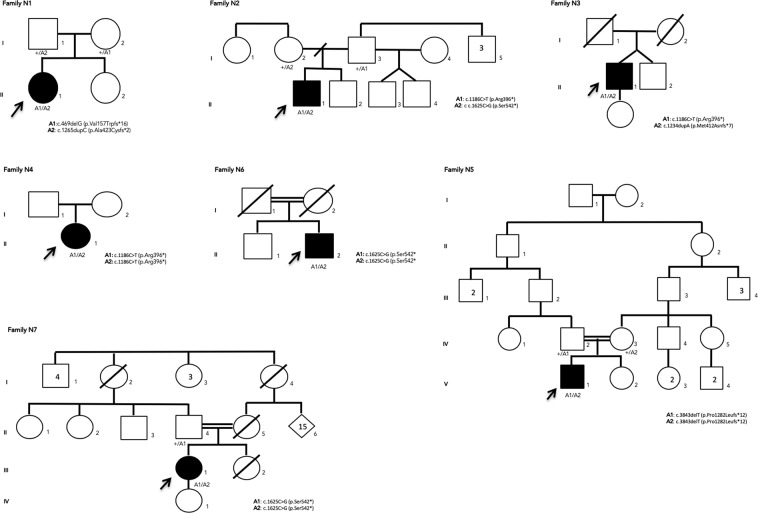
In the present study, we screened 529 Brazilian individuals affected by inherited retinal disorders. A total of seven unrelated and nonsyndromic patients with RP1 biallelic variants (OMIM # 180100) were diagnosed in our centre and included in the study. They had classic retinitis pigmentosa with diagnosis at the first decade of life. The visual acuities were severely affected at a young age. The fundus aspects were similar among all patients. An atrophic ring was present around the fovea in several cases. All patients had molecular diagnosis, with six different RP1 variants. This study reports two new pathogenic variants - two frameshift duplications (c.1234dupA p.Met412Asnfs7 and c.1265dupC p.Ala423Cysfs2) and reinforces other four known pathogenic variants - two frameshift deletions (c.469delG p.Val157Trpfs16 and c.3843delT p.Pro1282Leufs12) and two stop gain mutations (c.1186 C > T p.Arg396* and c.1625C > G p.Ser542*). These findings broaden the spectrum of RP1 variants. This study also reviewed the fundus characteristics that clinically could raise the hypothesis of a retinitis pigmentosa due to RP1 gene. It is worthwhile to try to identify the disease-causing variants in each patient since it can provide prognostic information and be useful in genetic consultation and diagnosis in the future.
在本研究中,我们筛选了 529 名受遗传性视网膜疾病影响的巴西个体。在我们中心诊断出了总共 7 名无关联且非综合征的 RP1 双等位基因突变(OMIM#180100)患者,并将他们纳入了研究。这些患者患有典型的色素性视网膜炎,发病年龄在第一个十年。视力在年轻时就受到严重影响。所有患者的眼底表现相似。在几个病例中,黄斑周围存在萎缩环。所有患者均进行了分子诊断,发现了 6 种不同的 RP1 变异。本研究报告了两种新的致病性变异 - 两种移码重复(c.1234dupA p.Met412Asnfs7 和 c.1265dupC p.Ala423Cysfs2),并证实了其他四种已知的致病性变异 - 两种移码缺失(c.469delG p.Val157Trpfs16 和 c.3843delT p.Pro1282Leufs12)和两种终止密码子获得突变(c.1186 C > T p.Arg396* 和 c.1625C > G p.Ser542*)。这些发现拓宽了 RP1 变异的范围。本研究还回顾了眼底特征,这些特征在临床上可能提示由于 RP1 基因突变引起的色素性视网膜炎。值得尝试在每个患者中识别致病变异,因为它可以提供预后信息,并在未来的遗传咨询和诊断中发挥作用。