Key Laboratory of Bioresources and Ecoenvironment (Ministry of Education), College of Life Sciences, Sichuan University, Chengdu, Sichuan 610065, China.
Sichuan Academy of Forestry, Chengdu, Sichuan 610081, China.
Zool Res. 2022 Sep 18;43(5):813-826. doi: 10.24272/j.issn.2095-8137.2022.072.
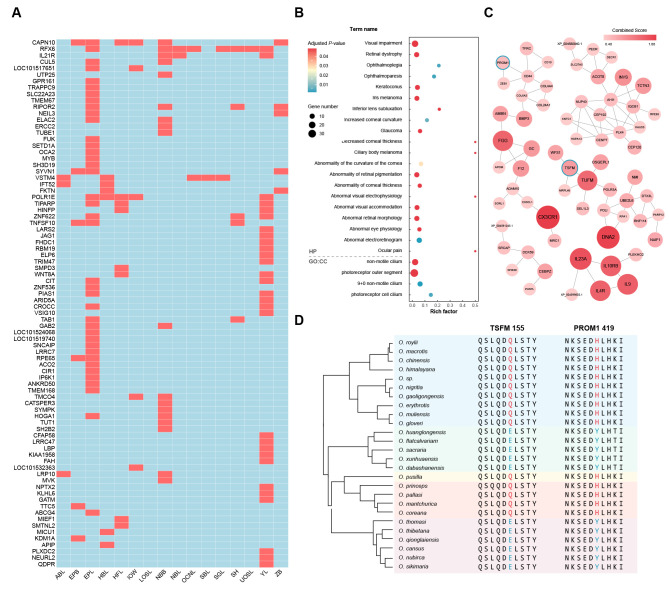
Pikas (Lagomorpha: Ochotonidae) are small mouse-like lagomorphs. To investigate their adaptation to different ecological environments during their dispersal from the Qinghai-Xizang (Tibet) Plateau (QTP), we collected 226 pikas and measured 20 morphological characteristics and recorded habitat information. We also sequenced the genome of 81 specimens, representing 27 putative pika species. The genome-wide tree based on 4 090 coding genes identified five subgenera, i.e., , , , , and , consistent with morphometric data. Morphologically, and had similar traits, including smaller size and earlier divergence time compared to other pikas. Consistently, the habitats of and differed from those of the remaining subgenera. Phylogenetic signal analysis detected 83 genes significantly related to morphological characteristics, including several visual and hearing-related genes. Analysis of shared amino acid substitutions and positively selected genes (PSGs) in and identified two genes, i.e., mitochondrial function-related (p.Q155E) and low-light visual sensitivity-related (p.H419Y). Functional experiments demonstrated that TSFM-155E significantly enhanced mitochondrial function compared to TSFM-155Q in other pikas, and PROM1-419Y decreased the modeling of dynamic intracellular chloride efflux upon calcium uptake. and individuals mostly inhabit different environments (e.g., subtropical forests) than other pikas, suggesting that a shift from the larger ancestral type and changes in sensory acuity and energy enhancement may have been required in their new environments. This study increases our understanding of the evolutionary history of pikas.
鼠兔(兔形目:鼠兔科)是小型鼠兔类兔形目动物。为研究其从青藏高原(QTP)扩散过程中对不同生态环境的适应,我们采集了 226 只鼠兔,测量了 20 种形态特征并记录了栖息地信息。我们还对 81 个样本的基因组进行了测序,代表了 27 种假定的鼠兔物种。基于 4090 个编码基因的全基因组树确定了五个亚属,即 、 、 、 、和 ,与形态数据一致。形态上, 和 具有相似的特征,包括体型较小和分化时间较早,与其他鼠兔相比。一致地, 和 的栖息地与其他亚属的栖息地不同。系统发育信号分析检测到 83 个与形态特征显著相关的基因,包括几个与视觉和听觉相关的基因。 和 中共享氨基酸替换和正选择基因(PSGs)的分析确定了两个基因,即与线粒体功能相关的 (p.Q155E)和与低光视觉敏感性相关的 (p.H419Y)。功能实验表明,与其他鼠兔中的 TSFM-155Q 相比,TSFM-155E 显著增强了线粒体功能,而 PROM1-419Y 降低了钙摄取时动态细胞内氯离子流出的建模。和 个体主要栖息在不同于其他鼠兔的不同环境(例如,亚热带森林)中,这表明在新环境中需要从较大的祖先类型转变,以及感觉敏锐度和能量增强的变化。本研究增加了我们对鼠兔进化历史的理解。