Glezer M G
Department of Preventive and Emergency Cardiology, Sechenov First Moscow State Medical University, Moscow, Russia.
Cardiol Ther. 2020 Jun;9(1):139-152. doi: 10.1007/s40119-020-00162-x. Epub 2020 Feb 1.
Overweight and obesity are increasing worldwide and are associated with an increased risk for cardiovascular disease (CVD). The aim of this study was to examine the burden of CVD risk factors among normal weight, overweight, and obese subjects with hypertension, and to evaluate the effectiveness of switching to a single-pill combination (SPC) of perindopril arginine/indapamide for blood pressure (BP) control in overweight and obese subjects treated in routine clinical practice.
FORSAGE was a 3-month, multicenter, observational, open-label study conducted in Russian patients with uncontrolled arterial hypertension under previous antihypertensive therapy. Subjects were switched to the full-dose perindopril arginine 10 mg/indapamide 2.5 mg SPC. BP was assessed at 2 weeks, 1 month, and 3 months, and serum creatinine and general health status at 3 months. The present post hoc analysis of the FORSAGE study results explored the effectiveness of perindopril arginine/indapamide SPC in patients with arterial hypertension with regard to baseline body mass index (BMI): normal (< 25 kg/m), overweight (25 ≤ BMI < 30 kg/m), and obese (≥ 30 kg/m).
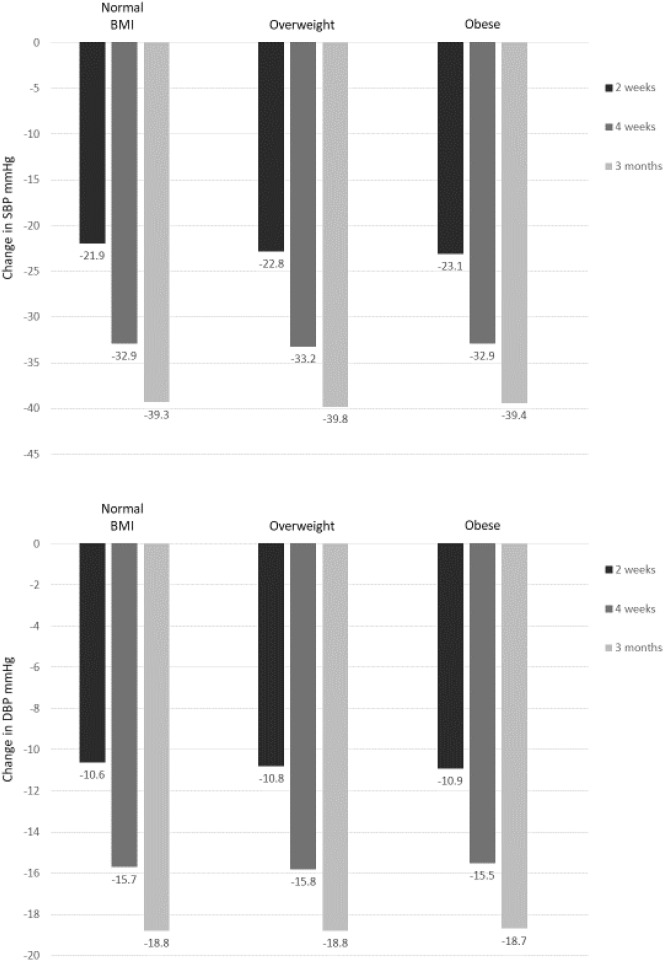
A total of 1969 patients were recruited, but BMI data were available for 1963 patients, two-thirds of whom were women. The distribution of BMI groups was as follows: < 25 kg/m (16.7%), overweight (48.7%), and obese (34.7%). Overweight or obese patients had more concomitant diseases such as diabetes mellitus or history of stroke, higher BP levels, serum cholesterol and creatinine, and lower glomerular filtration rates. Switching to perindopril arginine/indapamide SPC was associated with a statistically significant reduction in BP as early as the second week of treatment. At 3 months, systolic blood pressure (SBP)/diastolic blood pressure (DBP) had decreased significantly by 39.3/18.8 mmHg in the normal BMI group, 39.8/18.8 mmHg in overweight, and 39.4/18.7 mmHg in obese groups. The magnitude of the BP reduction was independent of BMI. Achievement of target BP (< 140/90 mmHg) was good in all groups, but lower in obese subjects (70.9%) than in overweight subjects (78.1%) or those with a normal BMI (81.8%) (P < 0.0001 for both comparisons).
In subjects with uncontrolled BP on existing antihypertensive therapy, switching to perindopril arginine 10 mg/indapamide 2.5 mg was associated with statistically significant decreases in BP and higher rates of target BP achievement in all BMI groups, including more than 70% of overweight and obese patients.
ISRCTN ID, ISRCTN14315146 (retrospectively registered 18/11/2019).
超重和肥胖在全球范围内呈上升趋势,且与心血管疾病(CVD)风险增加相关。本研究旨在调查患有高血压的正常体重、超重和肥胖受试者中CVD危险因素的负担,并评估在常规临床实践中接受治疗的超重和肥胖受试者改用培哚普利精氨酸/吲达帕胺单片复方制剂(SPC)控制血压(BP)的有效性。
FORSAGE是一项为期3个月的多中心、观察性、开放标签研究,针对先前接受抗高血压治疗但血压控制不佳的俄罗斯患者开展。受试者改用全剂量的培哚普利精氨酸10毫克/吲达帕胺2.5毫克SPC。在第2周、1个月和3个月时评估血压,在3个月时评估血清肌酐和总体健康状况。本次对FORSAGE研究结果的事后分析探讨了培哚普利精氨酸/吲达帕胺SPC在动脉高血压患者中,根据基线体重指数(BMI):正常(<25千克/米²)、超重(25≤BMI<30千克/米²)和肥胖(≥30千克/米²)的有效性。
共招募了1969例患者,但1963例患者有BMI数据,其中三分之二为女性。BMI组分布如下:<25千克/米²(16.7%)、超重(48.7%)和肥胖(34.7%)。超重或肥胖患者有更多合并症,如糖尿病或中风病史、更高的血压水平、血清胆固醇和肌酐,以及更低的肾小球滤过率。改用培哚普利精氨酸/吲达帕胺SPC与治疗第二周时血压的统计学显著降低相关。在3个月时,正常BMI组的收缩压(SBP)/舒张压(DBP)显著下降了39.3/18.8毫米汞柱,超重组下降了39.8/18.8毫米汞柱,肥胖组下降了39.4/18.7毫米汞柱。血压降低幅度与BMI无关。所有组的血压目标(<140/90毫米汞柱)达成情况良好,但肥胖受试者(70.9%)低于超重受试者(78.1%)或BMI正常的受试者(81.8%)(两项比较P均<0.0001)。
在现有抗高血压治疗下血压控制不佳的受试者中,改用10毫克培哚普利精氨酸/2.5毫克吲达帕胺与所有BMI组血压的统计学显著降低及更高的血压目标达成率相关,包括超过70%的超重和肥胖患者。
ISRCTN编号,ISRCTN14315146(2019年11月18日追溯注册)