Nedogoda Sergey V, Stojanov Vesna J
Department Volgograd Medical State University, Volgograd, Russia.
Center for Hypertension, Clinical Center of Serbia, Medical School University of Belgrade, Belgrade, Serbia.
Cardiol Ther. 2017 Jun;6(1):91-104. doi: 10.1007/s40119-017-0085-7. Epub 2017 Feb 8.
Patients with hypertension often require a combination of three antihypertensive agents to achieve blood pressure control, but very few single-pill triple combinations are available. The aim of this study was to determine whether a single-pill triple combination of perindopril, indapamide, and amlodipine was as effective as a dual-pill combination of perindopril/indapamide plus separate amlodipine at reducing blood pressure in patients with uncontrolled, essential hypertension.
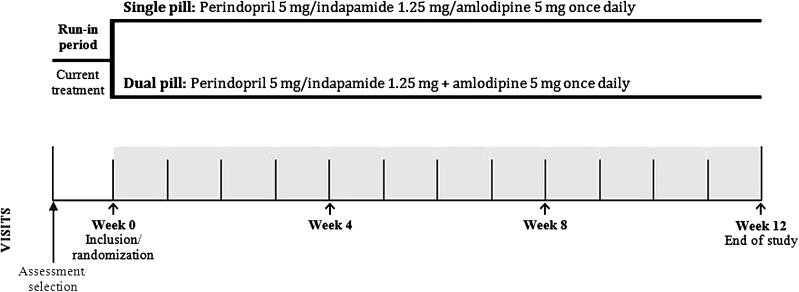
This international, multicenter, open-label, randomized controlled trial was conducted in men or women aged ≥18 years old with confirmed essential hypertension (SBP ≥140 and <160 mmHg and DBP ≥90 and <100 mmHg), uncontrolled on maximal dose antihypertensive monotherapy or with a single dose of dual therapy. Patients were randomly assigned to: single-pill triple combination of perindopril 5 mg/indapamide 1.25 mg/amlodipine 5 mg (Per/Ind/Aml) or dual-pill combination perindopril 5 mg/indapamide 1.25 mg + amlodipine 5 mg (Per/Ind + Aml) once daily for 12 weeks. The primary endpoint was change in office supine SBP and DBP from baseline to week 12. The proportion of responders defined as those with normalized BP (SBP <140 mmHg and DBP <90 mmHg), and/or decrease of SBP ≥20 mmHg, and/or decrease of DBP ≥10 mmHg at week 12 (W12) compared with baseline was also assessed. Secondary efficacy endpoints included change in office supine SBP and DBP, response, and BP control at weeks 4 and 8. The tolerability of the treatments was also assessed.
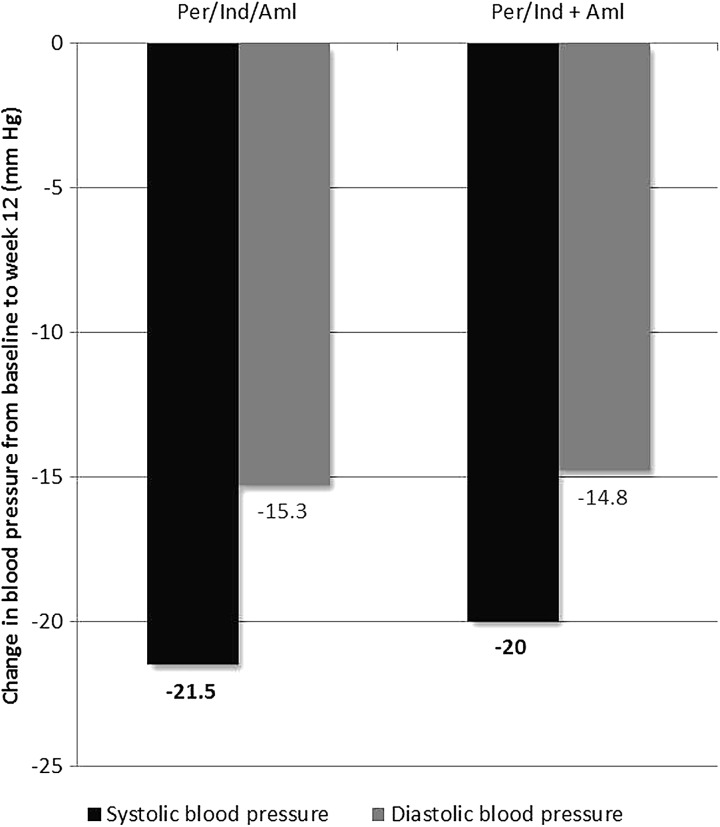
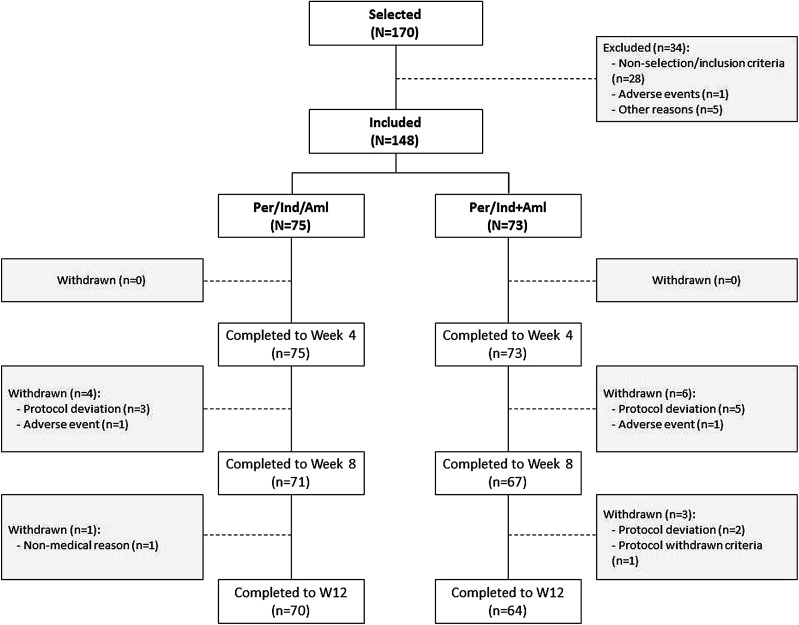
A total of 148 patients were randomized: 75 to Per/Ind/Aml and 73 to Per/Ind + Aml. Mean supine SBP and DBP were 149.1 ± 4.7 and 94.1 ± 3.1 mmHg, respectively, with no relevant between-group difference. At week 12, both triple-therapy regimens were associated with clinically significant reductions in SBP compared with baseline (-21.5 ± 11.7 and -20.0 ± 12.9 mmHg, respectively). Reductions in office supine DBP were also clinically significant (-15.3 ± 7.8 and -14.8 ± 9.0 mmHg, respectively). The proportion of treatment responders was high in both groups: 89.2 and 87.1%, respectively. The reduction in office supine SBP/DBP was already evident at week 4 and maintained for the duration of the study in both groups. The majority of patients were treatment responders at week 4 (89.2 and 82.9%, respectively) and had achieved BP control (87.8 vs. 78.6%, respectively), which was maintained until week 12 in both treatment groups. Both treatments were well tolerated with no between-group differences.
In adult patients with uncontrolled essential hypertension on treatment, single-pill triple-combination therapy with Per/Ind/Aml is as effective as the same dose dual-pill combination of Per/Ind + Aml. Both treatments were associated with clinically significant BP reductions compared with baseline and were well tolerated. Clinical trials number: http://www.controlled-trials.com ISRCTN: 16442558.
Les Laboratoires Servier.
高血压患者通常需要联合使用三种抗高血压药物来控制血压,但单一片剂的三联复方制剂却非常少见。本研究旨在确定培哚普利、吲达帕胺和氨氯地平的单一片剂三联复方制剂在降低未控制的原发性高血压患者血压方面是否与培哚普利/吲达帕胺加单独氨氯地平的双片剂组合同样有效。
本国际、多中心、开放标签、随机对照试验纳入年龄≥18岁、确诊为原发性高血压(收缩压≥140且<160 mmHg,舒张压≥90且<100 mmHg)、在最大剂量抗高血压单药治疗或单剂量双药治疗下血压仍未得到控制的男性或女性患者。患者被随机分配至:培哚普利5 mg/吲达帕胺1.25 mg/氨氯地平5 mg的单一片剂三联复方制剂(Per/Ind/Aml)或培哚普利5 mg/吲达帕胺1.25 mg + 氨氯地平5 mg的双片剂组合(Per/Ind + Aml),每日一次,共12周。主要终点是从基线到第12周诊室仰卧位收缩压和舒张压的变化。还评估了应答者的比例,应答者定义为在第12周(W12)时血压正常(收缩压<140 mmHg且舒张压<90 mmHg),和/或收缩压下降≥20 mmHg,和/或舒张压下降≥10 mmHg(与基线相比)的患者。次要疗效终点包括第4周和第8周诊室仰卧位收缩压和舒张压的变化、应答情况及血压控制情况。还评估了治疗的耐受性。
共有148例患者被随机分组:75例接受Per/Ind/Aml治疗,73例接受Per/Ind + Aml治疗。平均仰卧位收缩压和舒张压分别为149.1±4.7 mmHg和94.1±3.1 mmHg,两组间无显著差异。在第12周时,与基线相比,两种三联治疗方案的收缩压均有临床显著降低(分别为-21.5±11.7 mmHg和-20.0±12.9 mmHg)。诊室仰卧位舒张压的降低也具有临床显著性(分别为-15.3±7.8 mmHg和-14.8±9.0 mmHg)。两组治疗应答者的比例均较高:分别为89.2%和87.1%。两组在第4周时诊室仰卧位收缩压/舒张压的降低就已很明显,并在研究期间持续保持。大多数患者在第4周时即为治疗应答者(分别为89.