Department of Biological Sciences, University of Alberta, Edmonton, Canada.
Department of Biology, Carleton University, Ottawa, Canada.
Prion. 2020 Dec;14(1):56-66. doi: 10.1080/19336896.2020.1720486.
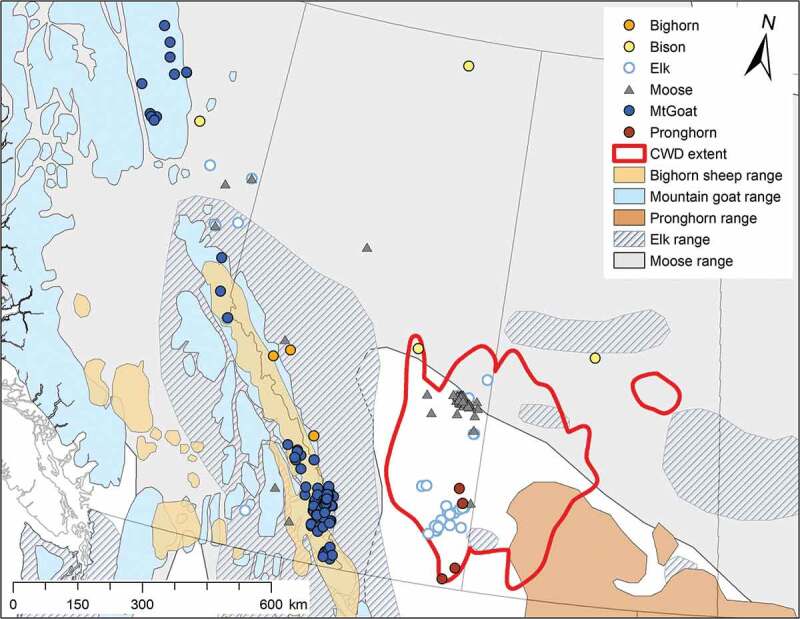
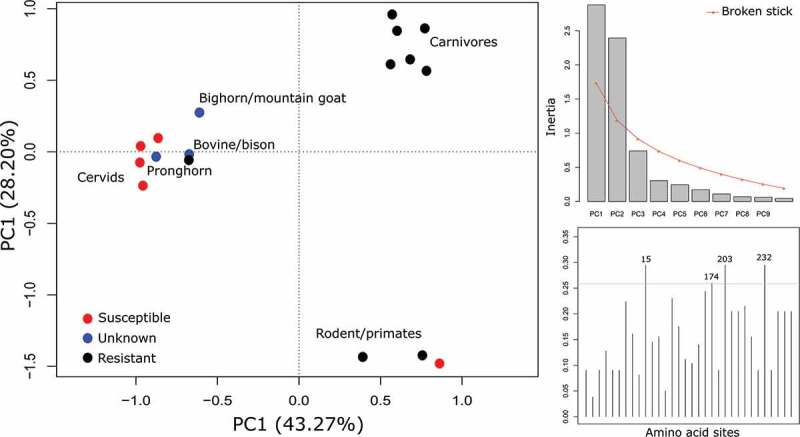
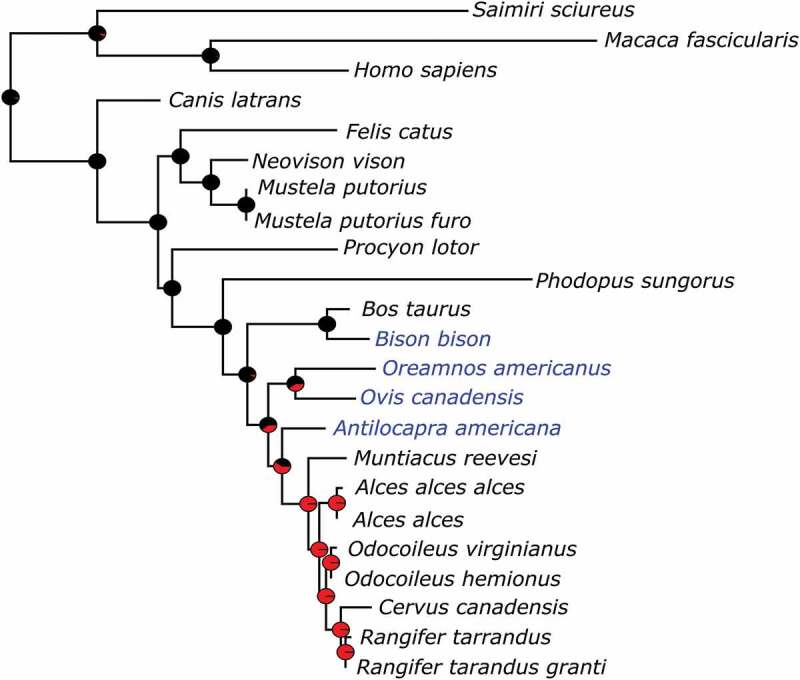
Wildlife disease incidence is increasing, resulting in negative impacts on the economy, biodiversity, and potentially human health. Chronic wasting disease (CWD) is a fatal, transmissible spongiform encephalopathy of cervids (wild and captive) which continues to spread geographically resulting in exposure to potential new host species. The disease agent (PrP) is a misfolded conformer of the cellular prion protein (PrP). In Canada, the disease is endemic in Alberta and Saskatchewan, affecting mule and white-tail deer, with lesser impact on elk and moose. As the disease continues to expand, additional wild ungulate species including bison, bighorn sheep, mountain goat, and pronghorn antelope may be exposed. To better understand the species-barrier, we reviewed the current literature on taxa naturally or experimentally exposed to CWD to identify susceptible and resistant species. We created a phylogeny of these taxa using cytochrome B and found that CWD susceptibility followed the species phylogeny. Using this phylogeny we estimated the probability of CWD susceptibility for wild ungulate species. We then compared PrP amino acid polymorphisms among these species to identify which sites segregated between susceptible and resistant species. We identified sites that were significantly associated with susceptibility, but they were not fully discriminating. Finally, we sequenced Prnp from 578 wild ungulates to further evaluate their potential susceptibility. Together, these data suggest the host-range for CWD will potentially include pronghorn, mountain goat and bighorn sheep, but bison are likely to be more resistant. These findings highlight the need for monitoring potentially susceptible species as CWD continues to expand.
野生动物疾病的发病率正在上升,对经济、生物多样性,甚至人类健康都产生了负面影响。慢性消耗性疾病(CWD)是一种致命的、可传播的鹿科动物(野生和圈养)海绵状脑病,其地理传播范围不断扩大,导致潜在的新宿主物种面临暴露风险。该病的病原体(朊病毒)是细胞朊蛋白(PrP)的错误折叠构象。在加拿大,该病在艾伯塔省和萨斯喀彻温省流行,影响马鹿和白尾鹿,对麋鹿和驼鹿的影响较小。随着疾病的持续蔓延,包括野牛、大角羊、山羊和叉角羚在内的其他野生有蹄类动物可能会面临暴露风险。为了更好地了解物种屏障,我们综述了目前关于自然或实验暴露于 CWD 的分类群的文献,以确定易感和抗性物种。我们使用细胞色素 B 构建了这些分类群的系统发育树,并发现 CWD 的易感性遵循物种的系统发育。利用该系统发育树,我们估计了野生有蹄类动物物种对 CWD 的易感性概率。然后,我们比较了这些物种中 PrP 氨基酸多态性,以确定哪些位点在易感和抗性物种之间发生了分离。我们确定了与易感性显著相关的位点,但它们并不能完全区分。最后,我们对 578 只野生有蹄类动物的 Prnp 进行了测序,以进一步评估它们的潜在易感性。综合这些数据表明,CWD 的宿主范围可能包括叉角羚、山羊和大角羊,但野牛可能更具抗性。这些发现强调了在 CWD 持续蔓延的情况下,需要对潜在易感物种进行监测。