Bell Tamsin E, Zhan Guowu, Wu Kejun, Zeng Hua Chun, Torrente-Murciano Laura
1Department of Chemical Engineering and Biotechnology, University of Cambridge, Philippa Fawcett Drive, Cambridge, CB3 0AS UK.
2Department of Chemical and Biomolecular Engineering, National University of Singapore, 4 Engineering Drive 4, Singapore, 117585 Singapore.
Top Catal. 2017;60(15):1251-1259. doi: 10.1007/s11244-017-0806-0. Epub 2017 Jun 29.
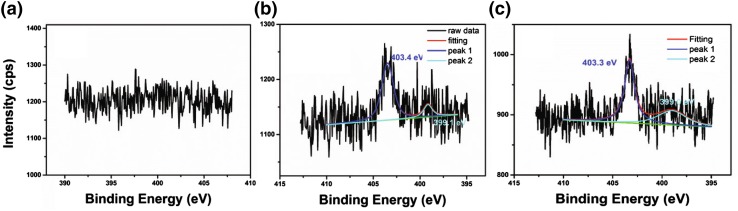
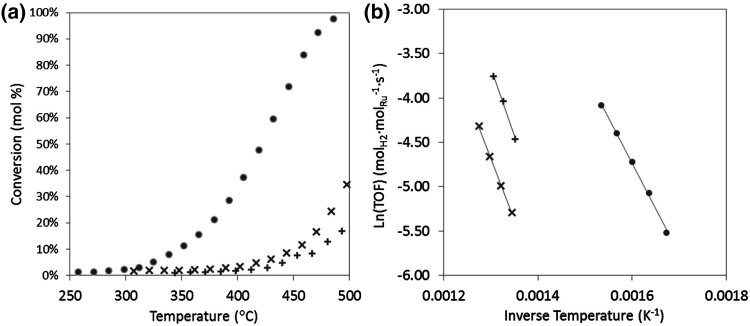
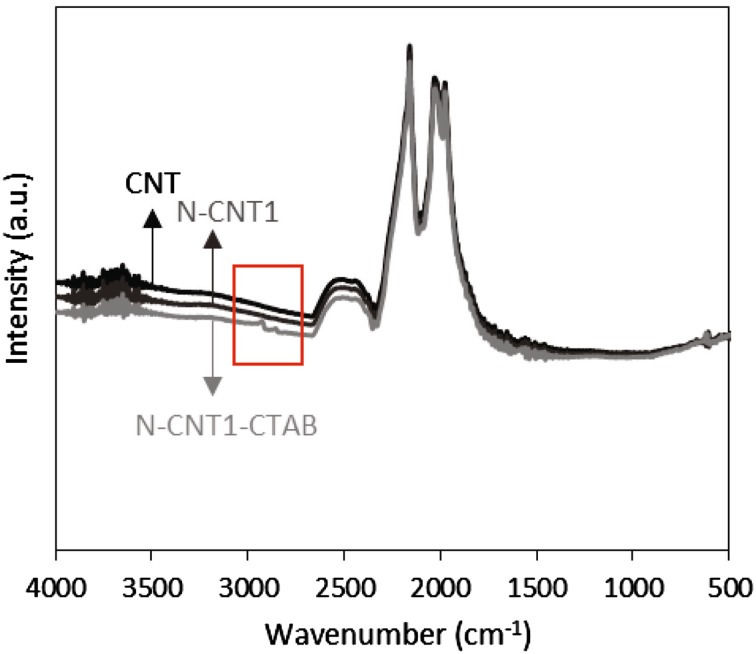
The use of ammonia as a hydrogen vector has the potential to unlock the hydrogen economy. In this context, this paper presents novel insights into improving the ammonia decomposition activity of ruthenium nanoparticles supported on carbon nanotubes (CNT) by nitrogen doping. Our results can be applied to develop more active systems capable of delivering hydrogen on demand, with a view to move towards the low temperature target of less than 150 °C. Herein we demonstrate that nitrogen doping of the CNT support enhances the activity of ruthenium nanoparticles for the low temperature ammonia decomposition with turnover frequency numbers at 400 °C of 6200 LH mol h, higher than the corresponding value of unmodified CNT supports under the same conditions (4400 LH mol h), despite presenting similar ruthenium particle sizes. However, when the nitrogen doping process is carried out with cetyltrimethylammonium bromide (CTAB) to enhance the dispersion of CNTs, the catalyst becomes virtually inactive despite the small ruthenium particle size, likely due to interference of CTAB, weakening the metal-support interaction. Our results demonstrate that the low temperature ammonia decomposition activity of ruthenium can be enhanced by nitrogen doping of the CNT support due to simultaneously increasing the support's conductivity and basicity, electronically modifying the ruthenium active sites and promoting a strong metal-support interaction.
将氨用作氢载体具有开启氢经济的潜力。在此背景下,本文提出了关于通过氮掺杂提高碳纳米管(CNT)负载的钌纳米颗粒的氨分解活性的新见解。我们的研究结果可用于开发更具活性的按需供氢系统,以朝着低于150°C的低温目标迈进。在此,我们证明,碳纳米管载体的氮掺杂增强了钌纳米颗粒在低温氨分解中的活性,在400°C时的周转频率为6200 LH⁻¹ mol⁻¹ h⁻¹,高于相同条件下未改性碳纳米管载体的相应值(4400 LH⁻¹ mol⁻¹ h⁻¹),尽管钌颗粒尺寸相似。然而,当使用十六烷基三甲基溴化铵(CTAB)进行氮掺杂过程以增强碳纳米管的分散性时,尽管钌颗粒尺寸很小,但催化剂实际上变得无活性,这可能是由于CTAB的干扰,削弱了金属-载体相互作用。我们的研究结果表明,通过对碳纳米管载体进行氮掺杂可以提高钌的低温氨分解活性,这是因为同时提高了载体的导电性和碱性,从电子角度修饰了钌活性位点并促进了强金属-载体相互作用。