Department of Leukemia, The University of Texas MD Anderson Cancer Center, Houston, TX.
Duchossois Center for Advanced Medicine, The University of Chicago, Chicago, IL.
Blood Adv. 2020 Feb 11;4(3):449-457. doi: 10.1182/bloodadvances.2019000767.
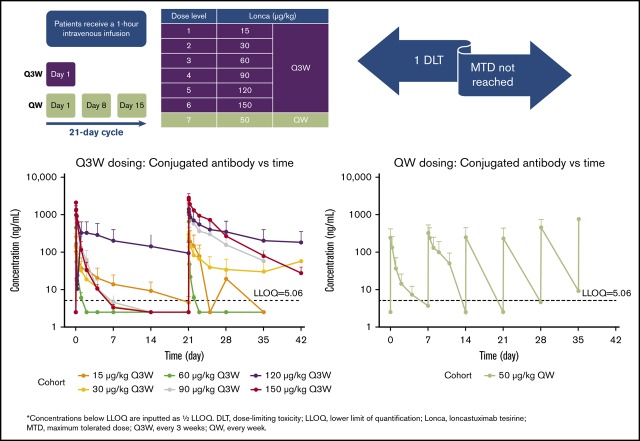
Relapsed or refractory (R/R) B-cell acute lymphoblastic leukemia (B-ALL) remains a therapeutic challenge. Loncastuximab tesirine is an antibody-drug conjugate against CD19, an antigen expressed in many B-cell malignancies. This open-label, single-arm, dose-escalation, dose-expansion study assessed the safety, tolerability, pharmacokinetics (PKs), immunogenicity, and preliminary clinical activity of loncastuximab tesirine in adults with R/R B-ALL. A total of 35 patients were enrolled, with a median age of 55 years (range, 20-80) and a median of 3 prior therapies (range, 1-15). All patients received at least 1 IV infusion of loncastuximab tesirine at 15 to 150 μg/kg once every 3 weeks (Q3W; n = 30) or 50 μg/kg IV weekly (n = 5). Common treatment-emergent adverse events (TEAEs) were nausea (42.9%), febrile neutropenia (37.1%), and reversible liver test abnormalities. Grade ≥3 TEAEs were reported in 85.7% patients, most commonly febrile neutropenia and other hematologic abnormalities and reversible liver test abnormalities. There were no treatment-related deaths. Four patients (11.4%) had grade 2 infusion-related reactions, and 1 patient (150 μg/kg Q3W) had a dose-limiting toxicity of hyperbilirubinemia that resolved within 6 days without further action. The maximum tolerated dose was not reached. Three patients achieved complete responses, 1 each at 30, 120, and 150 μg/kg Q3W. PK studies showed marked interpatient variability, with target-mediated drug disposition seeming to contribute to time- and dose-dependent disposition. No clinically relevant anti-drug-antibody formation occurred. The trial was terminated in the dose-escalation phase because of slow accrual. This trial was registered at www.clinicaltrials.gov as NCT02669264.
复发或难治性(R/R)B 细胞急性淋巴细胞白血病(B-ALL)仍然是一个治疗挑战。Loncastuximab tesirine 是一种针对 CD19 的抗体药物偶联物,CD19 是许多 B 细胞恶性肿瘤中表达的抗原。这项开放标签、单臂、剂量递增、剂量扩展研究评估了 loncastuximab tesirine 在 R/R B-ALL 成人中的安全性、耐受性、药代动力学(PK)、免疫原性和初步临床活性。共有 35 名患者入组,中位年龄为 55 岁(范围,20-80),中位既往治疗次数为 3 次(范围,1-15)。所有患者均接受了至少 1 次静脉输注 loncastuximab tesirine,剂量为 15 至 150μg/kg,每 3 周 1 次(Q3W;n=30)或 50μg/kg,每周 1 次静脉输注(n=5)。常见的治疗相关不良事件(TEAEs)为恶心(42.9%)、发热性中性粒细胞减少症(37.1%)和可逆性肝试验异常。85.7%的患者报告有≥3 级 TEAEs,最常见的是发热性中性粒细胞减少症和其他血液学异常以及可逆性肝试验异常。无治疗相关死亡。4 名患者(11.4%)发生 2 级输液相关反应,1 名患者(Q3W 150μg/kg)发生剂量限制性毒性的高胆红素血症,6 天内无需进一步治疗即可缓解。未达到最大耐受剂量。3 名患者达到完全缓解,分别为 Q3W 30μg/kg、120μg/kg 和 150μg/kg。PK 研究表明,患者间存在显著的变异性,靶向介导的药物处置似乎与时间和剂量依赖性处置有关。未发生临床相关的抗药物抗体形成。由于入组缓慢,该试验在剂量递增阶段终止。该试验在 www.clinicaltrials.gov 上注册为 NCT02669264。