Kooistra Lisa, Ruwaard Jeroen, Wiersma Jenneke, van Oppen Patricia, Riper Heleen
Department of Clinical, Neuro-and Developmental Psychology and the Amsterdam Public Health Research Institute, Vrije Universiteit Amsterdam, van der Boechorststraat 7, 1081 BT Amsterdam, The Netherlands.
Department of Research and Innovation, GGZ inGeest Specialized Mental Health Care, Oldenaller 1, 1081 HJ Amsterdam, The Netherlands.
J Clin Med. 2020 Jan 27;9(2):347. doi: 10.3390/jcm9020347.
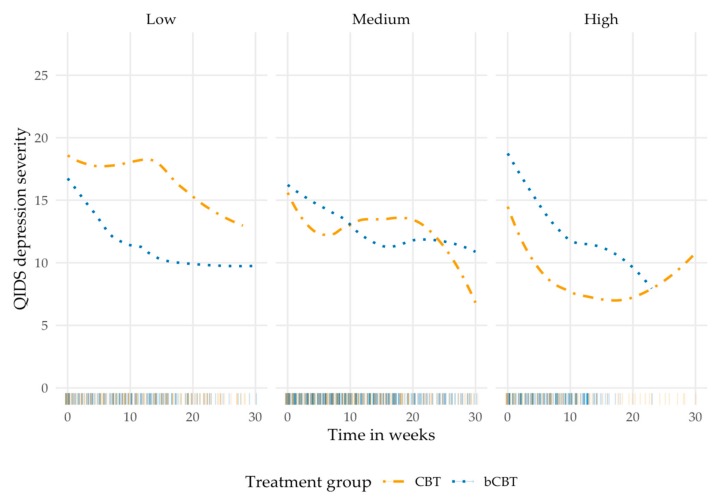
This study investigates working alliance in blended cognitive behavioral therapy (bCBT) for depressed adults in specialized mental health care. Patients were randomly allocated to bCBT ( = 47) or face-to-face CBT ( = 45). After 10 weeks of treatment, both patients and therapists in the two groups rated the therapeutic alliance on the Working Alliance Inventory Short-Form Revised (WAI-SR; Task, Bond, Goal, and composite scores). No between-group differences were found in relation to either patient or therapist alliance ratings, which were high in both groups. In the full sample, a moderate positive association was found between patient and therapist ratings on Task (ρ = 0.41, 95% CI 0.20; 0.59), but no significant associations emerged on other components or composite scores. At 30 weeks, within-and between-group associations between alliance and changes in depression severity (QIDS, Quick Inventory of Depressive Symptomatology) were analyzed with linear mixed models. The analyses revealed an association between depression over time, patient-rated alliance, and group ( < 0.001). In face-to-face CBT, but not in bCBT, lower depression scores were associated with higher alliance ratings. The online component in bCBT may have led patients to evaluate the working alliance differently from patients receiving face-to-face CBT only.
本研究调查了在专业精神卫生保健中,针对成年抑郁症患者的混合认知行为疗法(bCBT)中的工作联盟情况。患者被随机分配至bCBT组(n = 47)或面对面认知行为疗法(CBT)组(n = 45)。治疗10周后,两组的患者和治疗师均使用工作联盟量表简版修订版(WAI-SR;任务、联结、目标及综合得分)对治疗联盟进行评分。在患者或治疗师联盟评分方面,未发现组间差异,两组评分均较高。在全样本中,患者和治疗师在任务方面的评分存在中度正相关(ρ = 0.41,95%CI 0.20;0.59),但在其他分量表或综合得分上未出现显著相关性。在30周时,使用线性混合模型分析联盟与抑郁严重程度变化(QIDS,抑郁症状快速检查表)之间的组内和组间关联。分析显示抑郁随时间的变化、患者评定的联盟与组别之间存在关联(P < 0.001)。在面对面CBT组而非bCBT组中,较低的抑郁得分与较高的联盟评分相关。bCBT中的在线部分可能导致患者对工作联盟的评价与仅接受面对面CBT的患者不同。