Sharma Arvind, Schuetze Catherine, Phillips Clive J C
Centre for Animal Welfare and Ethics, School of Veterinary Science, The University of Queensland, Gatton Campus 4343, Australia.
Faculty of Arts and Social Sciences, The University of Sydney, New South Wales 2006, Australia.
Animals (Basel). 2020 Jan 28;10(2):211. doi: 10.3390/ani10020211.
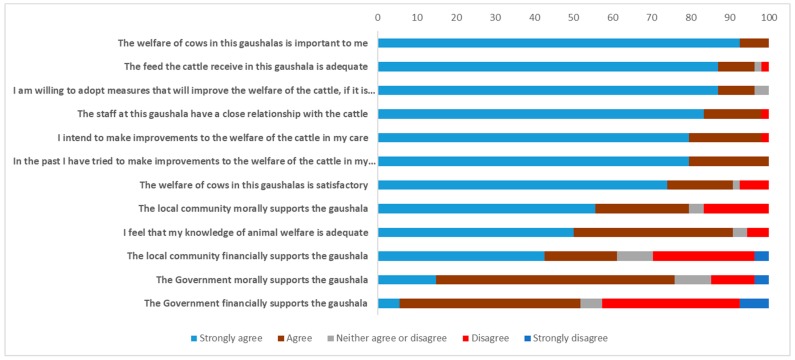
Gaushala management is a specialized profession requiring particular skills relating to the management of cow shelters or gaushalas, which are traditional and ancient Indian institutions that shelter old, unproductive and abandoned cows, The 1800 registered cow shelters in India have managers who are important stakeholders in the management of cows in these unique institutions. It is important to survey the routine management of these shelters and attitudes of the managers towards cow welfare to identify the constraints and welfare issues. We visited 54 shelters in six states of India for a face-to-face structured interview of the managers. Quantitative data collection included questions on demographics, routine management operations, protocols followed in the shelters and attitudes of the managers towards cow welfare. All shelters except one were managed by males, half of them were in the age range of 45-65 years, were university graduates or post-graduates, with 5-15 years shelter management experience, and with the majority having lived in rural areas for most of their lives. Each shelter housed a median of 232 cattle were housed, out of which 13 were lactating cows. The majority of managers vaccinated their animals against endemic diseases like foot and mouth disease, haemorrhagic septicaemia and black quarter (gangraena emphysematosa) and administered endo-and ectoparasiticidal treatments, however, hardly any screened the cattle for brucellosis and tuberculosis. Only 17% of the shelters had in house veterinarians and most cows died of old age, with an annual mortality rate of 14%. The majority of the shelters allowed the cows to reproduce. Access to pasture was available in only 41% of the shelters, while most allowed some access to yards. Most (57%) had limited biosecurity measures, but 82% of the shelters disposed of the carcasses by deep burial on their own premises or through the municipality, with 18% disposing of them in open spaces or nearby creeks. About one half of the shelters maintained records of the protocols followed routinely. Charitable societies ran half of the shelters, mostly through public donations, with accounts audited regularly. Most managers thought that shelter cows' welfare was important and that they should attempt to improve it. They were less in agreement that their knowledge of animal welfare was adequate. Local support, more moral than financial, was recognized more than government support. Managers perceived cow welfare as important from a religious perspective, citing the mother god and caring for abandoned animals as frequent themes in their definition of cow welfare. Caring for animals, mother and goddess were key elements in managers' perception of animal welfare. The recommendations arising from this survey include that the shelter managers should be involved in the decision-making process for the welfare of cows in shelters, which is vital for the sustainability of these unique institutions. Welfare could be improved by strict compliance with biosecurity measures and disease surveillance protocols, avoidance of unrestricted reproduction in cows and separation of males and females.

奶牛庇护所管理是一项专业工作,需要具备与奶牛庇护所管理相关的特定技能,奶牛庇护所是印度传统且古老的机构,用于收容年老、无生产力和被遗弃的奶牛。印度1800家注册奶牛庇护所的管理者是这些独特机构中奶牛管理的重要利益相关者。调查这些庇护所的日常管理以及管理者对奶牛福利的态度,以确定制约因素和福利问题非常重要。我们走访了印度六个邦的54家庇护所,对管理者进行面对面的结构化访谈。定量数据收集包括有关人口统计学、日常管理操作、庇护所遵循的规程以及管理者对奶牛福利态度的问题。除一家庇护所外,所有庇护所均由男性管理,其中一半年龄在45 - 65岁之间,是大学毕业生或研究生,有5 - 15年的庇护所管理经验,且大多数人一生大部分时间生活在农村地区。每个庇护所平均饲养232头牛,其中13头是泌乳母牛。大多数管理者为其动物接种口蹄疫、出血性败血症和黑腿病(气性坏疽)等地方病疫苗,并进行体内外驱虫治疗,然而,几乎没有人对牛进行布鲁氏菌病和结核病筛查。只有17%的庇护所有内部兽医,大多数奶牛死于老年,年死亡率为14%。大多数庇护所允许奶牛繁殖。只有41%的庇护所有牧场可供使用,而大多数允许奶牛进入一些场地。大多数(57%)庇护所的生物安全措施有限,但82%的庇护所通过在自己的场地深埋或通过市政当局处理尸体,18%的庇护所在露天场地或附近小溪处理尸体。约一半的庇护所记录了日常遵循的规程。慈善社团管理着一半的庇护所,大多通过公众捐赠,账目定期审计。大多数管理者认为庇护所奶牛的福利很重要,并应努力改善。但他们对自己动物福利知识是否足够的看法不太一致。人们认识到当地支持(更多是道义上而非经济上的)比政府支持更多。管理者从宗教角度认为奶牛福利很重要,在他们对奶牛福利的定义中,经常提到圣母和照顾被遗弃动物等主题。照顾动物、母亲和女神是管理者对动物福利认知的关键要素。本次调查提出的建议包括,庇护所管理者应参与庇护所奶牛福利的决策过程,这对这些独特机构的可持续发展至关重要。通过严格遵守生物安全措施和疾病监测规程、避免奶牛无节制繁殖以及将公母牛分开,可以改善福利。